Tag: Coping with grief

  • Grief Counsellor Support Options: What to Expect and How to Choose

    Grief Counsellor Support Options: What to Expect and How to Choose

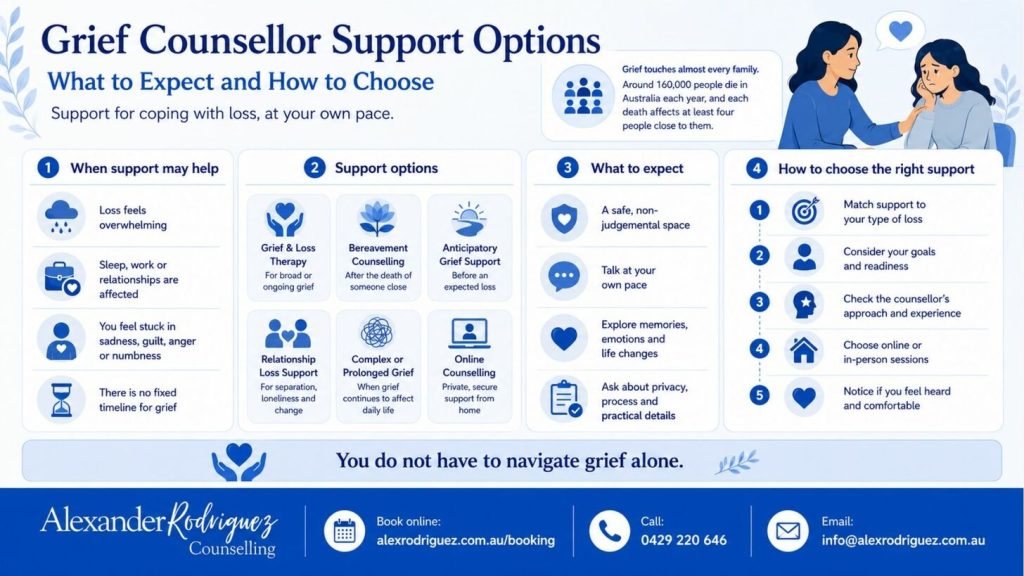
    A Grief Counsellor can offer you steady, professional support when a loss changes your world. Grief touches almost every Australian family at some point. Each year, around 160,000 people die across Australia, and it’s estimated that each death affects at least four people close to them. 

    That means hundreds of thousands of Australians are coping with loss at any given time, whether it happened recently or years ago. Grief counselling is not a one-size-fits-all process. Your experience of loss is shaped by your relationship with the person, your circumstances, and your own way of processing emotion.

    Working with a Grief Counsellor gives you a safe, non-judgemental space to talk openly about what you’re going through. You don’t have to grieve alone or feel pressure to “move on” by a certain date. Bereavement support can help you understand the stages of grief, work through difficult emotions like guilt, anger, or numbness, and slowly find your footing again. Counselling and Therapy sessions grounded in genuine care and practical guidance can support you as part of a trusted mental health service for people across Sydney and Parramatta. Whether you’re facing sudden loss or grief that has lingered longer than expected, support is available at your own pace.

    You don’t have to navigate grief on your own. Reaching out for support, whenever you feel ready, can be an important step towards feeling more like yourself again. Book a consultation with Alex Rodriguez to discuss the right grief and bereavement support for your needs. You can call 1300 467 513 or email info@alexrodriguez.com.au to enquire about available services or book your appointment online to get started at a time that suits you.

    Key Takeaways

    • Grief affects everyone differently, with no fixed timeline for healing.
    • A Grief Counsellor offers a safe space to process loss at your own pace.
    • Coping with loss can involve death, relationship breakdown, or anticipatory grief.
    • Bereavement support and grief counselling are available online or in person.
    • Reach out by phone, email, or online booking when you’re ready.
    Understanding Grief Counselling and When It May Help

    When life changes suddenly, finding a safe space to process your emotions is important. A Grief Counsellor can help you work through the ways loss has affected your mind, body, and daily routine. Coping with loss is rarely straightforward. Some days may feel manageable, while others bring emotions that seem to come out of nowhere. This is a normal part of grieving, and it does not mean something is wrong with you. Grief counselling offers you a structured, supportive space to talk through these ups and downs with someone trained to listen without judgement.

    Many people wait until grief starts affecting their sleep, relationships, or work before reaching out for help, but support can be useful at any point in the process. Understanding the stages of grief, such as denial, anger, bargaining, sadness, and acceptance, can help you make sense of what you’re feeling, even though grief rarely moves through these stages in a straight line. Bereavement support is not about rushing you towards “moving on.” Instead, it focuses on helping you carry your loss in a way that still allows you to live, connect, and function day to day. As part of a broader Counselling and Therapy approach, and grounded in the values of a trusted mental health service, this kind of support is designed to meet you where you are, whether your loss happened last week or several years ago.

    How grief counselling can support coping with loss

    A professional Grief Counsellor offers a confidential space to explore your feelings. Through grief counselling, you learn to navigate the complex waves of sorrow. This support helps you integrate your experience into your life story while keeping your sense of self.

    Common emotional, physical, and practical responses to grief

    Grief can surprise you with its many reactions. You might feel intense sadness, anger, guilt, or numbness. You could also experience changes in sleep, fatigue, or unexplained aches. Or you might struggle to concentrate at work or manage daily tasks.

    • Emotional: Feelings of intense sadness, anger, guilt, or numbness.
    • Physical: Changes in sleep patterns, fatigue, or unexplained aches.
    • Practical: Difficulty concentrating at work or managing daily household responsibilities.

    Why the stages of grief are not a fixed pathway

    Many believe grief follows a linear progression. But the stages of grief are not a fixed pathway. You might move back and forth between emotions or experience them in an unexpected order. Your unique experience is valid, and there’s no “right” way to heal.

    When additional bereavement support may be helpful

    Sometimes, the weight of loss feels too heavy to carry alone. Seeking bereavement support is helpful when grief is intense or interferes with daily life. If loss impacts your work, relationships, or self-care, a professional can offer the stability you need to move forward.

    What to Expect When You See a Grief Counsellor

    Dealing with loss is deeply personal, and your first meeting is about respecting that journey at your own pace. It’s normal to feel unsure about what happens next, whether you’ve never spoken to a counsellor before or you’re returning to grief counselling after some time. Knowing what to expect can make that first step feel less daunting. Your initial session is generally an opportunity to share your story in your own words, at your own speed, without pressure to explain everything at once.

    From there, a Grief Counsellor will work with you to understand your circumstances, your support networks, and what coping with loss looks like for you day-to-day. This might involve talking through the stages of grief, identifying triggers that bring up difficult emotions, or simply having a consistent space to check in each week. Sessions are shaped around your needs rather than a fixed script, and bereavement support can continue for as long as it feels helpful, whether that’s a few sessions or an ongoing part of your Counselling and Therapy. As with any mental health service, the goal is to help you feel heard, supported, and better equipped to manage your grief over ti

    What may happen during your first counselling session

    Your first session is about building a connection and understanding your story. A Grief Counsellor will ask you to share what’s been happening in your life. They want to know how you’ve been coping since your loss.

    This isn’t a clinical interrogation. It’s a safe space for you to express your needs and concerns. You might talk about physical or emotional changes you’ve noticed lately. This helps your counsellor better understand your grief, so they can support you effectively.

    How counselling and therapy can be tailored to your needs

    Healing looks different for everyone, which is why Counselling and Therapy should never follow a fixed script. Sessions can be shaped around your goals, your pace, and what feels most helpful to you. You are the expert on your own life, and your input shapes the direction of each session.

    A Grief Counsellor can adjust their approach depending on whether you need practical strategies for coping with loss, support through the stages of grief, or simply space to talk. Whether you’re looking for short term bereavement support or an ongoing part of your mental health service journey, sessions are built around what works for you.

    Talking about memories, emotions, and difficult changes at your pace

    You’re always in control of what you share. If you’re not ready to discuss certain memories or emotions, that’s okay. You can explore these topics when you feel safe and ready.

    This grief counselling approach means you never feel rushed. Whether you need to tackle daily challenges or process deep emotions, the session adapts to your comfort level.

    Privacy, professional boundaries, and your right to ask questions

    Keeping your sessions private and safe is a priority. Your counsellor will explain the boundaries that ensure confidentiality. You’re encouraged to ask any questions about the process, techniques, or your support plan.

    Aspect Expectation Reality
    Session Pace Fixed and rigid Flexible and client-led
    Topics Forced disclosure Your choice
    Goal Setting Generic advice Personalised support
    Environment Clinical/Cold Safe and empathetic

    Understanding these aspects can make you feel more confident about your grief counselling journey. Remember, this mental health service is here to support you. Your comfort is the most important part of the counselling and therapy experience.

    Grief Counsellor Support Options for Different Experiences of Loss

    Dealing with loss is unique for everyone, and there’s no one-size-fits-all way to heal. Some people are grieving the death of a parent, partner, child, or close friend, while others are coping with the loss of a pet, a relationship, or a significant life change. A Grief Counsellor understands that each of these experiences deserves its own space and its own pace of healing. Remember, the stages of grief are not a fixed path you move through in order. Your feelings are valid, whatever they look like and however long they last.

    Because grief shows up differently for everyone, grief counselling can be shaped around your specific situation, whether you’re dealing with a sudden or traumatic loss, an anticipated death after illness, or grief that has resurfaced after many years. Some people benefit from short-term support during a difficult period, while others prefer ongoing sessions as life continues to change around them. The aim is always to meet you where you are rather than expect you to fit a particular timeline.

    Grief and Loss Therapy for broad or ongoing grief concerns

    Some grief does not resolve quickly, and that is a normal part of the healing process for many people. If your loss has been lingering for months or years, or feels tied to other areas of your life, ongoing grief and loss therapy can offer steady, continued support. Rather than working towards a fixed end point, sessions can adapt as your needs change over time.

    How therapy may help you process emotions and adjust to change

    Grief counselling offers a safe space to explore your feelings. It helps you integrate your loss into your life story. You’ll learn to manage daily life while honouring your emotions.

    Bereavement Counselling after someone close to you has died

    Losing someone close to you, whether a parent, partner, child, sibling, or close friend, can bring on a wide range of emotions that feel difficult to manage alone. Bereavement counselling offers a space to process these feelings, make sense of your loss, and slowly find ways to adjust to life without that person. Support can begin whenever you feel ready, whether that’s shortly after the loss or sometime later.

    Support for sadness, guilt, anger, and changes in daily life

    Loss can bring intense emotions like sadness, guilt, or anger. Alex Rodriguez Counselling provides bereavement support for these feelings. A Grief Counsellor helps you adjust to life’s changes after a loss.

    Anticipatory Grief Support before an expected loss

    Grief does not always begin after a death. When someone close to you is living with a serious illness or nearing the end of life, you may already start to feel sadness, worry, or a sense of loss beforehand. This is known as anticipatory grief, and it’s a normal response to an expected loss. Support during this time can help you process these feelings while still being present for your loved one.

    Making space for uncertainty, preparation, and emotional connection

    Anticipatory grief is feeling the future while living in the present. Professional counselling and therapy can help you cope with this. It allows for meaningful connection and preparation during tough times.

    Support Type Primary Focus Best For
    Grief and Loss Therapy Ongoing emotional processing Long-term or complex grief
    Bereavement Counselling Immediate loss adjustment Recent death of a loved one
    Anticipatory Support Preparation and connection Expected or impending loss

    Choosing the right grief counselling depends on your needs and experience. Whether it’s immediate bereavement support or long-term guidance, a Grief Counsellor can guide you.

    Support for Relationship Loss, Life Changes and Complex Grief

    Even without a death, your world can feel turned upside down. Many people feel deep sadness during major life changes, such as separation or divorce, the end of a close friendship, retrenchment, moving away from home, or a significant health diagnosis. These experiences can bring on grief that feels just as real and disorienting as bereavement, even though it’s often overlooked or dismissed by others. A Grief Counsellor offers a safe space to process these feelings without judgement, whatever the cause of your loss.

    Some experiences of grief are also more complex, particularly when a loss involves guilt, unresolved conflict, trauma, or multiple losses happening close together. This is sometimes referred to as complicated or prolonged grief, and it may benefit from more structured, ongoing support. Grief counselling can help you work through these layered emotions at a pace that feels manageable, rather than expecting you to “get over it” quickly. Whatever form your loss has taken, your feelings deserve to be acknowledged and supported.

    Support After Relationship Loss or Separation

    Ending a relationship can be very painful. It’s like mourning the future you had planned with that person.

    Working through rejection, loneliness, identity changes, and co-parenting concerns

    After a relationship loss, you might feel rejected or lonely. These feelings can make you question who you are. Professional help is key to rebuilding your identity and dealing with the challenges of separation.

    Support for Major Life Changes and Identity Shifts

    Life is always changing, and big shifts can leave you feeling lost. Whether it’s a job change or a health issue, coping with loss means accepting these changes.

    Adjusting to changes in work, health, family roles, or sense of self

    Changes in family roles or health can be unexpected. These changes need time to adjust to. A Grief Counsellor helps you find your way without feeling overwhelmed by the stages of grief.

    Support for Complex or Prolonged Grief

    At times, your sadness doesn’t lessen as you’d hope. This is called complex grief or prolonged grief, where the pain stays strong.

    Recognising when grief continues to affect your wellbeing and functioning

    If your feelings stop you from doing everyday things, it’s time to seek help. If you struggle to work, keep relationships, or take care of yourself, don’t face it alone. Coping with loss is a journey, and you don’t have to do it by yourself.

    Online Grief Counselling with Alex Rodriguez Counselling

    Alex Rodriguez Counselling offers online support so you can access grief counselling from wherever you are in Australia, whether that’s Sydney, Parramatta, or a regional area. Online sessions mean you don’t need to travel or fit around long waiting times to get support. This can be especially helpful if you’re managing grief alongside a busy schedule, mobility challenges, or simply feel more comfortable talking from home.

    A Grief Counsellor can support you through video or phone sessions in much the same way as an in-person appointment, helping you work through coping with loss at your own pace. Online bereavement support still allows for the same level of care and privacy, while giving you more flexibility around when and where you connect. Whether you prefer face to face sessions or the convenience of speaking from home, the goal is to make Counselling and Therapy as accessible as possible.

    How secure online sessions can make support more accessible

    Technology has changed how we get mental health support. Secure video platforms let you talk to a qualified Grief Counsellor from home. These sessions are private and remove barriers that stop people from seeking help.

    What you need for a private and reliable online counselling appointment

    To make the most of your online grief counselling, prepare well. You’ll need a good internet connection and a device with a camera, like a laptop or tablet. Most importantly, find a quiet, private spot where you can talk freely without interruptions.

    Who may benefit from online grief counselling in Australia

    Many people across Australia find online counselling suits their lifestyle. It’s great for those in remote areas, with limited mobility, or very busy lives. It’s also perfect if you prefer discussing sensitive topics in your own space.

    How online sessions compare with face-to-face mental health support

    Online sessions offer a modern alternative to traditional face-to-face meetings. They provide the same empathy and clinical care as in-person sessions. The table below shows the main differences to help you choose what’s best for you.

    Feature Online Counselling Face-to-Face
    Location Anywhere with internet Clinic location
    Travel Time None Required
    Environment Your own home Professional office
    Accessibility High Moderate

    Choosing the right path for your healing is a personal decision. Whether you prefer online or in-person, the most important thing is to seek support. Alex Rodriguez Counselling is here to support you with compassion and expertise.

    How to Choose the Right Grief Counselling Option for You

    Finding a place where your loss is understood and valued is important. With so many grief support options available, from support groups to psychologists to counsellors, it can feel overwhelming to know where to start. Choosing the right one often comes down to what feels safe and manageable for you right now.

    When looking for a Grief Counsellor, it can help to consider a few practical things. Do you prefer one-on-one sessions or a group setting? Would you rather meet in person or access support online? Is there a particular type of loss you’re dealing with, such as the death of a family member, a relationship breakdown, or a more complex or prolonged grief experience? Grief counselling that feels like a good fit is usually one where you feel comfortable being honest, without pressure to “perform” or move faster than feels right. It’s also worth asking about the counsellor’s experience with bereavement support and how they tailor sessions to individual needs, since coping with loss looks different for everyone. Ultimately, the right option is the one that helps you feel heard and supported as you work through your grief.
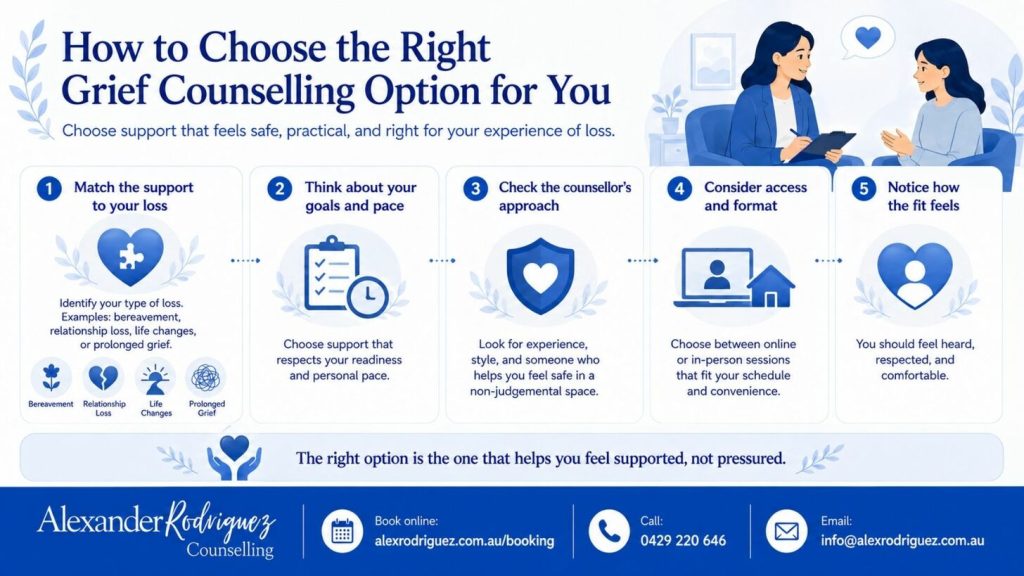
    Match the service to the type of loss you are experiencing

    Loss is different for everyone, and your needs can change. Whether it’s bereavement counselling after a loss or support for a big life change, make sure the service fits your needs.

    Consider your goals, readiness, and preferred pace

    Think about what you want to get from counselling and therapy. Some like a structured plan, while others need time to process their feelings. Choose a mental health service that respects your pace.

    Check the counsellor’s approach, experience, and professional suitability

    When searching for a Grief Counsellor, look at their background and style. At Alex Rodriguez Counselling, we use proven methods in a safe, non-judgemental space.

    Think about accessibility, session format, location, and scheduling

    Practicality is important for sticking with support. Think about whether online or face-to-face sessions work for you. Make sure the schedule fits your life to avoid extra stress.

    Notice whether you feel heard, respected, and comfortable

    Your initial feeling is crucial. Pay attention to whether you feel genuinely heard and safe. A top mental health service will always put your comfort first.

    Factor What to Look For Why It Matters
    Specialisation Relevant experience in your type of loss Ensures targeted, effective support
    Format Online vs. In-person availability Impacts your consistency and comfort
    Approach Empathetic and evidence-based methods Builds trust and therapeutic progress
    Connection Feeling respected and understood Foundation of a safe healing space

    Questions to Ask Before Choosing Grief and Loss Support
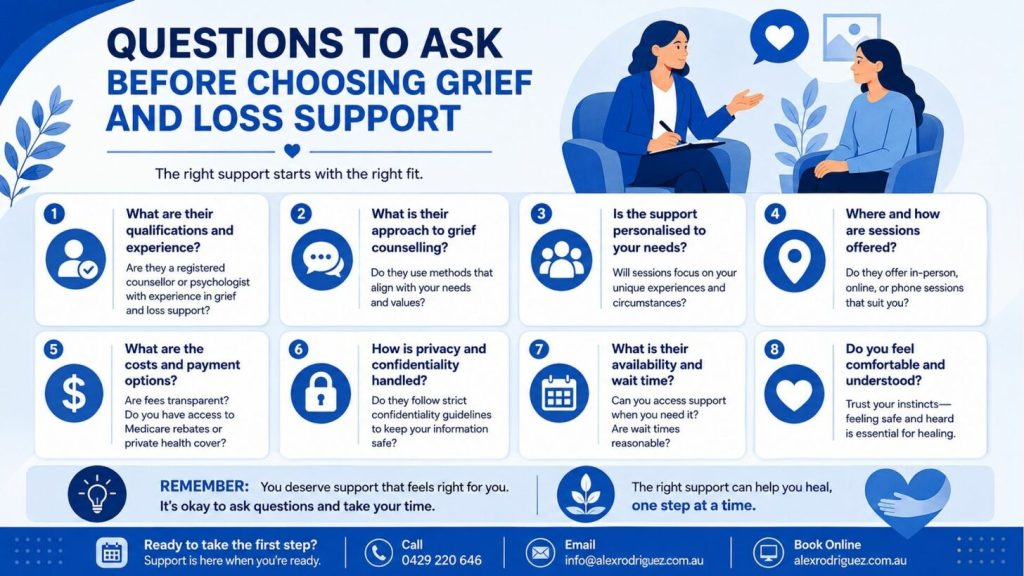
    Choosing the right professional for loss support is a big step, and reaching out shows real strength and care for your own well-being. It’s completely normal to feel unsure about who to choose or what to expect, so asking a few questions upfront can help you feel more in control of the process.

    Before booking a session, it may help to ask about the counsellor’s experience with bereavement support and whether they’ve worked with situations similar to yours, such as sudden loss, relationship breakdown, or complex grief. You might also ask how sessions are structured, how long support typically continues, and whether grief counselling is available online as well as in person. It’s reasonable to ask about cost, availability, and what a typical first session involves. A good Grief Counsellor will welcome these questions and take the time to explain how they can support your particular experience of coping with loss, rather than offering a one-size-fits-all approach.

    Questions about counselling methods and expected outcomes

    It’s okay to ask a Grief Counsellor about their approach. Find out how they tailor their counselling and therapy to you. Knowing if they use proven methods and what they aim to achieve is helpful.

    Questions about session frequency, duration, and review points

    Regular sessions are important for effective bereavement support. Ask how often and how long each session will be. Also, ask if there are times to review your progress and adjust your goals.

    Questions about confidentiality, privacy, and online security

    Your privacy is crucial in digital sessions. Ask about the security of video call platforms. A good mental health service will be open about their privacy policies.

    Questions about fees, cancellations, and practical arrangements

    Knowing the practical details of therapy can reduce stress. Ask about fees, payment options, and cancellation policies. This lets you focus on healing without worrying about logistics.

    When to ask about referrals or additional mental health services

    As your needs change, you might need different help. It’s okay to ask for referrals to other specialists. A quality mental health service will know when a team approach is best for you.

    Support Type Primary Focus Best For
    Individual Therapy Personalised healing Deep, private processing
    Bereavement Support Groups Shared experience Reducing isolation
    Specialised Counselling Targeted trauma work Complex grief symptoms

    Preparing for Your First Session with Alex Rodriguez Counselling

    You don’t need to have all the answers before your first session. It’s completely normal to feel a mix of emotions beforehand, whether that’s nervousness, relief, sadness, or even uncertainty about whether grief counselling is the right step for you. This time is about your well-being and healing, not about getting things “right.”

    There’s no need to prepare a list of talking points or rehearse what you want to say. A Grief Counsellor will guide the conversation gently, starting with what feels most comfortable to share. It can help to think about what you’re hoping to get from support, whether that’s a space to talk openly, practical strategies for coping with loss, or help understanding the stages of grief. If it’s useful, you might jot down a few things you’d like to mention, though this isn’t essential. What matters most is showing up as you are and allowing the session to unfold at your own pace.

    What to write down before your appointment

    Writing a few notes can help you feel more grounded. You might note any changes in your daily routine, like sleep or appetite. Tracking these small details helps your Grief Counsellor understand how you’re managing.

    How to describe what has happened and what you need now

    Just share your loss story in your own words when you meet us. You don’t need to follow a specific structure. Focus on what’s hard for you now and what grief support you need.

    Topics you can raise if grief is affecting sleep, work, or relationships

    Grief can impact many areas of life. It’s good to talk about how it’s affecting your work or relationships. Being open about these challenges lets your counsellor offer strategies for your situation.

    Why you do not need to have everything organised before seeking help

    You don’t need to have your thoughts organised for your first counselling session. We help you navigate your feelings at your own pace. Seeking grief support is a big step, and we’re here to help you, no matter how you feel.

    Your Grief Counsellor is there to guide you through coping with loss without judgment. You can come as you are, with all your questions and uncertainties.

    Booking Grief and Loss Counselling with Alex Rodriguez Counselling

    If you’re ready to seek support, Alex Rodriguez Counselling offers compassionate, personalised sessions to help you through your grief. Taking the first step towards healing is significant, and you don’t have to figure everything out before reaching out. Whether you’re looking for grief counselling after a recent loss or ongoing bereavement support for something more long-standing, help is available when you’re ready.

    Services available from Alex Rodriguez Counselling

    We offer a variety of specialised options to help you at your own pace. Whether it’s grief and loss counselling for a recent event or long-term support, our team is dedicated to your wellbeing.

    Grief and Loss Therapy

    This service provides a safe space to explore your feelings and develop healthy coping strategies.

    Bereavement Counselling

    Receive dedicated bereavement support after the death of a loved one. We help you navigate the complexities of mourning.

    Anticipatory Grief Support

    We offer guidance for those preparing for an expected loss. This allows you to find strength during a difficult transition.

    Support After Relationship Loss or Separation

    Healing from the end of a significant relationship takes time and understanding. Our sessions provide the support you need.

    Support for Major Life Changes and Identity Shifts

    Major transitions can trigger deep feelings of loss. We help you find your footing again.

    Support for Complex or Prolonged Grief

    If your grief feels stuck or overwhelming, our Grief Counsellor can help. We help you process these persistent emotions.

    Online Grief Counselling through secure sessions

    Access professional care from home through our secure, private digital platform.

    How to make an enquiry or arrange an appointment

    When you’re ready to book grief counselling, reaching out is simple and confidential. We encourage you to contact us to discuss how we can best support your unique path to healing.

    Get in Touch

    Call 1300 467 513, to speak with a member of our team about our mental health service options, or email info@alexrodriguez.com.au if you’d prefer to outline your needs in writing before we connect. You can also book grief counselling sessions at a time that suits your schedule through our secure online portal. We’re here to offer compassionate bereavement support and grief and loss counselling to help you move forward at your own pace.

    Conclusion

    Grief is not something you have to face alone, and there’s no right or wrong way to move through it. Reaching out to a Grief Counsellor can give you the space, understanding, and practical support you need to process your loss at your own pace. Whether you’re navigating the stages of grief after a death, adjusting to a major life change, or dealing with a more complex or prolonged experience of loss, grief counselling can help you find your way forward.

    Coping with loss looks different for everyone, and the right kind of bereavement support can make a meaningful difference to how you carry that experience over time. As part of a broader Counselling and Therapy approach, and grounded in the values of a trusted mental health service, support is available whenever you feel ready to take that first step. You don’t need to have everything figured out; you just need to be willing to reach out.

    You don’t have to navigate grief on your own. Reaching out for support, whenever you feel ready, can be an important step towards feeling more like yourself again. Book a consultation with Alex Rodriguez to discuss the right grief and bereavement support for your needs. You can call 0429 220 646 or email info@alexrodriguez.com.au to enquire about available services, or book your appointment online to get started at a time that suits you.
    FAQ

    How can grief counselling help me as I am coping with loss?

    Grief counselling offers a safe space to explore your feelings after a big loss. At Alex Rodriguez Counselling, we help you deal with changes in your life. You can process your grief at your own pace, without being judged.

    Do I have to go through the stages of grief in a specific order?

    No, you don’t have to follow a set order of grief stages. Everyone grieves differently. Our support acknowledges your unique journey, allowing you to move through emotions as you see fit.

    When is it the right time to seek professional bereavement support?

    You might need support if grief is too much to handle. If it’s affecting your work, studies, or family life, a Grief Counsellor can help. They provide tools to manage these challenges.

    What is the difference between Bereavement Counselling and Anticipatory Grief Support?

    Bereavement Counselling happens after a loss, focusing on adjusting to life without someone. Anticipatory Grief Support is for those facing an expected loss, preparing for changes. Both are part of Grief and Loss Therapy, tailored to your needs.

    Can Alex Rodriguez Counselling help with losses that aren’t related to a death?

    Yes, we help with big life changes too. This includes relationship changes, health issues, or job disruptions. A Grief Counsellor supports you in adjusting to these changes.

    What should I expect during my first session with a Grief Counsellor?

    Your first session is a gentle chat about your loss and how you’re coping. We discuss privacy and how we can tailor support to you. You’re in control of what you’re ready to share, with no pressure.

    Is online grief counselling as effective as face-to-face sessions?

    Yes, online sessions are just as effective. They offer privacy and convenience from anywhere in Australia. With a reliable internet connection, online support can be as impactful as in-person sessions.

    How do I know if I am experiencing complex or prolonged grief?

    Complex or prolonged grief is when pain doesn’t lessen and interferes with daily life. Signs include trouble working, strained relationships, or withdrawal. If you’re feeling stuck, counselling can help you move forward.

    What should I prepare before my first appointment?

    You don’t need to prepare much. Just note any changes in your health or how grief is affecting your life. Showing up as you are is the most important thing. We’ll work together to identify your needs.

    How can I book a session with Alex Rodriguez Counselling?

    To book a session, contact us directly. Call 1300 467 513, or use our online booking link. We’re here to offer the support you need during this tough time.
  • When Grief And Loss Matter: Symptoms, Triggers and Help Options

    When Grief And Loss Matter: Symptoms, Triggers and Help Options

    Grief and loss touch almost every Australian family at some point in life. In 2024, more than 187,000 deaths were registered across Australia, and research suggests that for every death, somewhere between four and nine people are personally affected by the loss. That means millions of people across Sydney, Parramatta and the rest of the country are quietly carrying grief right now, even when it doesn’t show on the outside. If you’re one of them, you’re far from alone, and what you’re feeling is a normal response to a very real loss.

    Understanding the grief meaning behind your emotions can help you make sense of what often feels like a whirlwind of ups and downs. Many people find it helpful to learn about the stages of grief, not as a strict checklist to tick off, but as a gentle guide to the range of feelings that can come and go without warning. Dealing with grief and coping with loss looks different for everyone, and there is no single right way to do it or a set timeframe to follow. For some, managing loss becomes a little easier with the right bereavement support, whether that’s leaning on family and friends, joining a support group, or speaking with a professional. Grief counselling and other counselling options can offer a safe, supportive space to work through these feelings at your own pace, with practical strategies tailored to your situation.

    You don’t have to go through grief and loss on your own. Alex Rodríguez is here to help. Contact us to talk about the right support for you. Call 0429 220 646, email info@alexrodriguez.com.au, or book online through our booking page. 

    Key Takeaways

    Grief and loss can follow any major life change, not just death, including breakups, job loss, or health diagnoses.

    Grief affects you physically too, causing fatigue, tightness, and disrupted sleep.

    The stages of grief move back and forth, not in a straight line.

    Coping with loss looks different for everyone, with no fixed timeline.

    Grief counselling and bereavement support can help you heal at your own pace.

    Understanding the Meaning of Grief and Loss

    Many people see grief as a short-term feeling, something that fades after a few weeks or months. In reality, grief and loss are more like a season of life, one that can stretch on longer than you expect and shift in shape along the way. The grief meaning behind this experience goes far beyond sadness after a death. It is about any big change that shakes up your world and challenges how you see yourself, your future, or your sense of safety. You might associate grief with losing a loved one, but it can also show up after a broken relationship, the end of a marriage, a job loss, a health diagnosis, moving away from home, or any major change that turns your life upside down. All of these experiences are valid forms of loss, even if they don’t involve death, and they can affect your thoughts, your emotions, your energy levels, and even your day-to-day choices, sometimes all at once.

    This is why dealing with grief looks different from person to person, and why coping with loss is rarely a straight line. Learning about the stages of grief can help you understand why your feelings seem to change without warning, from sadness one day to anger or numbness the next, but these stages are not a fixed checklist, and there is no correct order or timeline to follow. Some people move through them quickly, others sit with certain feelings for a long time, and many find themselves moving back and forth between stages more than once. Knowing this can take some of the pressure off, because managing loss is not about ticking boxes; it is about permitting yourself to feel what you feel, at your own pace. If your grief feels heavier than you can manage alone, bereavement support and grief counselling can offer a safe, steady space to process what you’re going through, and a counselling servicecan help you understand your experience, work through difficult emotions, and build practical strategies for moving forward, without rushing your healing or expecting it to look a certain way.

    Defining your personal experience with loss

    Understanding grief and loss means seeing how your life has changed. It’s unique to you, shaped by your past and background. You might notice changes in your life in different ways:

    • Physical: Changes in sleep, appetite, or feeling tired for no reason.
    • Emotional: Feeling sad, irritable, or numb.
    • Mental: Trouble focusing or feeling overwhelmed by simple tasks.

    By understanding your personal experience, you see that your reactions are normal. Treating yourself with kindness during this time is important.

    Why grief is a natural response to change

    Grief is a natural, healthy response to losing something important. When things change, your mind and body work to adjust. This shows your ability to care and connect with others.

    Seeing grief as a natural response helps you understand your feelings. You’re not just trying to “get over” these moments. You’re learning to include them in your life story. This view can help you feel better as you heal.

    Recognising the Common Symptoms of Grief

    When you’re dealing with grief, your body often speaks louder than your words. It’s common to feel like you’re carrying a heavy weight, one that shows up as constant tiredness, trouble sleeping, a tight chest, headaches, or a loss of appetite. Some people notice their heart racing for no clear reason, or feel physically drained even after a full night’s rest. Others find it hard to concentrate, forget small things, or feel foggy and disconnected from daily tasks. These physical signs are a normal part of grief, even though they can feel confusing or even a little frightening when you don’t expect them.

    Alongside the physical symptoms, grief can bring up a wide mix of emotions, sometimes all in the space of a single day. You might feel sadness, guilt, anger, relief, numbness, or anxiety, and it’s common for these feelings to shift without warning. Some days you may feel like you’re managing fine, and other days even small tasks can feel overwhelming. Coping with loss can also affect your motivation, your relationships, and your interest in things you used to enjoy. If these symptoms are making it hard to function day to day, or they are lasting longer than feels manageable, grief counselling and bereavement support can help you understand what you’re experiencing and give you practical ways to look after yourself while you heal.

    Physical manifestations of emotional pain

    Research suggests that grief can activate some of the same brain pathways involved in processing physical pain, which may help explain why grief can bring on real physical symptoms like chest tightness, a heavy or “gut-wrenched” feeling, or ongoing fatigue.

    Your body is processing a big life event. This can lead to sleep problems or a weakened immune system. Recognising these physical signs is a key step in your grief journey.

    Cognitive and behavioural changes to watch for

    Beyond physical signs, your mind might change too. It’s normal to experience memory lapses or find it hard to focus on simple tasks.

    These changes are usually temporary but can feel overwhelming. When dealing with grief, being gentle with yourself is crucial. Your brain is working hard to process your emotions.

    If you’re withdrawing from social activities or struggling with decisions, remember these are common. Prioritising self-compassion helps you heal at your own pace.

    Identifying Your Personal Triggers

    Learning to spot your personal triggers is a key part of healing. A trigger can be anything that brings your grief to the surface again, even when you feel like you’re doing okay. This might be a date on the calendar, a song, a smell, a place you used to visit together, or even a simple conversation that catches you off guard. Triggers are not a sign that you’re going backwards in your healing. They are a normal part of dealing with grief, and noticing them is often the first step towards understanding your own emotional patterns.

    Knowing what sets off your emotions gives you a sense of control over your coping with loss journey. When you can recognise a trigger before it hits, you have more chance to prepare for it, rather than being caught off guard. This might mean planning for anniversaries, permitting yourself to step away from a difficult situation, or simply reminding yourself that a wave of emotion is temporary. Over time, this awareness can make managing loss feel a little more predictable, and can support you in building healthier ways to respond when grief resurfaces. If certain triggers continue to feel overwhelming, grief counselling can help you explore where they come from and work through them at a pace that feels right for you.

    How anniversaries and milestones impact your healing

    Anniversaries, birthdays, and holidays can be tough reminders of what’s lost. Even years later, these dates can bring intense waves of grief that feel new. It’s okay to feel a surge of emotions during these times.

    As a big date nears, you might feel tired, or your mood could change. Knowing this ahead of time lets you plan for self-care. This way, you’re healthily managing your grief and loss.

    Navigating sensory reminders in your daily life

    Sensory triggers can be subtle but powerful. A song, a scent, or a familiar place can bring back memories. These unexpected encounters with the past are a natural part of life.

    When you meet these triggers, try to acknowledge the memory without letting it take over. You might take a deep breath, focus on the present, or allow yourself a moment to feel. Building these small strategies is crucial for coping with loss and staying emotionally well.

    Navigating the Stages of Grief

    You might have heard about the stages of grief, often listed as denial, anger, bargaining, depression, and acceptance. These emotional markers were first developed by Elisabeth Kübler-Ross to describe what people go through when facing their own death. Over time, they have been adapted to help anyone dealing with grief and loss, whether that loss is the death of a loved one, the end of a relationship, or another major life change. It’s worth knowing that these stages were never meant to be a strict step-by-step process, and using them in real life is rarely as neat as the list suggests.

    In reality, grief doesn’t move in a straight line from one stage to the next. You might feel acceptance one day and then find yourself back in anger or sadness the next, and that is completely normal. Some people skip stages altogether, while others move through them slowly, or revisit certain feelings more than once. Thinking of these stages as a loose guide, rather than a checklist to complete, can take the pressure off and make coping with loss feel less like something you’re doing wrong. If you’re finding it hard to make sense of where you are in your grief, grief counselling and supportive counselling can help you understand your emotions and move through them in a way that feels right for you.

    Moving through denial, anger, bargaining, depression, and acceptance

    The journey starts with denial, feeling numb or detached. As the shock fades, anger kicks in. You might lash out at yourself, others, or the situation.

    Then, bargaining comes, where you look for ways to change things. Depression follows, filled with deep sadness and reflection. Finally, acceptance means you’ve found a way to integrate this change into your life. Remember, these stages of grief are just tools for understanding your emotions.

    Understanding that healing is not a linear process

    Many think you must go through these emotions in order. But grief and loss are not always linear. You might skip stages or go back to them many times.

    You could feel several emotions at once, which can be overwhelming. Know that there’s no “right” way to grieve. Your own timeline is okay. By accepting your emotions’ flow, you can release the pressure and be kind to yourself as you heal.

    Step One: Acknowledging Your Need for Support

    Admitting you need help is a brave step towards healing. When you’re facing grief and loss, it’s easy to feel like you have to stay strong for everyone else, whether that’s your family, your children, or your workplace. You might feel pressure to hold things together, push your feelings aside, or carry on as if nothing has changed. But asking for help is not a sign of weakness. It’s a sign of self-care and strength, and it’s often the first real step towards dealing with grief in a way that actually helps you heal.

    It’s common to put off reaching out because it can feel uncomfortable, or because you’re not sure what kind of support you need yet. You don’t have to have it all figured out before you ask for help. Simply recognising that you’re struggling, and being willing to talk about it, is enough to begin managing loss more healthily. Whether that means leaning on trusted family and friends, joining a support group, or speaking with a professional through bereavement support or grief counselling, taking this first step can make the road ahead feel a little less overwhelming.

    Breaking the stigma around seeking professional help

    Many fear seeking a counsellor, worried about being judged or seen as weak. This fear stops many from getting the care they need. Seeking support is a sign of strength, not weakness.

    Talking to a professional gives you a safe space to share your feelings. It shows you value your mental health and are taking charge of your healing. It’s a crucial step in healthily dealing with grief and loss.

    Identifying when grief becomes complex or prolonged

    Healing is personal, but sometimes your emotions may need extra help. Watch how your daily life is affected by your feelings. If you can’t do your usual things, it might be time to seek help.

    Experts look for signs of prolonged grief disorder, lasting over 12 months in adults. Spotting these signs early helps you get the right help for your grief and loss. Your recovery is important, and noticing these signs is the first step to finding peace.

    Step Two: Exploring Grief and Loss Counselling Options

    You don’t have to face grief and loss alone. Professional support is available to help you make sense of what you’re going through, at a pace that feels right for you. Grief and loss counselling offers a structured, supportive way to work through your emotions, rather than trying to manage everything on your own. This might involve talking through your feelings, learning practical coping strategies, or simply having a safe space to be heard without judgement.

    Choosing the right kind of support is a meaningful step towards finding balance again. Some people benefit from one-on-one grief counselling, while others find comfort in group bereavement support, where they can connect with others who understand what they’re going through. counselling service can also help if your grief feels tangled up with other challenges, such as anxiety, relationship changes, or difficulty adjusting to daily life. There is no single right option, and what works well for one person may not suit another. The most important part is taking that first step and reaching out to deal with grief in a way that feels manageable and personal to you.

    How bereavement counselling provides a safe space

    Bereavement counselling gives you a confidential and non-judgmental environment. Here, you can share your deepest feelings. It’s a time to process your pain at your own pace, without pressure.

    By working with a professional, you can slowly integrate your loss into your life story. This makes it feel more manageable.

    Engaging in bereavement support helps you find healthy ways to cope with sadness. It provides a safe space to explore your memories and emotions. This is crucial for finding peace amidst grief.

    The benefits of anticipatory grief support

    Sometimes, you may feel grief before a loss, like with a terminal diagnosis. This is called anticipatory grief. It can be as intense as the loss itself. Seeking grief counselling early can help you prepare emotionally.

    Professional support during this time helps you connect meaningfully with your loved ones. It gives you tools to manage anxiety and stay well during tough times. Early bereavement support strengthens you to navigate your transition with clarity and kindness.

    Step Three: Managing Identity Shifts and Major Life Changes

    When your world changes, you might feel like a stranger in your own life. Grief and loss can shake your sense of self in ways you don’t always expect, especially when the change touches something central to who you are, like a relationship, a career, your health, or your role within your family. You may find yourself asking who you are now, without the person, job, or life you once knew. This kind of identity shift is a normal part of grief, even though it can feel unsettling and disorienting at first.

    Coping with loss in these moments often means slowly adjusting to a new reality that looks different from what you knew before. This doesn’t mean forgetting who you were or what you had. It means finding ways to rebuild your sense of self while carrying that experience with you. Small steps, like reconnecting with old interests, trying new routines, or simply giving yourself time without pressure to “move on” quickly, can support this process. If managing loss feels especially heavy during this stage, grief counselling and supportive counselling can help you work through these identity shifts and rebuild a steady sense of who you are, at your own pace.

    Finding yourself after a significant loss

    Rebuilding your identity takes time and gentle self-compassion. You’re not forgetting your past, but adding to it. By accepting changes, you can explore new interests and values.

    Managing loss means honouring the past while looking forward. See this change as growth, not a loss of self. You’re still you, but with a deeper understanding of your strength.

    Coping with the loss of a relationship or separation

    Ending a relationship can make you question who you are. The absence of a partner can feel overwhelming. Seeking support after relationship loss helps you regain confidence and independence.

    The table below shows how to handle different parts of your identity during this time:

    Focus Area Initial Challenge Growth Strategy
    Social Identity Feeling isolated or lonely Reconnect with old friends
    Daily Routine Lack of structure Create new, personal habits
    Self-Perception Loss of shared goals Define new personal milestones
    Emotional Health Overwhelming sadness Practice daily mindfulness

    Remember, grief and loss are unique to each person. Whether it’s a breakup or another big change, you’re not alone. Small, intentional steps will help you find balance and peace.

    Step Four: Utilising Online Grief Counselling

    Seeking help from home can feel far more comforting when you’re already carrying a lot. When you’re dealing with grief and loss, the thought of getting dressed, travelling, and sitting in an office can feel like too much on top of everything else. This is completely understandable, and it’s one of the reasons more people are turning to online support instead. Digital platforms now offer professional grief counselling that fits into your life more easily, without adding extra pressure to an already difficult time.

    Online sessions can give you the same quality of support as an in-person visit, but with the comfort of being in a familiar space. This can make it easier to open up, especially in the early stages of grief when even small tasks can feel exhausting. Counselling services offered online also give you more flexibility with timing, which can be helpful if you’re juggling work, family, or simply don’t have the energy for a longer commute. If you’ve been putting off more flexibility with timing, which can be helpful if you’re juggling work, family, or simply don’t have the energy for a longer commute. If you’ve been putting off bereavement support because it felt like one more thing to manage, online counselling may be a simpler way to start getting the help you need, from wherever feels most comfortable for you.

    The effectiveness of secure, remote sessions

    Many wonder if online meetings can replace face-to-face ones. Studies show that grief counselling via secure video links is just as good. You get the same empathy, expertise, and support from your own space.

    These sessions are private and secure, keeping your story safe. By choosing this, you get top-notch grief and loss support, no matter where you are in Australia.

    How to prepare for your first online appointment

    Getting ready for your first session can make you feel more grounded. A few simple steps before logging in can make your time more productive. Here are some tips to make your grief counselling session supportive:

    • Find a private space: Pick a quiet room where you won’t be disturbed for the call.
    • Check your technology: Test your internet, camera, and microphone a few minutes before.
    • Create comfort: Keep a glass of water, tissues, or a comforting item nearby to ease your nerves.
    • Set an intention: Take a moment to breathe and think about what you want to discuss or achieve.

    By preparing your space, you can be more open and honest. This proactive step helps you get the most from each session as you heal.

    Step Five: Implementing Daily Coping Strategies

    You deserve grace as you learn to manage your grief. When you’re dealing with grief, your body often reacts to stress in ways you might not expect, including changes linked to stress hormones like cortisol. These changes can affect your sleep, your appetite, and even your immune system, which is part of why grief can leave you feeling physically drained, not just emotionally tired. This is a normal response to a difficult experience, and it’s not something you need to push through without support.

    Small daily habits can make a real difference in coping with loss, even on the harder days. Simple things like keeping a regular sleep routine, eating regular meals, getting outside for fresh air, or gently moving your body can help support your wellbeing while you grieve. Journaling, talking to someone you trust, or setting aside quiet time to simply rest without pressure can also help with managing loss day to day. These strategies won’t take the grief away, and that’s okay. They are simply small ways to support yourself while you heal. If you’re finding it hard to build these habits on your own, grief counselling and bereavement support can help you develop practical, personalised strategies that suit your own pace and circumstances.

    Practising self-compassion during difficult days

    Remember, healing is not a race. Practising self-compassion lets you feel tired or overwhelmed without guilt. When you’re coping with loss, treat yourself with kindness, just like you would a close friend.

    Small, consistent habits can greatly improve your daily life. Try gentle movement, stay hydrated, and keep a routine. Remember, managing loss takes patience and regular self-check-ins.

    Building a support network that works for you

    You don’t have to face this alone. Building a strong support network is key. It can include family, friends, or professional counsellors who get you.

    If your grief symptoms last or are hard to handle, seeking help is brave. A good network offers emotional support and practical help. Having people who listen without pressure can help you feel grounded.

    How to Connect with Alex Rodriguez Counselling

    Reaching out for help is a brave step towards healing. If you’re dealing with grief and loss, you don’t have to face it alone. Alex Rodríguez Counselling offers counselling services built on empathy, care, and genuine understanding for tough times, whatever kind of loss you’re working through.

    Whether you’re looking for support for yourself or a loved one, connecting with a professional can make a real difference. Our service is designed to create a safe, non-judgmental space, one where your voice is heard and your experience is genuinely understood, without pressure to feel a certain way or heal on anyone else’s timeline. If you’re ready to talk, grief and loss counselling and bereavement support are available to help you take that next step, at your own pace.

    Booking your session online for immediate support

    Booking your appointment is easy through our digital platform. Visit https://www.alexrodriguez.com.au/counsellor-booking/ to access our scheduling system. Choose a time that suits you best.

    Contacting the service via phone or email

    Want to talk directly or have questions? Feel free to reach out. Call 0429 220 646 to discuss your situation.

    Starting can feel daunting. Here’s a quick guide on how we can help you.

    Contact Method Primary Purpose Availability
    Online Booking Schedule sessions 24/7 Access
    Phone Support Direct enquiries Business Hours
    Email Detailed questions Mon – Fri
    Service Focus Grief and loss Professional Care

    Conclusion

    It takes courage to face your emotions and start healing. Everyone experiences grief and loss in their own way, and there is no right or wrong way to feel. Understanding the meaning behind your emotions and recognising that the stages of grief rarely move in a straight line can help you make sense of what feels like a whirlwind some days. Dealing with grief and coping with loss rarely happens all at once, and that’s okay. You have the strength to move forward when you’re ready, even if that feels hard to believe right now, and small steps taken consistently can support you in managing loss over time. Your mental health deserves that same care and attention as anything else in your life.

    Seeking support from a professional can make a real difference. counselling service offering grief counselling and bereavement support can provide a safe, non-judgmental space to talk through your feelings, understand your experience, and slowly build the tools to move forward. This kind of support can help you feel a little less alone as you carry what you’re going through. Your future still holds possibility, even after loss. In time, many people find new meaning, new connections, and a renewed sense of who they are. Be patient and gentle with yourself as you navigate these changes, and know that support is there whenever you’re ready to reach out.

    You don’t have to go through grief and loss on your own. Alex Rodríguez is here to help. Contact us to talk about the right support for you. Call 0429 220 646, email info@alexrodriguez.com.au, or book online through our booking page. 

    FAQ

    What is the true meaning of grief in a professional context?

    Grief is more than just losing someone. It’s a natural response to big changes, like a job loss or health issue. At Alex Rodriguez Counselling, we see it as adjusting to a new reality when your sense of self changes.

    How can I tell if I am healthily dealing with grief?

    Healthy grief lets you feel all emotions without shame. It’s okay to seek support and be patient with your body. These signs show you’re adjusting in a tough but healthy way.

    Are the stages of grief always experienced in order?

    No, grief stages like denial and acceptance don’t always follow each other. You might skip or repeat them. Knowing this helps you not stress about reaching a certain stage too quickly.

    When should I consider seeking a professional counselling service?

    Seek help if you’re feeling overwhelmed or stuck. If your grief lasts over 12 months, it might be complex. Counselling offers a safe space to deal with these heavy emotions.

    What are some effective strategies for coping with loss daily?

    Coping with loss means being kind to yourself every day. Keep a routine, connect with loved ones, and know your triggers. It’s about being gentle with yourself as you heal.

    Is online grief counselling as effective as in-person therapy?

    Yes, online grief counselling is just as effective. It’s convenient and lets you support yourself from a safe place. It’s a great option for those who find it hard to get to in-person sessions.

    How does Alex Rodriguez Counselling help with identity shifts after a loss?

    Our service helps you rebuild your sense of self after big changes. We guide you in integrating your loss into a new identity. This way, you can honour your past while looking forward to a meaningful future.