
Tag: Mental well-being

  • When Should You Consider Psychotherapy? Signs You May Need Support

    When Should You Consider Psychotherapy? Signs You May Need Support

    Psychotherapy is often the first step people across Australia take when life starts to feel too heavy to carry on your own. If you have ever asked yourself What is psychotherapy?and whether it could help you, you are certainly not alone. According to the Australian Institute of Health and Welfare, psychologists (including clinical psychologists) delivered 49% of all Medicare-subsidised mental health services in Australia, more than any other provider type, including GPs and psychiatrists.

    This shows that reaching out for support, whether through a psychology service, counselling, or another allied health service, has become a well-established and widely used part of looking after your wellbeing in Australia.

    There are several types of psychotherapy, and a qualified psychotherapist can help you find an approach that suits your situation, whether you are managing stress, working through grief, or looking into psychotherapy for depression. You do not need a formal diagnosis to reach out. Often, the right time to start is when you notice changes in your sleep, motivation, concentration, or mood that last longer than a few weeks. Psychotherapy can offer a safe and supportive space to talk through what you are going through, make sense of your thoughts and feelings, and build practical strategies for coping with everyday challenges, with support from a mental health professional who understands your needs.

    Alex Rodriguez provides psychotherapy, counselling, and allied health support in Parramatta and Sydney, with telehealth available across Australia. Call 1300 467 513, email info@alexrodriguez.com.au, or book an appointment online to take the next step towards better wellbeing.

    Key Takeaways

    • You do not need a diagnosis or a crisis to consider psychotherapy.
    • Signs like ongoing stress, anxiety, low mood, or trauma symptoms often signal it is time to seek support.
    • A psychotherapist can help with emotional regulation, self-esteem, and relationship or family stress.
    • There are several types of psychotherapy, matched to your specific needs.

    What Is Psychotherapy and How Can It Support You?

    What is psychotherapy? In simple terms, psychotherapy is a structured, talk-based form of support where you work alongside a trained psychotherapist or mental health professional to better understand your thoughts, feelings, and behaviours. It gives you a dedicated space to explore what is going on in your life, without judgement, and with someone who is there to guide you rather than tell you what to do. Unlike a quick chat with a friend, psychotherapy follows a structured approach, drawing on evidence-based methods that are tailored to your personal circumstances. There are several types of psychotherapy, including cognitive behavioural therapy, talk therapy, and solution-focused approaches, and the right one for you will depend on what you are working through, whether that is anxiety, low mood, relationship difficulties, or psychotherapy for depression.

    At its core, psychotherapy is a partnership. You bring your experiences and goals, and your psychotherapist brings professional training, structure, and practical tools to help you move forward. This kind of support is often offered as part of a broader psychology service or allied health service, meaning you can access psychotherapy alongside other forms of care, such as occupational therapy or life coaching, depending on what suits your needs. Many people in Australia turn to psychotherapy during periods of stress, grief, major life changes, or ongoing anxiety, and you do not need a crisis or a formal diagnosis to benefit from it. Simply noticing that you are struggling to cope, sleep, focus, or feel like yourself can be reason enough to reach out and start the conversation.

    How psychotherapy differs from general advice or informal support

    Friends and family offer love and well-meaning advice, but they may be too close to remain objective. Psychotherapy provides a neutral, confidential space focused on your needs. Unlike casual conversations, it uses evidence-based techniques that support lasting change.

    • Professional objectivity: You receive feedback free from personal bias or history.
    • Structured approach: Sessions follow a clear path toward your specific goals.
    • Confidentiality: Your thoughts remain private within a safe, clinical setting.

    What to expect from working with a psychotherapist

    When you work with a psychotherapist, you enter a collaborative relationship. You will explore emotions, spot recurring patterns, and learn to manage difficult thoughts. This process helps you discover your own capacity for resilience, rather than telling you what to do.

    You can expect to feel heard and understood in a way that feels deeply validating. Your therapist will help clarify your values and develop practical tools for daily stress. Over time, these sessions build confidence for handling life’s challenges independently.

    How a psychology service can support your mental health goals

    Using a professional psychology service lets you shape care around your circumstances. You may choose General Psychology Therapy for daily stress or focused Individual Therapy Sessions. Clear goals help you track progress and celebrate small wins.

    Ultimately, this journey can help you live a more balanced and fulfilling life. You deserve a space where mental health comes first, with professional support to unlock your potential.

    Could Your Everyday Stress Be a Sign You Need Support?

    Stress is a normal part of life, but when it lasts for weeks rather than days, it can be a sign that you would benefit from psychotherapy. A little stress is common and often passes on its own, but ongoing tension can quietly drain your energy and ability to cope. You might notice trouble sleeping, feeling on edge, or struggling to switch off even when you get the chance to rest. When your usual coping tools stop making a difference, this is often a sign that professional support could help.

    Working with a psychotherapist or another mental health professional can make a real difference. Rather than waiting until stress becomes unmanageable, reaching out early can help you understand what is driving it and build practical strategies to manage it. This kind of support is often available through a psychology service or a broader allied health service, giving you access to care tailored to your situation. You do not need a crisis to ask for help; noticing that stress is affecting your daily life is reason enough.

    When ongoing pressure begins affecting sleep, focus, or energy

    Ongoing pressure can disrupt your basic needs. Poor sleep may leave you tired, even after a full night’s rest. Low energy can make mental clarity hard to maintain.

    Losing focus can make simple tasks feel huge. Trouble concentrating at work or at home may show that your nervous system is overloaded. Early psychotherapy can help prevent further burnout.

    Physical and emotional signs that stress is becoming difficult to manage

    Your body may speak before your mind accepts the strain. Physical signs include lasting muscle tension, headaches, or appetite changes. These symptoms may show you need stress management strategies.

    You may feel more irritable or reactive than usual. Small problems might trigger unusually strong frustration. Noticing these patterns can help restore calm and emotional balance.

    Stress support for work, study, parenting, and major life changes

    Whether you face career pressure or parenting challenges, you need not manage these burdens alone. Major life changes may require extra resilience support as you adjust. Help can give you tools to manage these challenges more easily.

    Professional guidance offers a safe place to explore your stressors and build lasting habits. Reducing everyday stress can improve your quality of life. Choosing psychotherapy can help you stay grounded during external pressures.

    When Does Anxiety Suggest It May Be Time to Seek Help?

    Anxiety is a natural response to stress, but it may be time to seek support when it starts to control your daily life rather than simply passing through it. Occasional nerves before a big event or decision are normal, but when worry becomes constant, hard to switch off, or starts affecting your sleep, work, or relationships, this can be a sign that professional support through psychotherapy would help. You might notice racing thoughts, restlessness, tension in your body, or a constant sense of dread that does not match what is actually happening around you.

    Reaching out to a psychotherapist is a proactive step towards reclaiming your peace of mind, not a sign that something is wrong with you. Support for anxiety is often available through a psychology service, where a professional can help you understand what is driving your anxiety and build practical strategies to manage it. You do not need to wait until anxiety feels unbearable; noticing that it is holding you back is reason enough to start the conversation.

    Persistent worry, fear, and difficulty switching off

    You might notice your mind feels like a runaway train that refuses to stop. Persistent worry often causes racing thoughts about “what if” scenarios, making it hard to relax or focus on the present. When these anxiety symptoms stop you from sleeping or enjoying downtime, your body stays on high alert.

    Avoidance, reassurance-seeking, and anxiety’s effect on daily life

    When fear influences your choices, you may avoid situations that once felt manageable. This might include skipping social gatherings, delaying important work tasks, or constantly asking others for reassurance to calm your nerves. Over time, avoidance can shrink your world and limit your ability to enjoy what matters most.

    These behaviours are often attempts to stay safe. However, they can reinforce the belief that the world is more dangerous than it truly is. Breaking this cycle often requires a shift in perspective and willingness to face these fears in a supported environment.

    Anxiety support and practical strategies for feeling more in control

    Working with a qualified mental health professional can give you tools to manage these challenges. Through psychotherapy, you can identify your triggers and challenge unhelpful thought patterns that fuel distress. This process does not eliminate all worry; it helps you build resilience.

    You will develop personalised coping strategies to manage physical sensations and regain a sense of agency. Practising these techniques can help you respond to stress with greater clarity and calm. You do not have to manage these feelings alone; professional guidance can make a significant difference to your overall well-being.

    How Can Psychotherapy Help With Depression?

    Depression can feel like walking through deep water alone, and psychotherapy for depression offers a way to start finding solid ground again. While everyone feels sad from time to time, depression is different; it is a persistent state that can affect your enjoyment, motivation, and relationships for weeks or months at a time. You might notice a loss of interest in things you used to enjoy, low energy, changes in sleep or appetite, or a heaviness that does not seem to lift.

    Working with a psychotherapist or mental health professional is a strong step towards healing, not a sign of weakness. Individual sessions can help you untangle the thoughts and feelings that keep you stuck and build a clearer path forward at a pace that suits you. This kind of support is often available through a psychology service, where care is tailored to your personal circumstances.

    Low mood, loss of interest, and changes in motivation

    Activities you once loved may no longer bring you joy. This low mood can feel like fog, making simple daily tasks hard.

    When your drive feels low, you may feel frustrated with yourself. Psychotherapy helps you spot these patterns without judgement and understand why your energy has dropped.

    Recognising hopelessness, withdrawal, and disrupted routines

    Feelings of hopelessness can make the future seem bleak or hard to manage. You may withdraw from friends and family, choosing isolation over social contact.

    This withdrawal can disrupt sleep, appetite, and daily routines. Spotting these signs early supports effective depression support and long-term recovery.

    Psychotherapy for depression and rebuilding connection with everyday life

    Engaging in psychotherapy for depression gives you a safe space to explore your experiences. Your therapist can challenge negative thought cycles and teach practical ways to improve your mood.

    Small, achievable goals can help you reconnect with the world around you. This process restores your sense of control and helps you find meaning in daily life.

    Feature Temporary Sadness Clinical Depression
    Duration Short-term (days) Persistent (weeks/months)
    Impact Minor disruption Significant life impairment
    Interest Maintained Loss of pleasure (anhedonia)
    Support Self-care/Rest Professional intervention

    When urgent mental health support is needed

    If you have thoughts of self-harm or suicide, you do not have to face this mental health crisis alone. Immediate help is available through emergency services or dedicated crisis hotlines in Australia.

    Your safety is the most important priority. Contact a medical professional or crisis support service immediately if you feel in danger.

    What Trauma-Related Signs May Indicate You Need Professional Support?

    Trauma can leave lasting imprints on your mind, making everyday life hard to manage alone, and psychotherapy can offer a safe way to start working through it. A recent bereavement, a difficult relationship, or a past event may still feel present, even years later, showing up as flashbacks, avoidance, irritability, or a sense of being on edge without a clear reason why. Your reaction is valid after an overwhelming experience, and these feelings do not mean something is wrong with you.

    Seeking support from a psychotherapist is a brave step towards reclaiming your sense of self, not a sign of failure. Trauma-informed care can help you process what happened at a pace that feels safe and build practical ways to cope day to day. This kind of support is often available through a psychology service, where a professional can work with you to understand your experience and guide your healing.

    Intrusive memories, nightmares, and emotional distress after trauma

    Your mind may return to a difficult event, even when you want to move forward. These intrusive memories may appear as vivid flashbacks or distressing thoughts that disrupt your day. Nightmares can disturb sleep, leaving you tired and unable to focus on daily tasks.

    Something that reminds you of the past may cause intense emotional distress. This is not weakness; it shows your nervous system is still processing what happened. Engaging in trauma therapy can help you manage these reactions and reduce their intensity over time.

    Feeling on edge, numb, or disconnected from yourself and others

    Your body may stay on high alert, leaving you constantly on edge or jumpy. You may also feel numb or detached as your mind tries to protect you from pain. Feeling disconnected from your surroundings or loved ones can be isolating.

    Recognising these patterns supports your healing journey. If you feel like you are just “going through the motions,” it may be time to seek psychotherapy. A qualified professional can explain these survival responses and help you feel more grounded.

    Trauma support that respects your pace, safety, and personal boundaries

    Effective trauma support rests on trust and emotional safety. You should never feel rushed to share details before you are ready. Your therapist will help set clear boundaries, keeping each session within your comfort zone.

    Trauma Response Impact on Daily Life Goal of Therapy
    Hypervigilance Constant exhaustion Calming the nervous system
    Emotional Numbness Social withdrawal Reconnecting with emotions
    Intrusive Thoughts Reduced concentration Processing past events

    Choosing trauma therapy that respects your autonomy can help you process experiences at a manageable pace. You have the right to move at a pace that respects your history and current needs. With the right professional support, you can build tools to move forward with clarity and confidence.

    When Might Emotional Regulation Support Be Helpful?

    If your emotional reactions feel too big for the situation, you are not alone, and this is often a sign that psychotherapy could help. Many people experience emotional overwhelm when their inner feelings do not seem to match what is actually happening around them, for example, feeling intense frustration over small setbacks or being unable to calm down once upset. This can leave you feeling exhausted, disconnected from others, or unsure why you react the way you do.

    Working with a psychotherapist gives you space to explore these intense feelings without judgement and start building tools to respond rather than react. Over time, this can help you feel steadier, more in control, and better able to navigate difficult moments as they arise. This kind of support is often available through a psychology service, where a professional can help you understand your emotional patterns and develop strategies tailored to your needs.

    Strong emotional reactions that feel difficult to understand or control

    You may feel confused when your reactions seem bigger than the events around you. Your body may become highly alert or deeply tired for reasons you cannot identify. If this pattern continues, it can affect work, relationships, and your sense of peace.

    Anger, irritability, shutdown, and rapid shifts in mood

    You may notice sudden mood swings that leave you tired or disconnected. At times, you may feel persistent irritability or intense anger; at other times, shut down, feel numb, or struggle to connect. Seeking anger management strategies or support for these shifts is a proactive step towards stability.

    Learning skills to respond rather than react

    The goal of emotional regulation support is to build effective coping skills. You can learn to pause between a trigger and your response, choose your actions, and avoid later regret. With guidance, you can navigate daily life with more balance and intention.

    Can Psychotherapy Help With Self-Esteem, Clarity and Resilience?

    When life demands too much, your confidence may waver, and this is where psychotherapy can offer real support. Mounting responsibilities, setbacks, or ongoing pressure can gradually chip away at your self-esteem, leaving you feeling unsure of yourself or disconnected from your sense of direction. You might notice self-doubt creeping into decisions that once felt straightforward, or a growing sense of feeling stuck rather than moving forward.

    Working with a psychotherapist offers a safe, judgement-free space to explore these feelings and understand where they are coming from. Over time, this support can help you rebuild self-esteem, gain clarity about what matters to you, and develop the resilience to handle life’s pressures with more confidence. This kind of support is often available through a psychology service, where a professional can work with you to build practical strategies suited to your goals.

    Self-critical thoughts and feeling uncertain about your worth

    Many people struggle with self-critical thoughts that repeat in their minds. You may question your value or feel you never do enough. This inner voice often grows from past experiences or high personal expectations.

    A professional can help you identify these patterns. Understanding their source helps you challenge them. This work helps you reclaim your sense of self-worth.

    Building mental clarity when decisions and responsibilities feel overwhelming

    When work, family, and personal goals compete, achieving mental clarity can seem impossible. Many daily choices can cause decision fatigue. You may feel stuck when every option seems difficult.

    Therapy gives you tools to clear your mind. Breaking complex problems into smaller steps can restore your focus. This approach helps you manage responsibilities with a calmer view.

    Developing resilience without dismissing your emotions

    True resilience support does not mean ignoring pain or “toughing it out.” It means processing emotions while staying steady during adversity. You deserve to feel your emotions without letting them control your life.

    A therapist can help you build strength after setbacks. You will learn that acknowledging sadness or frustration shows emotional maturity. This balance helps you grow stronger while staying true to yourself.

    Self-esteem-building support for healthier self-talk and boundaries

    Taking part in self-esteem-building support can help change your life. You can replace harsh self-talk with kinder, more realistic words. This change supports your long-term mental health.

    Setting healthy boundaries is an important part of this process. Saying no to draining demands protects energy for what matters. Psychotherapy offers guidance to make these changes last.

    Challenge Therapeutic Focus Expected Outcome
    Constant self-criticism Identifying negative loops Increased self-compassion
    Decision paralysis Prioritising values Improved mental clarity
    Poor boundaries Assertiveness training Healthier relationships
    Emotional burnout Resilience building Sustainable energy

    Should You Consider Therapy for Relationship or Family Stress?

    When home life feels tense instead of safe, it may be time to consider psychotherapy. Relationships and family dynamics can be complex, and it is not always easy to see a way through conflict, miscommunication, or ongoing tension when you are in the middle of it. An outside, professional view can help you understand patterns that keep repeating and find healthier ways to navigate them.

    Working with a psychotherapist gives you a safe space to process difficult feelings without taking sides or placing blame. This kind of support can help you improve communication, rebuild trust, and feel more settled at home, whether the difficulty involves a partner, a family member, or the wider household. Relationship and family support is often available through a psychology service, where a professional can help you work through these challenges at a pace that feels right for you.

    Communication difficulties, recurring conflict and emotional distance

    You may notice that communication difficulties now shape your daily interactions. Arguments and growing emotional distance can leave you feeling overwhelmed. These patterns may show that important needs remain unmet, causing conflict that drains your energy.

    Relationship issues support for individual concerns

    Seeking relationship issues support does not always mean your partner must attend. In a private setting, you can explore your reactions and patterns to gain clarity. This form of relationship therapy supports personal growth and shows how your history and habits affect connections.

    Family stress support during conflict, change, or caregiving pressures

    New parenthood, financial strain and caregiving demands can place great pressure on families. Using family stress support can help you manage these burdens without losing your sense of self. It offers a structured place to address unhealthy patterns and build lasting ways to relate to loved ones.

    How individual therapy sessions can help you understand your role and needs

    Through Individual Therapy Sessions, you can explore the roles you play in your family or partnership. You can learn to set healthy boundaries that protect your well-being and support stronger connections. These sessions help you understand your needs and be your best self in every relationship.

    What Types of Psychotherapy May Be Relevant to Your Needs?

    Learning about the different types of psychotherapy can help you choose a path that feels right for you. Psychotherapy is not a one-size-fits-all solution, it is a shared process designed around your personal circumstances, goals, and the challenges you are facing. Some approaches focus on changing unhelpful thought patterns, others on processing past experiences, and some on building practical skills for everyday life.

    A psychotherapist can help you understand which evidence-based method may suit your situation, whether that involves talk therapy, cognitive behavioural approaches, or trauma-informed care. There is no single right way to begin, and your therapist will work with you to find an approach that feels safe, manageable, and effective. This kind of tailored support is often available through a psychology service, where care is shaped around your unique needs rather than a fixed program.
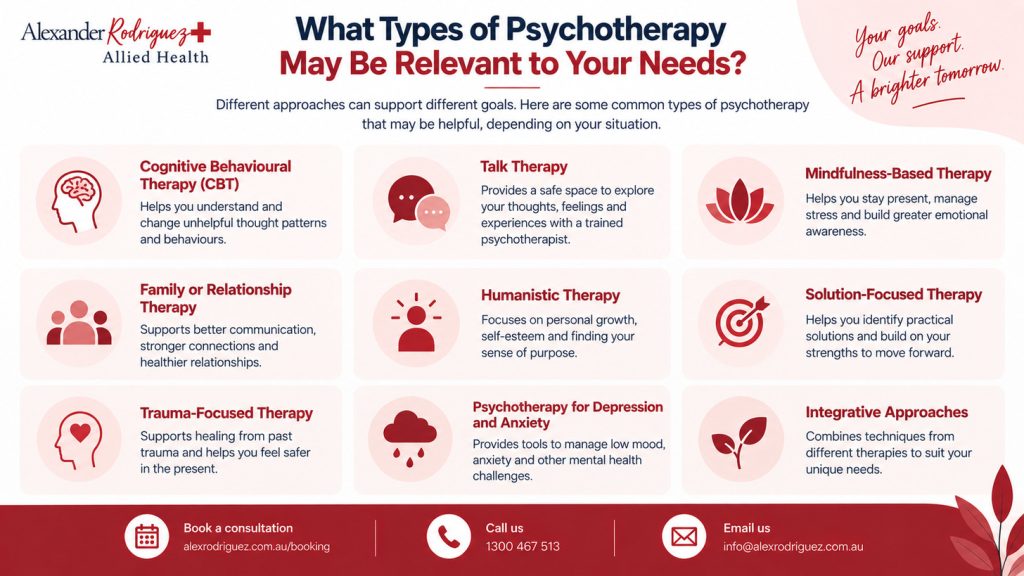
    Approaches for anxiety, stress, and emotional regulation

    If you need anxiety support, cognitive behavioural therapy (CBT) is often a primary choice. This approach helps you identify and challenge unhelpful thought patterns that add to stress. It also offers practical tools to manage your nervous system and regain calm.

    For emotional regulation support, mindfulness-based strategies can bring meaningful change. They teach you to observe your feelings without becoming overwhelmed. Learning to pause can help you respond to life’s challenges with greater clarity and calm.

    Approaches for depression, trauma, and low self-esteem

    If you are exploring psychotherapy for depression, your practitioner might suggest Acceptance and Commitment Therapy (ACT). This method helps you accept difficult emotions and take actions that match your values. It gently helps rebuild your connection to things that bring meaning.

    When you need trauma support, safety and pacing matter most. Trauma-informed care means you will not be rushed or pressured to revisit painful memories. It supports stability and helps you process experiences at a manageable speed, when you are ready.

    How your goals, preferences, and circumstances shape the therapy plan

    Your therapy plan should reflect your life story. A qualified professional will listen to your goals, such as improving self-esteem or managing a major life transition. Your preferences and current circumstances guide the treatment design.

    Working together, you and your therapist can adjust the intensity and focus of your sessions. This flexibility keeps your support relevant as your needs change over time. Your voice is the most important guide in deciding the direction of your healing journey.

    Why is there no single psychotherapy approach that suits everyone

    Human experience is complex and varied. What works perfectly for one person may not suit another, and that is normal. Your background, personality, and specific challenges shape how you respond to different therapeutic techniques.

    Choosing a professional who values your individuality supports a successful outcome. Staying open to different methods can help you find support that fits your life. Finding the right match is a vital part of the process, and you deserve a respectful plan.

    How Do You Know Which Mental Health Professional to Contact?

    Finding the right mental health professional can help you feel supported and move closer to your personal goals, but with so many titles and specialisations, the search can feel confusing. Counsellors, psychologists, psychiatrists, and other providers each offer different types of support, and it is not always clear which one suits your situation, whether you are dealing with anxiety, low mood, relationship stress, or simply feeling stuck.

    If you are looking for talk-based support to work through your thoughts and feelings, a psychotherapist is often a good starting point, offering psychotherapy tailored to your personal circumstances. This kind of support is commonly available through a psychology service, where a qualified professional can help you understand your options and guide you towards the right type of care. You do not need to have it all figured out before reaching out, a simple conversation can help clarify the best next step for you.

    The role of a psychotherapist and psychologist

    In Australia, titles for mental health experts can be confusing. A psychologist usually has a psychology degree and registration with the Psychology Board of Australia. They focus on evidence-based assessments and treatments.

    A psychotherapist often uses different talk-based approaches to explore your thoughts and feelings. Their training may differ, but both professionals offer a safe space for personal growth.

    Questions to ask about qualifications, experience and treatment goals

    When contacting a potential psychology service, ask questions about its support. You have the right to know who you work with and how they can help.

    Ask about their experience with your concerns, registration status, and preferred style of Psychotherapy. You could also ask how they measure progress and protect your confidentiality.

    What to consider when choosing an allied health service in Australia

    Choosing an allied health service means considering practical needs and clinical skills. Check its location, accessibility, and flexibility for your schedule.

    Also, check whether the provider belongs to relevant professional bodies. This shows they follow high care and ethical standards in Australia’s healthcare system.

    Professional Role Primary Focus Best For
    Psychologist Evidence-based therapy Specific mental health conditions
    Psychotherapist Deep emotional exploration Personal growth and patterns
    Counsellor Practical life challenges Immediate stress and transitions

    Ultimately, the best psychology service helps you feel heard, respected, and supported. Trust your instincts, because a strong connection with your mental health professional supports successful Psychotherapy.

    What Happens When You Book Psychotherapy With Alex Rodriguez?

    Seeking help takes courage, but knowing what to expect can make the process feel easier. When you book psychotherapy with Alex Rodriguez, the process usually starts with an initial consultation, where you can share what is going on and talk through what kind of support may suit you best. There is no pressure to have everything figured out beforehand; this first step is simply about starting the conversation.

    From there, your psychotherapist will work with you to explore the thoughts, feelings, or patterns behind what you are experiencing, and build a plan tailored to your personal goals. Sessions are designed to be a safe, judgement-free space where you can move at your own pace. This kind of individual, tailored care is offered as part of a broader psychology service, with in-person sessions available in Parramatta and Sydney, and telehealth options across Australia. Booking is simple; you can book an appointment online whenever you feel ready to take that first step.

    Preparing for your first individual therapy session

    You do not need a perfect explanation of your struggles before arriving. Feeling nervous or unsure about where to start is normal. Your psychotherapist will guide the conversation and help you explore your thoughts safely, without judgement.

    • Bring an open mind and a willingness to explore your experiences.
    • There is no pressure to share everything at once.
    • Focus on the main concerns that prompted you to seek support today.

    Discussing your concerns, goals, and preferred pace of support

    In your first meetings, you can discuss your goals and what you hope to achieve. This psychology service works with you, so your preferences always come first. You can choose the pace of your sessions, helping you feel comfortable and supported.

    Your plan can address immediate stress management, long-term growth, or both. You understand your life best, so your input matters throughout your psychotherapy journey.

    Accessing psychology services in Parramatta or arranging an enquiry

    If you seek a professional allied health service in the city centre, getting support is simple. You can arrange an enquiry to decide whether this approach suits you. Here are the details for psychology services in Parramatta.

    Location: Suite 15.01, Level 15, 60 Station St East, Parramatta NSW 2150

    Contact number: 1300 467 513

    Online booking: https://www.alexrodriguez.com.au/booking/

    Conclusion

    You do not need to wait for a major life crisis before prioritising your mental health. Many people find that psychotherapy helps them regain balance and clarity when dealing with stress, anxiety, or low mood, long before things reach a breaking point. If you have been wondering what is psychotherapy and whether it could help you, know that seeking support is a proactive choice, not a last resort. You may be managing relationship issues, family stress, or feeling overwhelmed by daily demands, and you deserve a safe, confidential space to explore what you are going through. There are several types of psychotherapy, and a qualified psychotherapist can help you find the approach that fits your needs, whether that involves working through anxiety, psychotherapy for depression, or simply building practical strategies for long-term emotional wellbeing. Dedicated support from a mental health professional is available, tailored to your unique circumstances, as part of a broader psychology service and allied health service, and reaching out is often the first step towards feeling more like yourself again.

    Alex Rodriguez provides psychotherapy, counselling, and allied health support in Parramatta and Sydney, with telehealth available across Australia. Call 1300 467 513, email info@alexrodriguez.com.au, or book an appointment online to take the next step towards better wellbeing.

    FAQ

    What is psychotherapy and how does it work?

    Psychotherapy is a talk-based form of professional support where you work with a trained psychotherapist to understand your thoughts, feelings, and behaviours, and build practical strategies for managing life’s challenges. Sessions are structured, confidential, and tailored to your personal goals.

    What is the difference between psychotherapy and counselling?

    Counselling often focuses on specific, immediate concerns such as a life transition or relationship issue, while psychotherapy tends to explore deeper, longer-standing patterns in thoughts and behaviour. Both can be valuable, and a mental health professional can help you decide which suits your needs.

    How do I know if I need to see a psychotherapist?

    You do not need a diagnosis or a crisis to see a psychotherapist. Signs it may help include ongoing stress, anxiety, low mood, trouble sleeping, relationship difficulties, or feeling unable to cope the way you usually would.

    What types of psychotherapy are available in Australia?

    Common types of psychotherapy include cognitive behavioural therapy (CBT), Acceptance and Commitment Therapy (ACT), and trauma-informed approaches. A psychotherapist will help match the right approach to your circumstances, whether you are managing anxiety, depression, or past trauma.

    Can psychotherapy help with anxiety and depression?

    Yes, psychotherapy can support people managing anxiety and psychotherapy for depression by helping identify triggers, challenge unhelpful thought patterns, and build coping strategies. It is not a replacement for medical treatment where that is needed.

    How much does psychotherapy cost in Australia?

    Costs vary depending on the provider, session length, and whether a Mental Health Treatment Plan or private health cover applies. It is best to check directly with your chosen psychology service for current session fees and rebate eligibility.

    Do I need a referral to see a psychotherapist?

    In many cases, you can access psychotherapy directly without a GP referral. However, a referral and Mental Health Treatment Plan may allow you to claim a Medicare rebate for some services, so it is worth checking with your provider.

    Where can I find psychotherapy services near Parramatta or Sydney?

    Alex Rodriguez offers psychotherapy and allied health services in Parramatta and across Sydney, with telehealth also available for clients throughout Australia. You can view available services or book an appointment online.

    How long does a course of psychotherapy usually take?

    There is no fixed timeframe. Some people benefit from a few sessions to work through a specific issue, while others engage in ongoing psychotherapy for deeper or longer-term support. Your psychotherapist will discuss a plan suited to your goals.

    Is online psychotherapy as effective as in-person sessions?

    Telehealth psychotherapy can be an effective option for many people, particularly where access, location, or scheduling make in-person visits difficult. The right format depends on personal preference and the type of support you need.
  • The Sunshine Mindset: Steps to Cultivate Daily Positivity

    The Sunshine Mindset: Steps to Cultivate Daily Positivity

    Sunshine mindset is my way of describing a deliberate daily choice to look for light, even when life feels heavy. In Australia, that choice matters because recent data from the National Study of Mental Health and Wellbeing shows that around 17 percent of Australians aged 16 to 85 experienced high or very high psychological distress. At the same time, the General Social Survey reports that more than half of us, 59 percent, faced at least one major personal stressor in the previous year, and our average life satisfaction sat at 7.2 out of 10, down from pre-pandemic levels.

    In this context, cultivating a sunshine mindset is not about pretending everything is fine; it is about building simple, practical habits that help us notice small wins, regulate our emotions, and create a little more warmth and hope every day.

    If you’re struggling and would like to explore services like Self-Esteem & Confidence Coaching, please reach out to us at Alex Rodriguez Counselling & Life Coaching. We’ve supported clients across Sydney and online for several years and bring practical, outcome-focused coaching to help you set clearer goals and healthier routines.

    Call on 0429 220 646, or email info@alexrodriguez.com.au to take the first step, or book a session online; the booking page lets you schedule on-site or online appointments for flexibility. We know how vital a positive outlook is. Our services aim to help people see life in a brighter light.

    Choosing a sunshine mindset boosts our mental health and gives us hope for the future.

    Key Takeaways

    • A sunshine mindset is a realistic, learnable way to choose optimism over automatic negative thoughts.
    • Noticing and working through barriers like stress, unhelpful thinking, and low energy makes positivity more achievable.
    • Simple morning rituals such as breathing, gratitude, and intention setting create a calm, hopeful start to the day.
    • Mindfulness techniques like grounding, body scans, and mindful breathing help us reset and stay positive throughout the day.
    • Building self-esteem and confidence makes it easier to handle setbacks and maintain a positive outlook.
    • Time management strategies reduce overwhelm, support work-life balance, and create space for joy.
    • A positive mindset improves focus and productivity, so we can tackle tasks with more energy and clarity.
    • Transforming daily habits with small, consistent changes builds long-term foundations for positivity.
    • Confident, assertive communication lets us share our sunshine mindset and uplift the people around us.
    • Alex Rodriguez Counselling & Life Coaching can support these skills through tailored coaching across key areas of life.

    What Is a Sunshine Mindset and Why It Matters

    A sunshine mindset is more than just “thinking happy thoughts.” It is a conscious way of seeing ourselves, other people, and our circumstances that leans toward realistic optimism instead of worst-case scenarios. In psychological terms, we are learning to gently counter ournatural negativity bias and patterns of automatic negative thoughts. When we choose a sunshine mindset, we are not ignoring stress, anxiety, or real problems. We are using cognitive reframing to notice what is working, what we can control, and what support we have, even on tougher days. It becomes a daily habit of shifting our attention from unhelpful thinking styles toward more balanced and encouraging thoughts.

    This mindset matters because what we focus on shapes how we feel and how we act. When we regularly tune into small wins, strengths, and moments of gratitude, we increase positive affect and give our brains new experiences to work with. Over time, that repeated focus strengthens helpful neural pathways, a process known as neuroplasticity. The result is lower stress, better emotion regulation, and a stronger sense of self-efficacy. A sunshine mindset can support higher self-esteem, healthier relationships, and more energy to go after our goals, rather than leaving us stuck in rumination or self-criticism.

    There is also a clear science behind this way of thinking. Positive psychology research, including the broaden-and-build theory of positive emotions, shows that practicing optimism, gratitude, and self-compassion can build psychological resilience and overall life satisfaction. When we treat a sunshine mindset as a learnable psychological skill rather than a fixed personality trait, it becomes something we can keep developing day by day. Even on cloudy days, we can still look for small rays of light and take one practical step that supports our mental and emotional well-being.

    The Science Behind Positive Thinking

    Positive thinking is not just a feel-good idea; it’s supported by science. Research shows it can improve our mental health by lowering stress and anxiety. This is because a positive mindset changes our brain chemistry, releasing happy hormones.

    How Positivity Impacts Mental Health

    Positivity greatly affects our mental health. By focusing on the good, we can handle stress better and fight anxiety and depression. It’s not about ignoring the bad, but about choosing to see the positive.

    The Australian Perspective on Positivity

    In Australia, there’s a growing focus on mental wellbeing and positivity. Local studies and experts stress the need for a positive mindset, especially during tough times like droughts and bushfires. By adopting a sunshine mindset, Australians can become more resilient and improve their well-being.

    Benefits of a Sunshine Mindset Impact on Mental Health Role in Building Resilience
    Improved mental well-being Reduces stress and anxiety Enhances ability to cope with challenges
    Increased happiness Promotes positive emotions Fosters a positive outlook
    Better relationships Improves communication Encourages empathy and understanding

    The Transformative Benefits of Embracing Your Sunshine Mindset

    Having a sunshine mindset can change many parts of our lives in practical, everyday ways. When we learn to notice small positives, challenge unhelpful thoughts, and respond to ourselves with more kindness, we start to reduce stress and improve our overall mood. This shift supports better emotion regulation, stronger resilience, and a greater sense of control over how we respond to challenges, even when we cannot change the situation itself. Over time, that daily dose of positivity helps protect our mental health and lifts our overall well-being.

    It also flows into our relationships, work, and personal goals. A sunshine mindset makes it easier for us to communicate more calmly, solve problems with a clearer head, and stay motivated when things take longer than we hoped. We are more likely to see setbacks as learning experiences instead of proof that we are failing. By embracing this way of thinking, we do not pretend life is perfect. Instead, we build an inner toolkit that helps us handle stress, find meaning in our experiences, and create a life that feels more balanced, hopeful, and fulfilling.

    Improved Mental Wellbeing

    Being positive can make our minds healthier. It lowers stress and anxiety. Gratitude habits help us see the good in our lives.

    Enhanced Physical Health

    Positive thinking is good for our bodies, too. People who think positively often have lower blood pressure and heart disease. They also have a stronger immune system.

    Physical Health Benefits Mental Health Benefits
    Lower Blood Pressure Reduced Stress and Anxiety
    Reduced Risk of Heart Disease Improved Mood
    Stronger Immune System Enhanced Resilience

    Stronger Personal and Professional Relationships

    A positive mindset makes our relationships better. Being positive and caring helps us connect with others. We build a supportive community.

    Greater Resilience During Challenging Times

    A sunshine mindset makes us stronger when things get tough. Focusing on the good and being grateful helps us face challenges. We come out stronger.

    Identifying and Overcoming Barriers to Positivity

    Embracing positivity is not always simple or natural. Many of us carry past experiences, stress, or unhelpful thinking patterns that pull our attention towards what is wrong instead of what is possible. The first step is to recognise these barriers instead of blaming ourselves for not being “positive enough.” We might notice habits like all-or-nothing thinking, constant self-criticism, or always expecting the worst. We might also see how lack of sleep, burnout, unresolved conflict, or ongoing worry make it harder for our minds to feel safe and hopeful.

    Once we understand what is getting in the way, we can start to gently work through it. Identifying our triggers, naming our unhelpful thoughts, and acknowledging old stories we tell ourselves creates room for change. From there, we can use tools like cognitive reframing, self-compassion, healthy boundaries, and small daily habits that support our nervous system, such as movement, rest, and connection. By steadily addressing these obstacles, we create stronger foundations for a sunshine mindset to grow, so positivity feels more genuine and sustainable rather than forced or fake.

    Recognising Negative Thought Patterns

    Negative thoughts can make it hard to stay positive. Mindfulness and cognitive-behavioral therapy help us spot and change these thoughts. By noticing our thoughts, we can start to see them in a better light.

    Managing Environmental Influences

    Our surroundings greatly affect our mindset. Places filled with negativity can pull us down. We must create a space that supports and uplifts us, helping us stay positive.

    Healing from Past Experiences

    Past traumas can deeply affect our mental health. Healing from these is key to a positive mindset. Self-esteem coaching offers valuable guidance and support during this journey.

    Morning Rituals to Kickstart Your Sunshine Mindset

    Mornings are like a blank page, and what we write on it can shape the rest of our day. When we begin with intentional, mindful morning rituals, we use behavioural activation to gently guide our brain and body into a calmer, more hopeful state. Simple practices such as diaphragmatic breathing or box breathing for 2 to 5 minutes help activate the parasympathetic nervous system, lowering our stress response and easing us out of “fight or flight.” A short mindfulness practice, like a 3-minute body scan or noticing five things we can see, hear, and feel around us, grounds us in the present instead of starting the day in autopilot or anxiety.

    We can then add positive psychology practices that actively build a sunshine mindset. Gratitude journaling, for example, might mean writing down three things we are thankful for and one reason each matters to us. This is a simple form of cognitive priming that trains our attention to notice positives, not just problems. Setting implementation intentions, such as “If I feel stressed today, I will pause and take three slow breaths,” helps us plan supportive responses before stress hits. We might also use self-compassion statements like “This is a hard moment, and it is okay to go gently,” or repeat a brief affirmation such as “I am learning to meet today with calm and kindness.”

    Physical rituals can reinforce these mental habits. Getting a few minutes of natural light exposure soon after waking helps support our circadian rhythm and boosts energy. Light stretching or a short walk counts as low-pressure movement that lifts positive affect without needing a full workout. Even enjoying a mindful cup of tea or coffee, where we slow down and notice the warmth, aroma, and taste, becomes a small mindful eating practice. Over time, these realistic morning rituals become anchors. They give us repeatable steps that make it easier to carry a sunshine mindset into the rest of the day, so positivity feels practiced and embodied, not forced or fake.

    Creating a Mindful Morning Routine

    Having a regular morning routine tells our brain it’s time to wake up and focus. You might meditate, do deep breathing, or just enjoy a quiet cup of tea. Start small and stick to it to nourish your body and mind.

    Powerful Positive Affirmations for Australians

    Positive affirmations can change our thoughts and help us feel more positive. For Aussies, affirmations that reflect the country’s relaxed vibe and love for nature work well. Saying “I am capable and strong, just like the Australian landscape” is a great way to start.

    Establishing a Daily Gratitude Practice

    Gratitude is key to keeping a sunny outlook. Journaling is a great way to practice it.

    The Five-Minute Gratitude Journal Method

    Take just five minutes each morning to write down three things you’re thankful for. This simple act can help you focus on the good things in your life.

    Day Gratitude 1 Gratitude 2 Gratitude 3
    Monday Good health Supportive family Beautiful sunrise
    Tuesday Meaningful work Nurturing friendships Cozy home

    By adding these morning rituals to our daily life, we can create a sunny mindset. This brings positivity and purpose to our days.

    Mindfulness Techniques to Maintain Positivity Throughout the Day

    Mindfulness helps us stay connected to a sunshine mindset by bringing our attention back to the present moment, instead of letting our thoughts spiral into worry or regret. It is the practice of noticing what is happening in our body and mind with curiosity rather than criticism. When we are mindful, we become more aware of our thoughts, feelings, and physical sensations as they arise, which gives us a small but powerful pause before we react. That pause is where we can choose kinder self-talk, more balanced thoughts, and calmer responses.

    Throughout the day, simple mindfulness techniques can help us maintain positivity in realistic ways. Mindful breathing is one of the easiest tools. Taking 3 to 5 slow, deep breaths using diaphragmatic breathing helps soothe our nervous system and reduce stress in the moment. Grounding exercises, such as the 5–4–3–2–1 method (naming five things we can see, four we can feel, three we can hear, two we can smell, and one we can taste), bring us back into our body when our mind feels scattered. These practices are quick, discreet, and can be used at our desk, on public transport, or during a short break.

    We can also practise mindful awareness of thoughts using a cognitive technique often called “noting.” When a negative or self-critical thought appears, we mentally label it as “worry,” “judgment,” or “story” instead of treating it as a fact. This small act of noticing creates distance between who we are and what we are thinking. Pairing this with self-compassion, such as silently saying, “It is understandable to feel this way,” reduces shame and helps us return to a more positive, balanced mindset.

    Mindfulness can be built into everyday activities, too. We might try mindful walking, where we pay attention to the feeling of our feet on the ground and the rhythm of our steps, or mindful eating, where we slow down enough to actually taste and enjoy our food. Even checking in with a quick body scan during the day, noticing where we feel tension and gently relaxing those muscles, can shift our mood. By weaving these small, evidence-based mindfulness techniques into our routine, we give ourselves regular opportunities to reset, regulate our emotions, and keep our sunshine mindset alive throughout the day.

    Present Moment Awareness Exercises

    Practicing mindfulness means focusing on the now. We pay attention to our thoughts and feelings without judging. For instance, we can focus on our breath, noticing how it feels in our nostrils.

    Breathing Techniques for Instant Calm

    Breathing can calm us down quickly. Deep, slow breaths help reduce stress. Try breathing in for four counts, holding for seven, and out for eight.

    Mindful Observation in Everyday Life

    Mindful observation is about noticing our surroundings. We see, hear, and smell the world around us. It helps us see beauty in everyday life.

    Using Australian Nature for Mindfulness Practice

    Australia’s nature is perfect for mindfulness. We can observe the beauty of the Outback or the coastlines.

    By using these mindfulness techniques daily, we can stay positive and strong. They help us face life’s challenges better.

    Building Self-Esteem and Confidence for a Positive Outlook

    On our journey to a sunny mindset, building Self-esteem & Confidence is one of the foundations that keeps our outlook steady. Healthy self-esteem is not about thinking we are better than others; it is about recognising our inherent worth and believing we can learn and grow. When we value ourselves, we are less likely to be knocked down by every mistake or criticism. Instead of seeing setbacks as proof that we are not good enough, we can view them through a growth mindset, as opportunities to adjust and improve.

    Strengthening self-esteem also connects with other types of coaching that support a positive outlook. Time Management skills help us organise our days so we feel less overwhelmed and more in control of our priorities. Focus & Productivity coaching teaches us how to reduce distractions and follow through on the tasks that actually matter, which boosts our sense of achievement. Working on Changing Habits gives us practical tools to replace unhelpful patterns with routines that support our wellbeing and sunshine mindset. Even Public Speaking coaching can lift our confidence by helping us communicate clearly, handle anxiety, and show up more authentically in front of others.

    A big part of this work is gently challenging the cognitive distortions that feed low confidence and replacing harsh self-talk with more realistic, supportive statements. We can keep a “wins list,” notice small daily successes across self-esteem, time management, focus, habits, and communication, and celebrate each one. As we focus on our worth, practise these different coaching skills, and speak to ourselves with the same kindness we would offer a friend, our confidence grows. That inner confidence makes it much easier to maintain a sunshine mindset, because underneath the ups and downs, we start to feel that we can cope, we can learn, and we are worthy of good things.

    Recognising Your Inherent Worth

    Understanding your inherent worth means knowing you’re valuable, no matter what. It’s about seeing your worth isn’t based on what others think but on who you are. As “You alone are enough.”

    Challenging Self-Limiting Beliefs

    It’s important to challenge beliefs that hold us back. These beliefs often stem from past experiences or negative comments. By facing and changing these, we can build a more positive view of ourselves.

    Celebrating Personal Achievements

    It’s crucial to celebrate our achievements, big or small. Recognising our successes helps us stay positive and keeps us motivated to reach our goals.

    Time Management Strategies That Foster Positivity

    By focusing on what really matters and managing our time well, we create more space for happiness to grow. When we use simple time management strategies, we reduce decision fatigue and lower the constant feeling of being “behind.” Prioritising our tasks, planning our day, and protecting our energy help us feel more in control, which directly supports a sunshine mindset. Instead of rushing from one thing to the next, we can move through the day with clearer intentions and less stress.

    Practical tools make this easier. Techniques like time blocking (scheduling specific tasks into set time slots) and the Pomodoro Technique (working in short, focused bursts with regular breaks) support better focus and productivity. Using a daily to-do list that highlights our top three priorities ensures we tackle what is truly important rather than getting lost in busywork. When we pair this with healthy boundaries, such as limiting after-hours emails or setting phone-free pockets of time, we create a more realistic work-life balance.

    Good time management also frees up time for the activities that lift our mood, such as exercise, hobbies, social connection, or quiet rest. Scheduling these “positive fuel” activities into our calendar is a form of behavioural activation that reminds us that fun and rest are not extras; they are essentials. As we manage our time more intentionally, we experience more small wins each day, feel more capable, and find it easier to maintain a positive, sunshine mindset.

    Prioritising Tasks for Reduced Stress

    One key time management tactic is to sort tasks by importance. Doing the most critical tasks first can lessen stress and overwhelm. Stephen Covey wisely said, “The key is not to prioritize what’s on your schedule, but to schedule your priorities.”

    Creating Boundaries for Mental Well-being

    Setting clear boundaries is vital for our mental health. Saying “no” to tasks that don’t fit our priorities or cut into personal time is key. This helps safeguard our mental well-being and keeps us positive.

    Scheduling Time for Joy and Relaxation

    It’s important to make time for things that make us happy and relaxed. Whether it’s reading, walking, or yoga, downtime is essential. Studies show that breaks boost focus and productivity.

    Australian Work-Life Balance Approaches

    In Australia, a healthy work-life balance is highly sought after. Many enjoy outdoor activities and quality time with loved ones. Adopting this mindset can lead to a more positive and balanced life.

    By using these time management tips, we can live a more positive and balanced life. It’s about choosing to put our well-being and happiness first.

    Enhancing Focus and Productivity with a Positive Mindset

    Positive thinking is more than just feeling good in the moment. It is a practical tool that shapes how our brain directs attention, solves problems, and manages energy throughout the day. When we approach tasks with a positive mindset, we boost attentional control and cognitive flexibility – we find it easier to concentrate on what matters and to shift gears when plans change. Instead of getting stuck in “I cannot do this” thinking, we tap into self-efficacy and a growth mindset, which helps us stay engaged for longer and recover faster when things are difficult.

    A sunshine mindset also supports Focus & Productivity coaching in very concrete ways. Positive emotions increase our motivation to start tasks, not just think about them, which is vital for overcoming procrastination. When we believe our efforts will pay off, we are more likely to break big projects into smaller steps, use techniques like task chunking or the Pomodoro method, and follow through on what we planned. This creates a feedback loop: each small success reinforces our confidence, which makes it easier to tackle the next challenge with focus and energy.

    Over time, combining a positive mindset with Changing Habits and strong Time Management skills leads to a more sustainable way of working. We become better at choosing high-value tasks, letting go of perfectionism, and noticing when we need a break before burnout hits. By thinking positively and acting intentionally, we can lift our productivity at work and in our personal lives, while still protecting our well-being and keeping our sunshine mindset alive.

    Single-Tasking vs. Multi-Tasking

    Studies show that single-tasking is often more productive than trying to do many things at once. When we focus on one task, we can give it our full attention. This reduces mistakes and boosts quality. On the other hand, trying to do too many things at once can distract us and lower our productivity.

    Creating an Environment That Fosters Focus

    Our surroundings greatly affect our ability to focus. Keeping our workspace clean and free of clutter helps us stay focused. Adding things that make us feel good, like plants or inspiring quotes, can also clear our minds.

    Positive Reinforcement Techniques

    Using positive reinforcement can really help us stay productive. By giving ourselves rewards for finishing tasks or hitting milestones, we stay motivated. Positive affirmations and visualizing success can also keep our mindset positive.

    Productivity Coaching Methods from Alex Rodriguez

    Alex Rodriguez Counselling & Life Coaching provides personalised coaching to improve focus and productivity. They help clients find their strengths and work on their weaknesses. This way, everyone can find strategies that work best for them to reach their goals.

    Transforming Daily Habits to Support Long-term Positivity

    Daily habits quietly shape how positive or drained we feel, often more than big life events. Many of us run on autopilot, repeating routines that increase stress, reduce sleep, or keep us glued to screens late at night. Transforming these patterns starts with habit awareness – noticing which behaviours lift our mood and which ones repeatedly leave us flat, anxious, or exhausted. When we identify habits that drain our energy, such as constant multitasking, skipping meals, or scrolling through social media before bed, we can begin to design healthier alternatives that support a more optimistic outlook.

    Behavioural science shows that habits are built from a cue–routine–reward loop. To change a habit, we do not rely on willpower alone. Instead, we adjust one part of the loop. For example, if arriving home is the cue for collapsing on the couch and doom scrolling, we might replace the routine with a short walk, a glass of water, or five minutes of stretching while listening to music. The reward is the same sense of unwinding, but the behaviour now supports our well-being. Over time, these tiny shifts become new automatic routines that feed positivity rather than drain it.

    It can also help to link new habits to existing routines, using habit stacking. After brushing our teeth, we might spend one minute noting something we are grateful for. After making coffee, we take three slow breaths before checking emails. These small actions, repeated consistently, act as behavioural activation that nudges us towards a sunshine mindset even when motivation is low. As we gradually change our daily habits in this way, we build a lifestyle that protects our energy, supports resilience, and makes a positive view of life feel natural and sustainable rather than forced.

    Identifying Habits That Drain Your Energy

    The first step is to find habits that make us feel low. These include too much social media, being hard on ourselves, and not moving enough. Being aware of these habits helps us make better choices.

    Establishing New Positive Routines

    After spotting bad habits, we can start new good ones. This might mean meditating, reading, or enjoying nature. Consistency is key in making new habits stick, so start small and be patient.

    The 21-Day Habit Formation Process

    The 21-day rule is a popular way to change habits for good. By sticking to a new habit for 21 days, we can make it a regular part of our lives.

    Habit Coaching Techniques for Lasting Change

    Habit coaching helps us track our progress and celebrate small wins. It also involves building new habits on top of old ones. Here are some effective techniques:

    Habit Coaching Technique Description
    Habit Stacking Building new habits onto existing ones
    Progress Tracking Monitoring our progress to stay motivated
    Celebrating Small Victories Recognizing and celebrating our achievements

    Using these techniques and staying consistent can change our daily habits for the better. This supports long-term positivity.

    Expressing Your Sunshine Mindset Through Confident Communication

    Confident communication is one of the most powerful ways to express our sunshine mindset in the real world. When we speak clearly and kindly, we do more than share ideas; we model optimism, resilience, and respect. Strong Self-esteem & Confidence help us communicate without shrinking back or overpowering others, so our words feel both grounded and genuine. This kind of communication is often called assertive communication – we express our needs, feelings, and opinions honestly while still considering the rights and feelings of the people around us.

    Developing these skills can be a key focus of Public Speaking and communication coaching. We learn practical tools like using open body language, maintaining comfortable eye contact, and varying our tone so our message feels warm and engaging. Techniques such as practicing short “sunshine statements” – simple, positive messages about hope, encouragement, or gratitude – help us feel more prepared when we speak up in meetings, social situations, or presentations. We can also use active listening, reflecting back what others say, and acknowledging their emotions, to create conversations where positivity flows in both directions.

    Over time, confident communication turns our sunshine mindset into something others can see and feel. A sincere compliment, a calm response in a tense moment, or a hopeful perspective shared in a group can shift the atmosphere more than we realise. By combining inner work on confidence with practical speaking skills, we become better at spreading encouragement, setting healthy boundaries, and inspiring others to explore their own more positive outlook.

    Positive Language Patterns in Everyday Conversations

    Positive words can change how people hear us. Using positive language in our talks makes our world better. For example, saying “I’m exploring options” instead of “I’m not sure” can really change things.

    Body Language That Conveys Confidence

    Our body language shows if we’re confident or not. Keeping eye contact, standing up straight, and using open gestures helps. These actions make our words more powerful.

    Public Speaking with a Positive Mindset

    Public speaking is a great chance to share our sunshine mindset with many. By focusing on our message and speaking with confidence, we can inspire others. Mindfulness and positive self-talk help us feel calm and confident before we speak.

    Communication Coaching Tips from Alex Rodriguez

    Improving our communication takes practice and help. Alex Rodriguez Counselling & Life Coaching gives great advice. By working on our language, body language, and speaking skills, we can share our sunshine mindset clearly and confidently.

    Conclusion: Your Journey to Sustained Positivity

    Exploring the sunshine mindset shows us how daily positivity can slowly reshape our well-being. Morning rituals, mindfulness, supportive self-talk, and small changes to how we manage time, habits, and communication all help us see the bright side more often and respond to stress with more calm and clarity. Over time, this improves our mental health and the way we show up in our relationships, work, and personal goals.

    Having a sunshine mindset also helps us face life’s tough times with greater resilience. Instead of feeling stuck or powerless, we can draw on the tools in this article to steady ourselves, celebrate small wins, and move forward in a kinder, more intentional way. For more structured support, Alex Rodriguez Counselling & Life Coaching is here to walk alongside us with tailored coaching in areas like confidence, focus, time management, habit change, and public speaking.

    By choosing a sunshine mindset, we permit ourselves to grow into our full potential. Step by step, we can build a life that feels more joyful, grounded, and purposeful, even when the weather is not always sunny.

    Call on 0429 220 646, or email info@alexrodriguez.com.au to take the first step, or book a session online; the booking page lets you schedule on-site or online appointments for flexibility. We know how vital a positive outlook is. Our services aim to help people see life in a brighter light.

    FAQ

    What is a sunshine mindset and how can it be cultivated?

    A sunshine mindset is a positive and optimistic view of life. We can develop it by being grateful, practicing mindfulness, and thinking positively.

    How can morning rituals help in kickstarting a positive mindset?

    Morning rituals like a mindful routine, positive affirmations, and daily gratitude can start your day positively. They set a good tone for the day.

    What are some effective time management strategies that foster positivity?

    Good time management includes prioritising tasks, setting boundaries, and making time for fun. It helps reduce stress and boosts wellbeing.

    How can we build self-esteem and confidence for a positive outlook?

    We can boost self-esteem by valuing ourselves, overcoming negative thoughts, and celebrating our wins. Self-esteem coaching, like Alex Rodriguez Counselling & Life Coaching, can also help.

    What is the 21-day habit formation process, and how can it support long-term positivity?

    The 21-day habit formation helps create lasting change by sticking to a new habit for 21 days. It helps build positive routines and get rid of energy-draining habits, leading to long-term positivity.

    How can we express our sunshine mindset through confident communication?

    We can show our sunshine mindset through confident talk by using positive words, confident body language, and practicing public speaking. Tips from Alex Rodriguez Counselling & Life Coaching can be very helpful.

    What are some mindfulness techniques that can help maintain positivity throughout the day?

    Mindfulness techniques like being present, breathing exercises, and observing daily life can keep positivity high. Using Australian nature for mindfulness is also great.