Tag: Self-Care Practices

  • Relationship Burnout: Why You Feel Emotionally Exhausted

    Relationship Burnout: Why You Feel Emotionally Exhausted

    Relationship counselling is worth thinking about if you have started to feel worn down by your relationship rather than lifted up by it. A study cited by the Australian Institute of Family Studies found that of 1,204 Australian adults surveyed, only 22% sought professional help when experiencing relationship issues. Many more simply push through in silence.

    This gap matters because relationship burnout rarely fixes itself. It builds quietly, showing up as emotional exhaustion in relationships long before anyone names what is actually happening. If you feel tired even after a full night’s sleep, snap at small things, or dread simple conversations with your partner, these can be early relationship burnout signs. It is not about one bad week. It is the slow weight of giving more than you receive until you feel like you are living in an emotionally drained relationship rather than a supportive one.

    Ongoing relationship stress does not stay in one place. It follows you to work, into your friendships, and into how you sleep at night. Over time, this constant strain can turn into full relationship fatigue, where even small requests from your partner feel like too much to handle. Left unaddressed, this often leads to emotional disconnection, where you and your partner start living side by side rather than together. These relationship problems are common, and they do not mean your relationship is beyond help. Many couples find that improving communication is the first real step forward. A good counselling service gives you both a safe space to slow down, understand what has changed, and learn practical ways to reconnect with your partner again.

    You do not have to carry relationship burnout on your own. Relationship counselling with Alex Rodríguez offers a safe, supportive space to reconnect with your partner. Call1300 467 513, email info@alexrodriguez.com.au, or book a consultation online to take the next step towards better wellbeing.

    Key Takeaways

    • Relationship burnout builds slowly through ongoing, unnoticed strain, not one bad week.
    • Emotional exhaustion in relationships often shows up as tiredness, flatness, or feeling distant from your partner.
    • Common relationship burnout signs include avoidance, less warmth, and growing emotional disconnection.
    • Small steps, like better couples’ communication, can ease relationship fatigue over time.
    View original

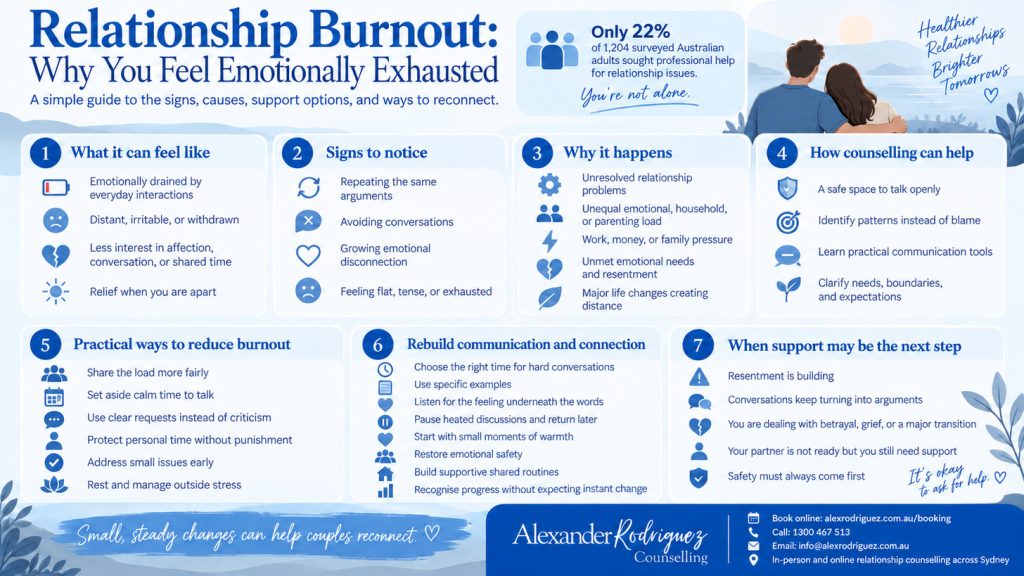
    What Relationship Burnout Can Feel Like

    When the spark in your partnership fades, you might feel more than everyday stress. Relationship burnout often shows up as a heavy tiredness that does not go away, even after rest. Many people feel empty around their partner and find even small talk harder than it used to be. This is different from a rough patch. Emotional exhaustion in relationships builds slowly, often without either person noticing at first, leaving you feeling present but distant, going through the motions without the warmth that used to come naturally.

    Over time, this can lead to emotional disconnection, where conversations stay surface-level rather than open and honest. Noticing these relationship burnout signs early makes a real difference, and it is not a sign of failure. It is a sign that your relationship needs some attention and support. Relationship counselling can help you understand what is happening and guide you both towards feeling more connected again.

    Understanding emotional exhaustion in relationships

    Emotional exhaustion in relationships feels like numbness or constant frustration. You might not get excited about plans anymore or struggle to talk deeply. This emotional disconnection makes you feel like you’re living with a stranger.

    It’s common to feel like you’re always giving but getting little back. This can build resentment over time. In an emotionally drained relationship, trying to connect feels pointless.

    How relationship fatigue differs from ordinary tiredness

    Relationship fatigue is different from regular tiredness. A good night’s sleep might fix physical tiredness but not burnout. This fatigue stays even when things get better or you take a break.

    If you’re always feeling drained, it’s more than just tiredness. Relationship burnout shows your partnership’s emotional foundation needs work.

    Why burnout can affect otherwise caring partners

    You might wonder how caring partners end up in tough spots. Relationship burnout often comes from chronic stress, unmet needs, or too much emotional work. Even the most caring partners can break when they feel unsupported or unheard.

    Being in this cycle doesn’t mean your love is gone. It means your emotional reserves are empty from ongoing stress. Getting help from Relationship Counselling can help address these issues and start healing.

    Relationship Burnout Signs You Should Notice
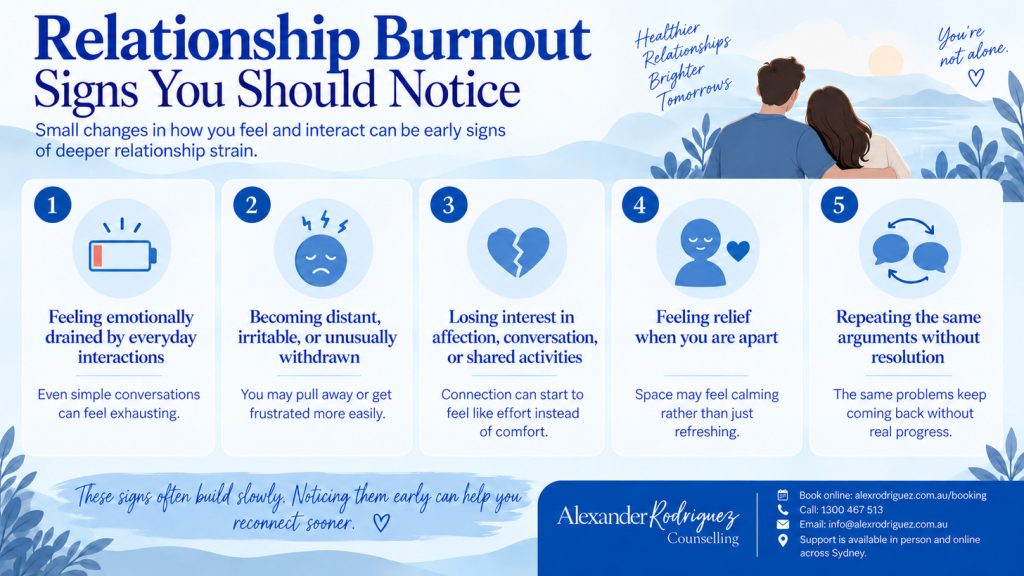
    Spotting small changes in how you interact can show if you’re experiencing relationship burnout. These relationship burnout signs creep up slowly, often hiding behind busy schedules or the everyday pressures of life. They’re easy to miss until they start to overwhelm you, showing up as a quiet distance between you and your partner rather than one big, obvious moment. Learning to notice these early patterns can help you understand what is really going on before emotional exhaustion in relationships takes hold.

    Feeling emotionally drained by everyday interactions

    Even simple talks with your partner can leave you feeling drained. Being in an emotionally draining relationship means your energy is always low. You might find it hard to muster the energy for simple chats or to make decisions together.

    Becoming distant, irritable, or unusually withdrawn

    Stress can change how you feel. You might get short with your partner over small things or prefer to be alone. This unusual withdrawal is a way to protect yourself from more emotional exhaustion.

    Losing interest in affection, conversation, or shared activities

    When you’re emotionally spent, things that used to make you happy now feel like chores. You might stop wanting physical touch or meaningful talks. Even activities you loved doing together start to feel like obligatory tasks instead of fun.

    Feeling relief when you are apart

    Feeling calm or relieved when your partner is away is a big sign. While everyone needs alone time, feeling a significant weight lift when you’re alone means stress is present. This is a clear sign that your situation needs attention.

    Repeating the same arguments without resolution

    Dealing with the same relationship problems over and over is common. It feels like you’re in a never-ending cycle, saying the same things without being heard. Getting help from a relationship counsellor can help you break these patterns and find the reasons behind your relationship burnout.

    Why Emotional Exhaustion Develops Between Partners
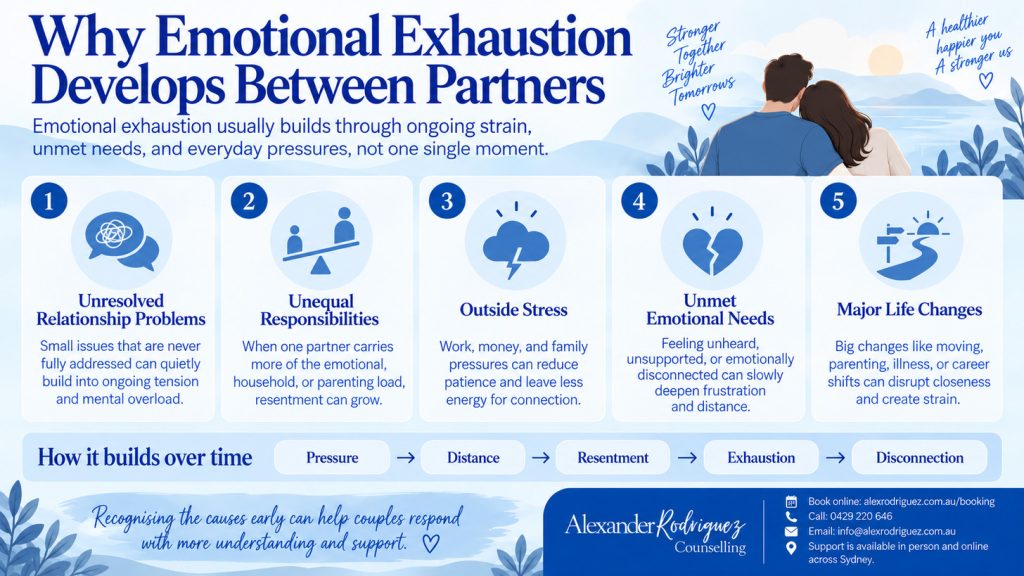
    Many couples wonder why their bond feels so exhausting. It’s rarely just one thing. Emotional exhaustion in relationships usually comes from many small, ongoing issues that build up quietly over time, rather than one single event.

    Unmet needs, unspoken frustrations, and mismatched effort can all add to this weight. When one partner feels like they are carrying more of the emotional load, relationship stress starts to settle in. Left unspoken, small relationship problems can pile up until even simple moments together feel heavy. Over time, this ongoing pressure is often what turns everyday tension into deeper relationship fatigue.

    Unresolved relationship problems that continue to build

    Ignoring relationship problems doesn’t make them go away. They stay hidden, using up your mental energy. Over time, they slowly drain the life from your relationship.

    Unequal emotional, household, or parenting responsibilities

    Feeling like you’re carrying too much can lead to relationship fatigue. If one person does all the work, resentment grows. This imbalance is a big source of frustration.

    Relationship stress caused by work, finances, or family pressures

    Modern life brings relationship stress from work, money, and family. These pressures leave little energy for your partner. If not managed, they can harm your bond.

    Long-term resentment and unmet emotional needs

    Resentment quietly harms your connection. Unmet emotional needs can make you pull away. This cycle of emotional disconnection makes reaching out harder.

    Emotional disconnection after major life changes

    Big changes, like moving or having kids, change your relationship. Finding new ways to communicate is hard. Without effort, you might live separate lives.

    Factor Impact on Couple Resulting Feeling
    Unresolved Conflict High mental load Exhaustion
    Unequal Duties Increased resentment Frustration
    External Stress Reduced patience Distance
    Unmet Needs Lowered intimacy Loneliness

    Recognising these patterns is the first step to change. By understanding relationship fatigue, you can tackle relationship problems. This leads to a more balanced, supportive future.

    How Relationship Counselling Can Help

    Feeling overwhelmed in your relationship is more common than you might think, and professional support can help guide you through it. Relationship counselling offers a neutral, safe space to explore your feelings openly, without judgement from either side. Working with a counselling service can help you and your partner understand what has changed and why, giving you both room to slow down, be heard, and see your relationship in a new light.

    Over time, this kind of support can help rebuild couples’ communication, ease emotional disconnection, and guide you towards how to reconnect with your partner in a way that feels genuine. While counselling cannot guarantee a specific outcome, it can offer practical strategies and a supportive space to work through challenges together, at your own pace.

    Creating a safe space to discuss difficult relationship concerns

    Dealing with relationship burnout can make talking tough. A therapist creates a safe place for you to share your feelings. This is key for tackling deep relationship problems that often stay hidden.

    Identifying patterns instead of blaming each other

    It’s common to point fingers when you’re tired. But a therapist helps you focus on the issues, not who’s to blame. This way, you can work together to change negative patterns.

    Learning practical tools for couples’ communication

    Good couples’ communication can be learned. Couples therapy teaches you how to listen and respond better. These skills help reduce tension and ensure your partner understands you.

    Working towards clearer needs, boundaries, and expectations

    Feeling drained can come from unspoken expectations or different goals. Counselling helps you express your needs and set boundaries. Relationship counselling services support you in clarifying these. Aligning your goals can lead to a more fulfilling relationship.

    Practical Ways to Reduce Relationship Burnout

    Relationship fatigue can feel overwhelming, but small changes can make a real difference. To ease relationship burnout, it often helps to start with simple adjustments to your daily routine rather than trying to fix everything all at once, especially when things have felt heavy for a while.

    Small, consistent steps tend to create more lasting change than big, sudden shifts. Even short moments of connection, like checking in with each other or sharing small tasks more evenly, can help you and your partner find balance again over time.

    Share the emotional and practical load more fairly

    It’s common for one person to do more household chores or emotional work. This can lead to resentment. Make a list of your daily tasks to find out where the imbalance is. By sharing responsibilities, you can avoid feeling overwhelmed.

    Set aside regular time for calm, focused conversations

    Life can get in the way, making it hard to connect. Set aside a time each week to talk without distractions. This helps you stay connected and prevents feeling apart.

    Replace criticism and defensiveness with specific requests

    When you’re tired, it’s easy to criticise. Instead, make specific requests that focus on your feelings. This way, you can express your needs without causing tension.

    Protect personal time without using distance as punishment

    Everyone needs time alone to recharge. Pursuing hobbies or spending time with friends is healthy, as long as you communicate your needs. Protecting your personal time helps you stay energised for when you’re together.

    Address small concerns before they become major conflicts

    Ignoring small relationship problems can lead to big issues. Tackle these problems early to avoid frustration. If you struggle, consider Relationship Advice Sessions to learn how to handle these conversations.

    Rest, reconnect, and manage outside sources of relationship stress

    Work and financial worries can affect your home life. Getting enough rest is key to managing relationship stress. When you’re well-rested, reconnecting with your partner becomes easier. If you’re still struggling, Relationship Counselling can offer the help you need.

    Rebuilding Couples’ Communication When You Feel Drained

    If you’re experiencing emotional exhaustion in relationships, changing how you talk to each other is often key to feeling better. When you’re drained, even simple chats can leave you feeling defensive or wanting to pull away, rather than open and connected.

    By gently changing how you handle these moments, such as pausing before reacting or naming how you feel rather than shutting down, you can reduce tension and build a calmer, more supportive space. Strengthening couples communication in this way does not need to happen all at once. Small shifts, made consistently, can ease relationship stress and help you both feel more heard over time.

    Choose the right time to raise a sensitive issue

    When dealing with relationship burnout, timing is crucial. Don’t bring up big topics when you’re both tired, hungry, or in a rush. Instead, pick a time when you’re both calm and can focus.

    Use specific examples rather than broad accusations

    Generalising your relationship problems can lead to endless arguments. Stick to one specific event instead of saying “you always” or “you never.” This way, your partner gets your point without feeling attacked or overwhelmed.

    Listen for the feeling beneath your partner’s words

    Often, the words in a fight are just the tip of the iceberg. Try to catch the deeper emotion, like fear, loneliness, or a need for connection. Couples Therapy shows that acknowledging these feelings can calm things down faster than arguing facts.

    Pause a heated conversation without abandoning the discussion

    It’s okay to step back when emotions are high. A respectful pause is different from walking away or giving up. Agree on a signal to stop, take time to calm down, and promise to come back to the talk later.

    Agree on one achievable communication change to practise

    Trying to fix everything at once can exhaust you. Choose one small, easy goal, like checking in for five minutes each evening without phones. Small, consistent changes are often more effective than trying to change everything at once.

    Communication Habit Impact on Relationship Recommended Shift
    Generalising with “Always/Never” Increases defensiveness Use specific examples
    Interrupting to defend Stops understanding Listen to the feeling
    Ignoring the need for a break Escalates conflict Take a calm pause
    Focusing on blame Deepens resentment Focus on shared needs

    How to Reconnect With Your Partner After Burnout

    Moving past emotional disconnection starts with small steps towards your partner, rather than one big gesture. When you’re dealing with relationship burnout, it’s hard to feel close again straight away, and that’s completely normal.

    You don’t need to fix everything at once. Learning how to reconnect with your partner often works best when you focus on rebuilding connection slowly, through small moments of warmth, honesty, and shared time. Over time, these steady steps can ease relationship fatigue and help you both feel more like a team again.

    Start with small moments of warmth and appreciation

    Start with small gestures that show you care. A note, a kind word, or a touch can bridge the gap. These small moments of warmth lower defenses and remind you both that you’re a team.

    Restore emotional safety before expecting greater intimacy

    Intimacy grows when both feel secure and heard. Before diving deep, create a safe space to share needs without fear. If this is hard, Couples Therapy can help build that safety.

    Make shared routines feel supportive rather than obligatory

    Stress can turn daily tasks into chores. But you can turn them into chances to connect. Make routine tasks into shared experiences where you support each other. This reduces the feeling of being overwhelmed.

    Revisit the experiences and values that brought you together

    Remember the history and values that united you. Talking about good memories or future goals can realign your views. This often improves couples communication by focusing on your long-term commitment.

    Recognise progress without expecting instant change

    Recovery isn’t always linear, and celebrating small wins is key. Be patient with yourself and your partner. If you’re stuck, Relationship Counselling can help keep you moving forward.

    • Acknowledge that healing takes time and consistent effort.
    • Focus on quality interactions rather than the quantity of time spent together.
    • Use Relationship Counselling to navigate complex emotional hurdles.
    • Stay curious about your partner’s evolving needs and feelings.

    When Relationship Counselling May Be the Right Next Step
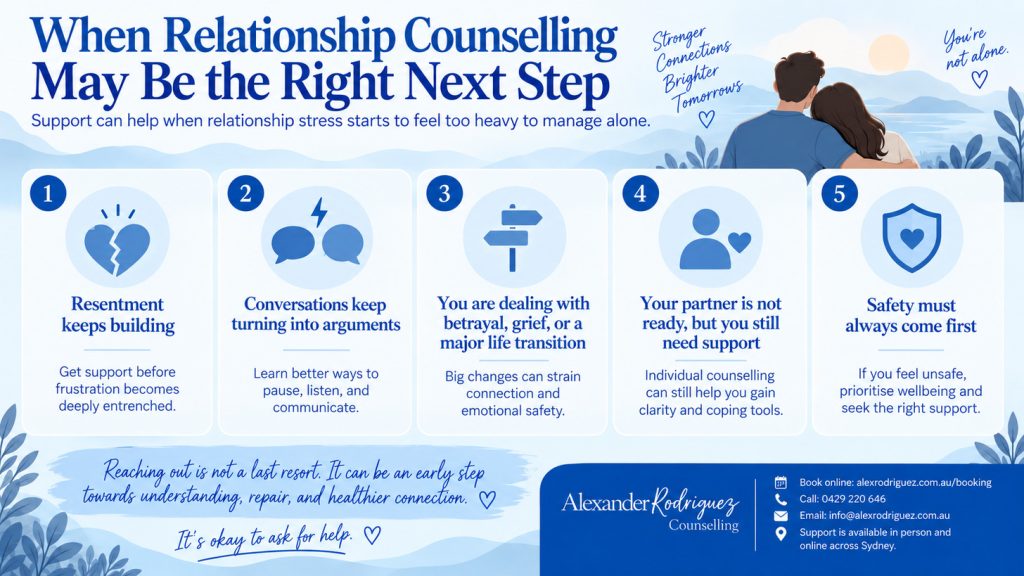
    Sometimes, relationship stress feels like too much to manage alone, and that is worth paying attention to. Noticing several relationship burnout signs together, rather than just one, is often a sign that some extra support could help.

    Relationship counselling can help you understand your feelings more clearly and give you both practical ways to move forward, rather than staying stuck in the same patterns. Reaching out at this stage is not a last resort. It is simply a supportive step towards feeling more connected again.

    Seeking help before resentment becomes entrenched

    Resentment grows slowly and can harm your relationship. If you’re keeping track of who’s wrong, it’s time to act. Relationship counselling can help you deal with these issues before they ruin your relationship.

    Getting support when conversations repeatedly become arguments

    Trying to talk but always ending in fights? This can make you feel stuck. Counselling provides a safe space to learn how to communicate better.

    Exploring counselling after betrayal, grief, or a major transition

    Big life changes can lead to feeling disconnected. Whether it’s after a betrayal, grief, or a big change, counselling can help. It helps you deal with these tough times and rebuild your relationship.

    Considering individual support when your partner is not ready

    You can start improving your relationship even if your partner isn’t ready. Seeking individual support can help you grow. This can change the whole relationship.

    Understanding when relationship safety must come first

    Your safety is always the most important thing. If you feel unsafe, your well-being comes first. Use relationship counselling in Sydney and crisis support to keep you safe.

    • Couples Counselling for communication and repair.
    • Individual support for personal clarity and growth.
    • Breakup, Separation and Divorce Counselling for supported transitions.

    Relationship Counselling Services at Alex Rodriguez Counselling

    Feeling overwhelmed in your relationship is common, and finding the right support can make a real difference. At Alex Rodríguez, we offer personalised relationship counselling designed to help you work through relationship problems in a safe, supportive space, whether you are struggling with communication, distance, or ongoing relationship stress.

    We offer sessions for individuals and couples across Sydney and Parramatta, both in person and online, making it easier to find support that fits around your life. Whether you are looking to strengthen your connection or simply understand what you are feeling, our counselling service offers practical guidance at a pace that suits you.

    Relationship Counselling for emotional exhaustion and recurring conflict

    If relationship burnout is affecting you, our sessions are here to help. We create a safe space to talk about your feelings. We’ll help you find the reasons behind your exhaustion and teach you how to handle ongoing conflicts.

    Couples Therapy for communication, connection and relationship repair

    In our couples therapy, we focus on strengthening your bond. We work on improving couples’ communication. This way, you can express your needs better and build a stronger connection.

    Couples Counselling for partners facing ongoing relationship stress

    Dealing with relationship stress can affect your mental health and daily life. We offer support to manage stress and strengthen your relationship from within.

    Marriage Counselling for long-term concerns and changing needs

    Long-term relationships face new challenges that need expert help. Our marriage counselling tackles complex issues. We help you navigate changes and meet new expectations together.

    Breakup, Separation, and Divorce Counselling for supported transitions

    Ending a relationship is tough. We offer compassionate support to help you cope with separation. We aim to help you move forward with strength and clarity.

    Family Relationship Counselling for conflict across family relationships

    Family conflicts can drain everyone. Our family-focused sessions aim to improve understanding and resolve tensions. We work to create a more supportive home environment.

    Friendship Relationship Counselling for strained or changing friendships

    Friendships are important for our well-being, but they can also face challenges. We provide guidance to help you navigate difficult changes in your friendships. We aim to restore mutual respect.

    Relationship Advice Sessions for focused guidance on a specific concern

    At times, you might need advice on a specific issue. Our relationship counselling advice sessions offer practical steps to address your concerns. We provide immediate, actionable advice.

    Finding Relationship Counselling in Sydney

    You don’t have to face relationship stress by yourself. Expert help is available close to home, right across Sydney. Finding the right local guidance is often the first step towards healing your connection.

    Alex Rodríguez offers relationship counselling for individuals and couples in Sydney, Parramatta, and surrounding areas, with both in-person and online sessions available. Wherever you are in Sydney, support is within reach when you are ready to take that step.

    Relationship Counselling Sydney Clients Can Access in a Supportive Setting

    We offer relationship counselling tailored to your needs, whether you’re facing relationship burnout or want to improve communication. Our services support couples across Greater Sydney.

    Book Online, Call, or Email Us

    Book your session online, or call us on 0429 220 646 to arrange a time that suits you. Our team is here to help you start your journey towards a healthier, more connected partnership through relationship counselling services in Sydney.

    Conclusion

    Relationship burnout is more common than many people realise, and it rarely appears out of nowhere. It builds slowly through emotional exhaustion, unnoticed signs of relationship burnout, and the quiet weight of feeling stuck in an emotionally drained relationship. Left unaddressed, ongoing relationship stress can lead to relationship fatigue and deeper emotional disconnection between you and your partner.

    The good news is that relationship problems do not mean your relationship is beyond repair. Small, consistent steps, better communication between partners, and support from a trusted counselling service can all help you find your way back to each other. Relationship counselling offers a safe, supportive space to work through what has changed and start learning how to reconnect with your partner again, at a pace that feels right for you both.

    You do not have to carry relationship burnout on your own. Relationship counselling with Alex Rodríguez offers a safe, supportive space to reconnect with your partner. Call 1300 467 513, email info@alexrodriguez.com.au, or book a consultation online to take the next step towards better wellbeing.

    FAQ

    What exactly is relationship burnout compared to just a stressful week?

    Relationship burnout is more than just a stressful week. It’s a deep emotional exhaustion that doesn’t go away with a break. It happens when the effort you put into your relationship feels unbalanced, leading to constant fatigue.

    What are the most common relationship burnout signs I should look out for?

    Signs include feeling emotionally drained and getting irritable easily. You might also feel relieved when apart or avoid closeness. Other signs are losing interest in activities and feeling stuck in the same problems.

    How does an emotionally drained relationship impact my daily life?

    It can drain your energy for work or hobbies. You might feel numb or disconnected. Simple interactions can feel like a chore due to the stress and resentment.

    Can external factors like work or finances contribute to relationship fatigue?

    Yes, outside pressures like work or money problems can add to stress. When these pressures meet unmet needs at home, it can lead to deep emotional exhaustion. This makes it hard to keep a healthy connection.

    How to reconnect with your partner when you both feel burnt out?

    Start with small steps to reconnect. Focus on brief moments of warmth and appreciation. Rebuilding routines and improving communication through counselling can help you gradually reconnect.

    Why should we consider relationship counselling support in Sydney at Alex Rodriguez Counselling?

    Relationship counselling offers a safe space to discuss problems without blame. At Alex Rodriguez Counselling in Blacktown, you can learn to identify patterns and set boundaries. It provides tools for better communication and a healthier future.

    Can I seek support if my partner isn’t ready to attend counselling yet?

    Absolutely. Individual counselling can help you understand your feelings and develop strategies. It’s a step towards recovery, even if your partner isn’t ready yet.

    Where is Alex Rodriguez Counselling located for face-to-face sessions?

    The clinic is at Suite 207a, 30 Campbell St, Blacktown, NSW 2148, Australia. You can also call 0429 220 646 for support.
  • When to Seek a Therapist: Key Signs and Next Steps

    When to Seek a Therapist: Key Signs and Next Steps

    A therapist can help you make sense of what you are feeling and give you tools to cope, whether you are going through a hard time or simply want to understand yourself better. Many people believe you only need a mental health therapist during a crisis or a serious diagnosis. In reality, support is just as valuable for everyday stress, low mood, or feeling stuck. This mindset matters more than ever. According to the Australian Bureau of Statistics, one in five Australians (21.5 per cent, or around 4.3 million people) experienced a mental health condition in a recent 12-month period. These numbers show that struggling with your mental health is common, and reaching out is a proactive and normal step, not a last resort.

    The tricky part is that signs you need therapy often build up slowly, so they can be easy to miss or brush off. You might feel constantly overwhelmed, stuck in negative thinking, or simply not like yourself anymore. Understanding these early signs can help you act before things become harder to manage. If you are ready to explore support, learning about the different types of therapy, such as talk-based counselling, and knowing how to choose a therapist who feels right for you, can make the process feel less daunting. Whether you are looking for a private practitioner or a broader mental health service, taking that first step is often the hardest part, and the most important one.

    There is no right or wrong time to start therapy or counselling. Whether you are dealing with something specific or just feel like you need to talk, support is available. Contact Alex Rodríguez to enquire about therapy and counselling services.

    Call 0429 220 646, email info@alexrodriguez.com.au, or book your consultation online.

    Key Takeaways

    • Therapy is a helpful tool for personal growth, not just for managing crises.
    • Persistent feelings of overwhelm or sadness are common signs you need therapy.
    • Recognising emotional shifts early helps you maintain better long-term wellbeing.
    • You do not need a formal diagnosis to benefit from speaking with a mental health therapist.
    • Taking the first step to reach out is a positive move towards feeling like yourself again.

    What Does a Therapist Do, and When Can Therapy Help?

    A therapist is a trained professional who helps you make sense of your thoughts, feelings, and behaviours. Working with a mental health therapist is a team effort, not something done to you. Together, you explore what is going on for you in a safe, private, and non-judgmental space. This might include stress, anxiety, grief, or simply feeling like things have become too much to carry on your own.

    Understanding the early signs you need therapy can help you reach out before things feel overwhelming. Learning about the different types of therapy available and knowing how to choose a therapist who feels like the right fit can make the process feel far less daunting. Whether you are drawn to counselling for a specific issue or a broader mental health service for ongoing support, taking that first step is often the hardest part, and the most important one.

    How a mental health therapist can support your wellbeing

    Your wellbeing is the main goal in every session. A skilled Therapist helps you spot patterns that might be holding you back. They teach you tools to better manage your emotions and thoughts.

    What counselling and therapy can help you work through

    Counselling and therapy help you tackle many personal challenges. Whether it’s internal struggles or outside pressures, these sessions offer a chance for growth.

    Emotional distress, difficult thoughts and unhelpful behaviours

    Feeling stuck in worry or negative thoughts is common. A counselling approach breaks down these feelings into smaller parts. You’ll learn to swap bad habits for better ones that support your mental health.

    Relationship, work and life changes

    Big life changes can be stressful. Whether it’s a job change, a breakup, or family issues, professional help is key. You’ll learn to communicate better and become more resilient for future challenges.

    Why you do not need to wait for a crisis

    Many think they must be in crisis to seek help. But counselling and therapy are best used as tools for growth. You can start improving your health at any time, not just when things get tough.

    Support Type Primary Focus Best For
    Counselling Current life issues Short-term problem solving
    Psychotherapy Deep-seated patterns Long-term personal growth
    Crisis Support Immediate safety Emergency intervention

    Starting therapy is a sign of strength, not weakness. Tackling small issues early can prevent them from becoming big problems. A qualified Therapist can help you stay balanced, ensuring you’re supported before things get too hard.

    When Should You See a Therapist?

    Knowing when to see a therapist is often the first step towards feeling better. Many people wonder whether their situation is “serious enough” to justify getting help, but the truth is, you do not need to wait for a crisis to reach out. Learning to recognise the early signs you need therapy can help you get support before things start to feel unmanageable.

    If your daily life, sleep, or choices are often being shaped by how you feel, that is a sign worth paying attention to. A mental health therapist offers a safe, private space to talk these things through, and can help you understand what kind of support, whether therapy or counselling, might be the right fit for you.

    Persistent anxiety, worry or panic

    Constant worry might mean it’s time for anxiety therapy. If your heart races, thoughts spin, or you have panic attacks, your nervous system is stressed.

    Low mood, hopelessness or loss of interest

    Feeling down sometimes is normal. But if you’re always feeling hopeless or lose interest in things you love, you might need help. A professional can guide you through these tough feelings.

    Anger that feels difficult to control

    Everyone gets frustrated, but uncontrolled anger can harm your life or work. Anger management counselling can help you understand and manage your anger better.

    Grief that is affecting your ability to cope

    Loss is a personal journey, and healing takes time. If your grief is making it hard to function, grief counselling provides a supportive space to work through your emotions.

    Relationship problems that keep repeating

    Stuck in the same arguments or patterns with others? Relationship counselling can help you break these cycles. It improves your communication, leading to stronger relationships.

    Stress, uncertainty or dissatisfaction at work

    Work stress can affect your home life, impacting sleep and focus. Feeling constantly drained or unsure about your job? A therapistcan help you find clarity and set better mental health boundaries.

    What Are the Signs You Need Therapy?

    Spotting the early signs you need therapy is key to feeling better before things start to feel overwhelming. We all go through ups and downs, and feeling low or stressed from time to time is a normal part of life. The difference is in how long these feelings last and how much they start to affect your day-to-day life.

    If low mood, anxiety, or stress begin to stick around rather than pass, it may be time to consider therapy or counselling support. A mental health therapist can help you understand what you are experiencing and work through it in a safe, supportive space, rather than trying to manage it alone.

    Your daily routines and responsibilities are becoming harder

    Feeling overwhelmed by simple tasks like getting out of bed or doing chores is a sign. You might find it hard to stay productive or focus on things you used to handle easily.

    Your sleep, appetite or energy has noticeably changed

    Physical changes are common mental health symptoms. If you’re sleeping too much or too little, or your appetite has changed a lot, your body might be stressed. Feeling constantly tired can also make it hard to connect with others.

    You are withdrawing from people or activities you once enjoyed

    It’s okay to want alone time, but avoiding friends and family is a warning sign. If you no longer enjoy hobbies or social events, it might mean you need help.

    You rely on alcohol, substances or avoidance to manage feelings

    Developing coping mechanisms that don’t last is common. If you’re using alcohol, substances, or avoiding problems to feel better, it’s a sign you need better strategies for your emotional wellbeing.

    You keep experiencing the same thoughts, conflicts or reactions

    Feeling stuck in a cycle is frustrating. If you keep having the same negative thoughts or conflicts, therapy can help you break these patterns and develop healthier ways of thinking.

    Friends, family or colleagues have expressed concern

    Those close to us often notice changes before we do. If your loved ones have mentioned you seem different or are worried about your mental health symptoms, listen to them.

    How long should symptoms last before you seek support?

    There’s no set time to wait before looking for therapy support. But if your distress is ongoing, getting worse, or really affecting your life, it’s time to act. Always check with a doctor first to rule out physical health issues that might be causing your signs of mental distress.

    How Do You Know Whether You Need Therapy or Immediate Help?

    Understanding the difference between planned support and immediate help can be an important, and sometimes life-saving, distinction. Therapy and counselling are designed to help you manage ongoing emotional challenges, such as stress, anxiety, low mood, or difficult life transitions, over time. They are not designed to respond to acute emergencies or moments of crisis.

    If you or someone you know is in immediate danger, or experiencing thoughts of self-harm, please contact Lifeline on 13 11 14 or Beyond Blue on 1300 22 4636, or call 000 in an emergency. For ongoing support, finding the right mental health service, whether that is a mental health therapist or a counsellor, can help ensure you get the type of care that matches your situation.

    Recognising the difference between ongoing distress and an emergency

    Ongoing distress lasts weeks or months, like feeling low, anxious, or having relationship issues. These are usually handled through regular sessions with a professional. An emergency is when you feel you can’t keep yourself safe right now.

    What to do if you are worried about self-harm or suicide

    If you’re thinking about harming yourself, know you’re not alone, and help is available. Asking for self-harm support is brave and necessary. You don’t have to face these feelings alone, and professionals are trained to listen without judgment.

    When to contact a GP, NHS service or urgent mental health team

    If your mental health is getting worse but you’re not in danger, start with your GP. They can refer you to an urgent mental health support team if needed. These services help between routine care and emergency help.

    How to respond if someone else may be at immediate risk

    If you’re worried about someone, your main goal is their safety. Encourage them to talk to a professional or sit with them while they call. If they’re in distress, staying calm and present can help a lot.

    Call 999 or attend A&E when there is immediate danger

    If someone is in danger of hurting themselves or others, don’t wait. Call 999 or go to A&E right away. Emergency services are ready to respond quickly in a crisis.

    Which Types of Therapy Could Address Your Concerns?

    Wondering which type of therapy might be right for you is a completely normal part of getting started. Everyone experiences life differently, and what helps one person may not suit another. This is why there are several types of therapy available, each designed to support different needs, challenges, and personal preferences.

    Understanding a little about these approaches can help you feel more prepared and less unsure when reaching out for the first time. Whether you are looking for counselling to work through a specific issue or ongoing support from a mental health therapist, knowing your options makes it easier to find a mental health service that genuinely fits what you are going through.

    Depression and anxiety therapy for persistent worry and low mood

    Feeling trapped in fear or sadness? Depression and anxiety therapy can help. It focuses on changing negative thoughts. You’ll learn new ways to cope with your feelings every day.

    Anger management counselling for intense or escalating anger

    Feeling like your emotions are out of control? Anger management counselling is here to help. You’ll learn to spot triggers before anger takes over. This way, you can express your needs without hurting yourself or others.

    Relationship counselling for communication and recurring conflict

    Relationship counselling is for anyone wanting better connections. It’s not just for couples in trouble. You’ll learn to listen better and share your feelings clearly and kindly.

    Grief and loss counselling after bereavement or major change

    Feeling lost after a big change? Grief and loss counselling offers support. It’s a safe place to process your feelings. You’ll slowly adjust to your new life.

    Career counselling for work-related uncertainty and decisions

    Feeling stuck at work? Career counselling can help. It helps you find your professional values and grow. You’ll make choices that support your long-term happiness.

    How your therapist can tailor counselling to your goals

    A good therapist sees you as an individual, not just symptoms. They’ll tailor their approach to fit you. They adapt their methods to keep sessions relevant and helpful.

    Why the right approach may change as your needs develop

    Your needs can change over time in therapy. What you need at first might be different later. Your therapist will check your goals often to ensure you’re getting the right support.

    Therapy Type Primary Focus Key Benefit
    Anxiety/Depression Thought patterns Improved mood stability
    Anger Management Emotional regulation Reduced conflict
    Relationship Communication skills Stronger connections
    Career Professional clarity Increased job satisfaction

    What Should You Consider When Choosing a Therapist?

    Starting therapy is a big step, and finding the right person to support you can feel just as important as the decision to start. Knowing how to choose a therapist is not just about picking a name from a list. It is about finding someone whose approach, experience, and manner genuinely fit your personal needs.

    The right mental health therapist or counselling professional is someone you feel comfortable opening up to, who understands the specific challenges you are facing, and whose way of working suits how you like to process things. Taking a little time to consider this can make a real difference to how supported you feel throughout your journey with a mental health service.

    Check the therapist’s qualifications, experience and professional registration

    Make sure your therapist is well-trained. Look for therapist qualifications from respected bodies.

    Check if they are professionally registered with groups like the BACP or UKCP. These groups make sure therapists follow strict rules and ethics.

    Look for experience with your specific concern

    Therapists work differently. Some deal with trauma, others with stress or relationships.

    Ask about their experience with your issue. Feeling understood right away shows they’re a good fit.

    Consider confidentiality, boundaries and safeguarding arrangements

    Your safety and privacy are key. A good therapist will explain how they protect your data and confidentiality.

    They should also talk about their safety policies. Knowing these helps you feel safe to share openly.

    Ask whether online or in-person appointments suit your circumstances

    Today, therapy is more flexible than ever. You might prefer online therapy at home or face-to-face sessions.

    • Think about travel time and accessibility.
    • Consider your comfort with digital platforms.
    • Make sure your space for online sessions is private and quiet.

    Compare availability, fees, cancellation terms and session length

    Practical details matter too. Make sure counselling fees fit your budget for the long haul.

    Know the cancellation policy to avoid surprises. Understanding session length helps plan your week better.

    Trust the importance of comfort and a respectful therapeutic relationship

    The best therapy makes you feel genuinely heard and respected. If you don’t click with someone, it’s okay to look elsewhere.

    Your comfort is crucial. Trust your gut when choosing a therapist for your journey.

    How Can You Prepare for Your First Therapy Session?

    Deciding to seek support is a big step, and it is normal to feel a little nervous before your first session. Taking some time to prepare beforehand can help you feel more comfortable and settled when the day arrives.

    Your therapist is there to support you in a safe, non-judgmental space, so there is no need to have everything figured out in advance. Whether you are starting counselling or ongoing therapy with a mental health therapist, simply showing up and being open to the process is enough for a first session at any mental health service.

    Write down the main reasons you are seeking support

    You don’t need to write a detailed story or script. Just jotting down a few reasons why you’re seeking support can be really helpful. This helps you focus before you go.

    Notice the situations, thoughts and feelings you want to discuss

    Before your first therapy session, pay attention to what makes you feel upset. Noticing these patterns can give your therapist valuable insights. Keep a note on your phone to capture these emotional support needs as they come up.

    Identify what you would like to change or understand

    Think about what you hope to get out of therapy. Maybe you want to manage stress, improve relationships, or just understand yourself better. Having some idea of your goals is a good start. These goals can change as you go along.

    Bring relevant questions without feeling pressure to have everything organised

    It’s okay to bring a list of questions to your first therapy session. You might want to ask about the therapist’s approach or how they keep things confidential. There’s no pressure to have everything planned out; your therapist will guide the conversation.

    What to expect if discussing personal experiences feels uncomfortable

    Talking about your life can be tough or emotionally taxing. It’s normal to feel vulnerable. Your therapist will work at a pace that feels right for you.

    You can ask to pause, clarify or revisit a difficult topic

    If you feel like things are moving too fast, you can always stop. You can ask to pause, clarify something, or come back to a tough topic later. Remember, your emotional support and comfort are key to reaching your therapy goals.

    What Can You Expect from Therapy After You Begin?

    Starting therapy is a big step, and finding the right person to support you can feel just as important as the decision to start. Knowing how to choose a therapist is not just about picking a name from a list. It is about finding someone whose approach, experience, and manner genuinely fit your personal needs.

    The right mental health therapist or counselling professional is someone you feel comfortable opening up to, who understands the specific challenges you are facing, and whose way of working suits how you like to process things. Taking a little time to consider this can make a real difference to how supported you feel throughout your journey with a mental health service.

    How therapist and client agree on goals and priorities

    At the start, you and your therapist set clear counselling goals. This ensures your sessions focus on what’s important to you. By setting priorities, you create a plan for your personal growth.

    Why progress can include setbacks as well as improvements

    Remember, therapy progress isn’t always smooth. You might feel better one day and struggle the next. These ups and downs are part of the healing journey, not failures.

    How you can review whether therapy is helping

    Checking your progress regularly is key. Ask yourself if you’re gaining new insights or feeling more capable. If you’re feeling stuck, talk about it in your sessions to find a better path.

    When to discuss changing the approach or seeking another therapist

    If the types of therapy aren’t working for you, it’s okay to say so. Your therapist will respect your decision to try something new or seek another practitioner.

    How counselling can support practical changes between sessions

    The work you do in sessions can impact your daily life. Your therapist will help you apply what you learn to real situations, ensuring your growth is lasting.

    Building skills for emotional regulation, communication and coping

    You’ll learn emotional regulation techniques to manage intense feelings. You’ll also develop coping strategies to handle stress better. These skills improve your communication and help you build stronger relationships.

    Stage of Therapy Primary Focus Expected Outcome
    Initial Assessment Goal setting Clear direction
    Active Sessions Skill building Improved resilience
    Review Phase Progress tracking Adjusted strategies
    Maintenance Long-term growth Lasting change

    How Can Alex Rodriguez Counselling and Therapy Support You?

    Life’s challenges can be tough to face alone, and you do not have to carry them by yourself. Alex Rodriguez Counselling and Therapy offers a safe, supportive space where you can explore your thoughts and feelings without fear of judgement, at a pace that feels right for you.

    Whether you are looking for counselling to work through a specific concern or ongoing support from a mental health therapist, the goal is to help you feel heard, understood, and equipped with practical strategies to move forward. As a mental health service, the focus is on personalised, compassionate support tailored to what you are going through, not a one-size-fits-all approach.

    Support for anxiety, depression, grief, relationships, anger and career concerns

    Our practice provides a wide range of mental health services tailored to your needs. Whether you’re struggling with worry or major life changes, we’re here to guide you.

    Anger Management Counselling with Alex Rodriguez Counselling and Therapy

    Feeling angry all the time? Anger management counselling can help. We teach you to recognise what makes you angry and how to express your feelings in a healthier way.

    Relationship Counselling for communication and connection

    Good communication is key to a strong relationship. Through relationship counselling, you and your partner can learn to handle conflicts better. You’ll also work on rebuilding trust and deepening your connection.

    Depression and Anxiety Therapy for emotional wellbeing

    Dealing with stress or feeling down all the time can be draining. Our depression and anxiety therapy sessions offer practical tips to boost your emotional health. We help you find balance again.

    Grief and Loss Counselling during bereavement and transition

    Grief is a personal journey that sometimes needs extra support. Our grief and loss counselling offers a caring space to deal with your emotions during tough times.

    Career Counselling for work and professional decisions

    Work stress or doubts about your career can affect your whole life. Career counselling helps you make clear decisions. It ensures your work aligns with your personal values.

    Conclusion

    Starting your journey towards better mental health can feel scary, but you do not have to face it alone. Noticing that your daily habits, sleep, or feelings have shifted is a significant realisation in itself, and recognising these early signs you need therapy is often the hardest and most important part of the process. Reaching out to a mental health therapist gives you a safe, confidential space to talk openly about what you are experiencing, whether that is grief, work-related stress, constant worry, or simply feeling unlike yourself. Depending on what you are working through, different types of therapy or counselling approaches, and knowing how to choose a therapist who feels like the right fit, can offer practical tools to help you move forward through a trusted mental health service.

    If you are feeling overwhelmed, please remember that support is always available. You can take the first step today by reaching out for a therapy or counselling consultation. Before your first session, it can help to jot down what you are hoping to get out of therapy, or any questions you have, as this small step of preparation can make starting the process feel a little less daunting.

    There is no right or wrong time to start therapy or counselling. Whether you are dealing with something specific or just feel like you need to talk, support is available. Contact Alex Rodríguez to enquire about therapy and counselling services.

    Call 0429 220 646, email info@alexrodriguez.com.au, or book your consultation online.

    FAQs

    How do you know if you need to see a therapist?

    The most common signs you need therapy include feeling persistently overwhelmed, noticeable changes in sleep or appetite, ongoing low mood, or losing interest in things you used to enjoy. If your usual ways of coping are not helping anymore, or you find yourself avoiding people or responsibilities, it may be time to speak with a professional.

    Do you have to wait for a crisis before starting therapy?

    No, you do not need to wait until things feel unmanageable. Therapy and counselling can support you with everyday stress, low mood, or difficult life changes, not just major crises. Seeking support earlier often makes challenges easier to work through before they build up.

    What is the difference between needing therapy and needing immediate help?

    Therapy is designed for ongoing, scheduled support, not emergencies. If you or someone you know is at immediate risk, or experiencing thoughts of self-harm, please contact Lifeline on 13 11 14 or Beyond Blue on 1300 22 4636, or call 000. For everything else, a mental health service can help guide you towards the right kind of ongoing support.

    How do I choose the right therapist for my situation?

    Knowing how to choose a therapist starts with checking their experience with the concern you are facing, whether that is anxiety, relationships, grief, or anger. Just as important is how comfortable and understood you feel when talking to them. It is completely normal to need a session or two to work out if it feels like the right fit.

    What types of therapy are available?

    There are several types of therapy, and the right approach depends on what you are working through and what feels most comfortable for you. This can include depression and anxiety therapy, relationship counselling, grief and loss counselling, career counselling, and anger management counselling.

    Do I need a formal diagnosis to start therapy or counselling?

    No, a diagnosis is not required to benefit from counselling or therapy. Many people seek support for life changes, work stress, relationship difficulties, or simply wanting a space to talk things through, with or without a specific diagnosis.

    What should I do if I need urgent help rather than a scheduled session?

    If you are in crisis or feel at risk, please do not wait for a scheduled appointment. In Australia, call 000 in an emergency, or contact 24/7 support lines such as Lifeline on 13 11 14 or Beyond Blue on 1300 22 4636. Therapy is well suited to ongoing support, but your safety always comes first.

    How will I know if therapy is actually helping?

    Progress in therapy is not always a straight line, and some setbacks along the way are a normal part of the process. Checking in regularly with your mental health therapist about how you are feeling, and being open if something is not working, helps ensure the support stays relevant to your needs.