Blog

  • Allied Health Assistant vs Support Worker: Key Differences

    Allied Health Assistant vs Support Worker: Key Differences

    Allied Health Assistants and Support Workers have different roles; it can feel confusing at first, especially if we are choosing a career path or trying to understand who is doing what in an Australian care setting and how it can be applicable for us. In Australia, the need for practical support is high, with the Australian Bureau of Statistics reporting 5.5 million people (21.4%) were living with disability.

    The NDIS has also grown quickly, with official reporting showing more than 739,000 participants receiving support. With so many people relying on support every day, it helps to know which role fits which needs, and why the titles are not interchangeable.

    If you are comparing roles, it usually comes down to three things: what each person is allowed to do, who supervises the work, and the difference in qualifications expected for the setting. Allied Health Assistants often support therapy programs that are designed and overseen by allied health professionals, while Support Workers usually focus on day-to-day help like personal care, routines at home, and community access.

    Both matter in real life, but they sit in different parts of the care system, and they may work under different rules depending on the workplace. This guide breaks down the key differences in responsibilities and expectations across care support roles, so it is easier to understand which role suits the support needed, and which pathway makes sense for a future job in health and disability services.

    Call on 0429 220 646, or email info@alexrodriguez.com.au to take the first step, or book a session online; the booking page lets you schedule on-site or online appointments for flexibility. We know how vital a positive outlook is, and our services aim to help people see life in a brighter light.

    Key Takeaways

    • AHAs support therapy tasks under supervision. Support Workers support daily living.
    • The difference in qualifications matters and shapes what each role can do.
    • NDIS funding and documentation work best when roles stay clear and in scope.
    • Pay and career growth vary by setting, award level, and shift penalties across care support roles.

    The Evolving Landscape of Healthcare Support in Australia

    The roles for an allied health assistant or a support worker are becoming a more important comparison as Australia’s health and disability system shifts towards community-based care and home-based supports. Demand is rising across hospitals, clinics, aged care, disability services, and mental health support, and that growth is closely linked to two big national pressures: an ageing population and higher levels of disability-related need. In 2022, the Australian Bureau of Statistics reported 5.5 million Australians (21.4%) had disability, which increases demand for both therapy services and practical assistance delivered in everyday settings. The allied health workforce has also grown substantially. The Australian Institute of Health and Welfare reported that allied health practitioners increased from 108,680 to 180,924, showing how quickly the sector is expanding alongside community need.

    As care shifts into homes and communities, the roles supporting this system become more visible and more specialised. This is where a clear aha vs sw role comparison matters. Allied Health Assistants often work within therapy teams and support treatment plans under professional supervision, while Support Workers typically provide day-to-day help with routines, personal care, transport, and community participation within care support roles. Understanding the difference in qualifications, scope, and supervision requirements helps you choose the pathway that matches your strengths, preferred work environment, and long-term career direction.

    Recent Changes in the Australian Healthcare System

    Australia’s healthcare has seen big changes lately. There’s a focus on personalised care and support services. This has led to a higher need for workers who can offer top-notch support in different places.

    The role of Allied Health Assistants has grown. They now play a key role in delivering care and support. Support Workers are also being used more to give vital services to those who need them.

    This shift shows a bigger trend towards community-based care. It aims to help people live independently. As healthcare keeps changing, these roles will likely become even more important.

    What Is an Allied Health Assistant?

    An Allied Health Assistant (AHA) supports allied health professionals, such as occupational therapists, physiotherapists, and speech pathologists, by helping deliver parts of a client’s therapy program under supervision. In practice, this can include preparing therapy spaces and equipment, assisting with exercises or activities that have been planned by the clinician, documenting basic session details, and helping clients practise functional skills in a safe, structured way.

    While the role is hands-on and client-facing, AHAs work within clear boundaries, follow clinical instructions, and escalate concerns to the supervising professional when needed. The clinician documents basic session details and helps clients practise functional skills in a safe, structured way. While the role is hands-on and client-facing, AHAs work within clear boundaries, follow clinical instructions, and escalate concerns to the supervising professional when needed.

    Definition and Core Responsibilities

    An Allied Health Assistant (AHA) works closely with professionals like occupational therapists and physiotherapists. Their main tasks include:

    • Helping with therapy and exercises
    • Supporting with daily tasks
    • Keeping the environment safe and supportive
    • Recording progress and sharing it with supervisors

    Work Settings and Environments

    Allied Health Assistants work in many places, like hospitals and aged care homes. Their work settings can be very different, from busy hospitals to community services.

    Case Example: AHAs in Occupational Therapy

    In occupational therapy, AHAs are key in helping clients with special needs. For example, they might help someone who’s recovering or managing a long-term condition. They assist with tasks like cooking or getting dressed in a supportive setting.

    Learning about the role of an Allied Health Assistant shows how important they are to healthcare.

    What Is a Support Worker?

    A Support Worker helps people manage everyday life, especially when disability, ageing, mental health, or illness makes daily tasks harder. Support can include personal care (such as showering and dressing), meal preparation, cleaning, shopping, transport, and support to attend appointments or participate in the community. In many settings, Support Workers also provide social support and companionship, helping clients feel safer, more connected, and more confident at home and in public.

    Support Workers typically follow an agreed support plan that outlines goals, routines, preferences, and safety needs. Depending on the service, they may contribute observations that help inform updates to that plan, but clinical assessment and therapy planning are usually handled by qualified health professionals.

    Definition and Key Functions

    Support Workers help those who need daily assistance. Their main tasks include:

    • Assisting with personal care, such as bathing and dressing
    • Helping with household chores, like cleaning and laundry
    • Providing companionship and emotional support
    • Assisting with meal preparation and nutrition

    Common Employment Settings

    Support Workers work in many places, including:

    • Private homes
    • Residential care facilities
    • Community centers
    • Hospitals

    Case Example: Support Workers in Daily Living Assistance

    Imagine an elderly person living alone who needs help. A Support Worker visits to assist with shopping, cooking, and cleaning. They also spend time chatting and doing activities the client likes. This support helps the client stay independent and happy.

    Allied Health Assistant vs Support Worker: Direct Comparison

    When comparing an allied health assistant vs support worker, it helps to look at what each role is actually responsible for on shift, what tasks are in scope, and who provides direction. Both roles support people to live better day to day, but they operate in different parts of the care system.

    An Allied Health Assistant usually works within a therapy team and supports a clinician-delivered plan under supervision, while a Support Worker focuses on daily living assistance and community participation based on an agreed support plan. Understanding these differences upfront makes an aha vs sw role comparison clearer, especially when considering care support roles, the difference in qualifications, and long-term career fit.

    Scope of Practice and Authority Boundaries

    Allied Health Assistants work with the help of experts like physiotherapists. They help carry out treatment plans. They can’t make decisions on their own, though.

    Support Workers, on the other hand, might work alone more. They help people with everyday tasks and sometimes check their health. How much freedom they have depends on where they work.

    Key differences in scope of practice include:

    • Allied Health Assistants help with therapy and support treatment plans.
    • Support Workers focus on personal care and daily tasks, and sometimes health checks.

    Supervision Requirements and Professional Autonomy

    Allied Health Assistants need more supervision than Support Workers. They must work closely with a qualified expert. Support Workers might have less supervision, depending on their job and the person they’re helping.

    Practical scenarios can help illustrate these differences:

    Practical Scenarios Illustrating Key Differences

    Imagine a client needs help with physical therapy. An Allied Health Assistant, supervised by a physiotherapist, is the right choice. But for help with daily tasks like bathing, a Support Worker is better.

    Role Scope of Practice Supervision Level
    Allied Health Assistant Therapeutic interventions, clinical treatment plans High (direct supervision)
    Support Worker Personal care, daily living activities Variable (less direct supervision)

    Knowing these differences helps you choose the right support. It’s important for your needs or the needs of your clients.

    Qualification and Training Pathways

    When comparing allied health assistant vs support worker, the biggest difference often shows up in the difference in qualifications and how training aligns with day-to-day responsibilities. Both are important care support roles, but they prepare you for different types of work and different levels of supervision.

    As an Allied Health Assistant, you will usually follow a training pathway that focuses on supporting therapy services safely and accurately under clinical direction. Qualifications commonly include a Certificate III or Certificate IV in Allied Health Assistance, with units that build skills in working within a therapy team, following treatment instructions, and supporting structured programs.

    As a Support Worker, you will more often complete training that focuses on personal care, community participation, and practical daily living support. Common pathways include Certificate III in Individual Support (Ageing, Disability, or Home and Community) or related community services qualifications. This pathway tends to prioritise communication, duty of care, safe manual handling, and person-centred support.

    This aha vs sw role comparison makes it easier to choose a pathway that fits the type of support work you want to do, the environment you want to work in, and the level of clinical structure you prefer within care support roles.

    Allied Health Assistant Certification in Australia

    In Australia, you need a certificate or diploma to be an Allied Health Assistant. These courses are at registered training organisations (RTOs) all over the country. They teach you about patient care, talking to people, and basic medical tasks.

    Key components of Allied Health Assistant training include:

    • Clinical skills training
    • Workplace safety and infection control
    • Effective communication techniques

    Support Worker Educational Requirements

    Support Workers might not need formal qualifications to start working. But having a certificate III or IV in individual support or a related field helps. Many Support Workers also do specialised training in areas like disability support or aged care.

    Recognition of Prior Learning Considerations

    Both Allied Health Assistants and Support Workers can use Recognition of Prior Learning (RPL). RPL lets you get credit for skills and knowledge from work, volunteering, or other training. This can make getting formal qualifications faster and cheaper.

    When deciding between these roles, think about your career goals and what each role needs. While Allied Health Assistants often need formal qualifications, Support Workers might have easier entry points.

    NDIS Considerations and Funding Models

    NDIS Considerations and Funding Models sit at the centre of any allied health assistant vs support worker decision, because NDIS funding rules shape what gets delivered, how it is recorded, and what level of oversight is required across care support roles. In the NDIS, supports are grouped into budgets such as Core Support, Capacity Building Support, and Capital Support, and those categories influence whether a support is considered day-to-day assistance, skill-building and therapy-related work, or equipment and home modifications.

    That structure matters in an AHA vs. SW role comparison because Support Worker shifts are commonly tied to practical daily support and community participation, while an Allied Health Assistant role is more often connected to therapy programs that are delegated by a qualified clinician and delivered within clear clinical boundaries. This is also where the difference in qualifications becomes more than a hiring requirement, because training, supervision expectations, and scope of practice need to align with how support is funded and claimed. When funding categories, support descriptions, and documentation all match, services run smoothly, participants get consistent support, and teams avoid avoidable compliance issues that can arise when roles are blurred.

    How NDIS Categorises These Roles

    The NDIS sorts Allied Health Assistants and Support Workers by their roles and services. Allied Health Assistants fall under ‘Therapeutic Supports’ as they assist allied health professionals. Support Workers might be in different categories, like ‘Daily Personal Activities’ or ‘Community Participation.’

    Funding Allocations and Service Agreements

    Funding for Allied Health Assistants and Support Workers comes from the participant’s NDIS plan. The plan lists the needed supports and services and the allocated funds. Service agreements are then made between the participant and the provider. These agreements cover the service details, including what’s included, who’s responsible, and how it’s paid.

    Navigating NDIS Provider Requirements

    To be an NDIS provider, Allied Health Assistants and Support Workers must meet certain criteria. This includes being registered and certified. “The NDIS Commission sets out the standards and requirements for NDIS providers,” highlighting the need for quality and safety. Meeting these standards is essential for getting funding and offering effective support.

    Understanding NDIS categorisation, funding, and service agreements helps Allied Health Assistants and Support Workers. They can then provide top-notch support to NDIS participants.

    Career Development and Professional Growth

    If you are weighing up allied health assistant vs support worker, it helps to think beyond your first role and look at where each pathway can take you. As demand across disability, aged care, and community health services continues to grow, you will find more chances to specialise, build confidence in complex situations, and move into higher-responsibility positions within care support roles.

    In an aha vs sw role comparison, your growth can look quite different depending on the role you choose. If you start as an Allied Health Assistant, you can build experience supporting therapy programs, develop stronger clinical communication, and move into more specialised settings as your skills expand. If you start as a Support Worker, you can grow into supporting higher needs clients, take on mentoring or senior shifts, and progress into coordination-style work where you help keep services consistent and goal-focused. In both pathways, the difference in qualifications matters because extra training and targeted certificates can increase your scope, employability, and long-term career options.

    Career Progression for Allied Health Assistants

    Allied Health Assistants can move up to senior positions or focus on certain areas like physiotherapy. With more experience and training, they can handle more complex tasks. This can lead to better pay and job satisfaction. Career advancement opportunities come from more education and certifications.

    Advancement Opportunities for Support Workers

    Support Workers can also grow by learning new skills or becoming managers. Many places offer training and chances to improve skills. Professional growth comes from always learning and keeping up with new tech and care methods.

    Success Stories and Career Path Examples

    Take the case of an Allied Health Assistant who worked hard and got a special physiotherapy role. Support Workers have also become leaders, leading teams and helping create care plans. These stories show the chances for career development and growth in these jobs.

    Salary Expectations and Job Market Analysis

    allied health assistant and support worker pay can look similar at first glance, but once you do an aha vs sw role comparison, the differences start to show. Your earning potential is shaped by where you work (public hospital, private clinic, community, aged care, disability), how your role is classified under an award or enterprise agreement, and whether you pick up penalties (evenings, weekends, sleepovers) or casual loadings. The difference in qualifications also matters, because more structured, delegated therapy support work often comes with clearer competency expectations and progression pathways, while broader care support roles can vary widely depending on the provider and the type of support delivered.

    Comparative Pay Scales Across Australia

    Salaries for Allied Health Assistants and Support Workers vary in Australia. This is due to the location and the employer. Salaries range from $45,000 to over $60,000 a year. This depends on experience, qualifications, and job specifics.

    Role Best available Australia-wide pay indicator Source
    Allied Health Assistant Typical advertised salary range is $65,000 to $75,000 SEEK salary guide.
    Support Worker (closest standard category: Aged and Disabled Carers) Median weekly earnings $1,564 (full-time median; 60% part-time share) Jobs and Skills Australia occupation profile.
    Support Worker (same category, alternate government view) $1,564 per week average salary figure shown for this occupation Australian Government YourCareer profile.

    Employment Trends and Future Outlook

    Job prospects for Allied Health Assistants and Support Workers are good. This is due to an ageing population and the need for more healthcare services. The outlook is bright, with opportunities in both public and private sectors.

    Private vs Public Sector Employment

    Choosing between the private and public sectors affects your salary and job security. Private employers might offer better pay. Public sector jobs, however, provide more job security and benefits.

    Making the Right Choice for Your Healthcare Needs

    Choosing the right support matters because it shapes the care received day to day. In an allied health assistant vs support worker decision, the best fit depends on the type of help needed. If support is required with daily routines like personal care, meals, cleaning, transport, or community access, a Support Worker is usually the better match. If support is needed to build specific skills through a structured therapy program, an Allied Health Assistant may be more suitable because the work is linked to a clinician’s plan and supervision. This aha vs sw role comparison helps keep care support roles clear, supports safe service delivery, and improves outcomes, especially when NDIS funding is involved.

    When to Engage an Allied Health Assistant

    An Allied Health Assistant is perfect for those needing help with health issues like rehabilitation or physiotherapy. They work with allied health professionals to help with therapy and daily tasks.

    Situations Best Suited for Support Workers

    Support Workers are great for personal care and daily tasks like bathing or dressing. They’re good for people needing help with daily activities but not needing the special care of an Allied Health Assistant.

    Accessing Occupational Therapy Services Through Our Team

    Our team provides occupational therapy services for everyone. With our Allied Health Assistants, you get top-notch support and therapy. Contact us today to learn more about our services and how we can support you.

    Conclusion

    Understanding the difference between an allied health assistant vs support worker helps you make a clearer, more confident choice for your needs. A more confident choice for your needs. An Allied Health Assistant usually supports a structured therapy plan under clinical supervision, while a Support Worker focuses on practical, everyday help such as personal care, household routines, transport, and community participation. Once these boundaries are clear, it becomes easier to match the right role to the right outcome.

    Whether you are considering a career pathway or organising care for yourself or a family member, a strong aha vs sw role comparison reduces confusion, supports safer service delivery, and helps ensure supports align with funding and goals across care support roles. The key is choosing the role that fits the level of structure needed, the setting in which support will happen, and the type of progress you want to see, while keeping the difference in qualifications and supervision requirements in mind.

    Call on 0429 220 646, or email info@alexrodriguez.com.au to take the first step, or book a session online; the booking page lets you schedule on-site or online appointments for flexibility. We know how vital a positive outlook is, and our services aim to help people see life in a brighter light.

    FAQ

    What is the main difference between an Allied Health Assistant and a Support Worker?

    Allied Health Assistants help with specific therapies under supervision. Support Workers assist with daily living tasks.

    What qualifications do I need to become an Allied Health Assistant in Australia?

    You need a Certificate III or IV in Allied Health Assistance. This includes training in occupational therapy.

    How do Support Workers differ from Allied Health Assistants in terms of their role?

    Support Workers help with daily tasks like personal care and household chores. Allied Health Assistants support specific therapies under supervision.

    Are Allied Health Assistants and Support Workers funded by the NDIS?

    Yes, both can be funded by the NDIS. Funding depends on the individual’s needs and goals.

    What are the career development opportunities for Allied Health Assistants and Support Workers?

    Allied Health Assistants can move to senior roles or specialize. Support Workers can take on more responsibility or become Allied Health Assistants.

    How do I decide whether to engage an Allied Health Assistant or a Support Worker for my healthcare needs?

    Choose an Allied Health Assistant for specific therapies. Pick a Support Worker for daily living tasks. Healthcare professionals can help decide.

    What are the salary expectations for Allied Health Assistants and Support Workers in Australia?

    Salaries vary by location, experience, and employer. Allied Health Assistants usually earn more due to their training.

    Can Support Workers perform tasks that are typically the domain of Allied Health Assistants?

    No, Support Workers should not do tasks that need Allied Health Assistant training. Their roles are different.

    What kind of supervision is required for Allied Health Assistants?

    Allied Health Assistants work under allied health professionals. These professionals supervise and delegate tasks.

  • Counselling vs Therapy: Which Is Right for Managing Anxiety and Depression?

    Counselling vs Therapy: Which Is Right for Managing Anxiety and Depression?

    Managing anxiety and depression is a growing concern for many Australians, with mental health challenges becoming more visible across all age groups. As awareness increases, so does the need to understand the types of professional support available. Two of the most common approaches—counselling and therapy—offer distinct pathways to recovery, each with unique methods, goals, and qualifications. Knowing the difference between them is essential for making informed decisions about the kind of support that best fits your needs. Managing anxiety and depression can feel overwhelming. But, getting professional help is a key step towards recovery.

    At Alex Rodriguez Life Coaching & Counselling, I know how vital it is to find the right support. That’s why I offer custom Depression & Anxiety Counselling services. They’re designed to meet your specific needs.

    I’ve helped many people on their journey to wellness. I’m dedicated to creating a safe and caring space. Whether you’re dealing with anxiety or depression, I’m here to help you find a lasting positive change.

    Key Takeaways

    • Understand the difference between counselling and therapy for managing mental health.
    • Discover the benefits of personalised Anxiety Counselling and Depression Counselling.
    • Learn how to choose the right support for your unique needs.
    • Find out how professional help can lead to lasting positive change.
    • Explore the importance of seeking support for anxiety and depression.

    The Mental Health Landscape in Australia

    Australia is seeing a big change in its mental health scene where Anxiety and depression are major concerns. Australia’s mental health landscape is marked by growing public awareness, increasing demand for support services, and a national push toward early intervention and holistic care. Mental health has become a major public health priority, driven by social, economic, and cultural pressures that affect individuals across all age groups. While government initiatives like Medicare’s Better Access have improved access to treatment, challenges remain—particularly in rural and remote areas. Community-based programs, digital mental health tools, and integrated service models are now playing a critical role in supporting Australians to seek help earlier and more effectively. In such circumstances it’s key to grasp the current mental health situation in Australia. Australia is seeing a big change in its mental health scene. Anxiety and depression are major concerns. It’s key to grasp the current mental health situation in Australia.

    Current Statistics on Anxiety and Depression

    In a recent study statistics reveal a concerning rise in mental health challenges across Australia, with the Australian Bureau of Statistics reporting that about 1 in 5 Australians (22%, or 4.3 million people aged 16–85) experienced a mental disorder in the past year, and anxiety disorders remain the most common, affecting 17.2% of the population. Depression and other affective disorders impact around 7.5%, while young people are particularly vulnerable—almost three-quarters of Australian adolescents experience significant symptoms of depression or anxiety at some point during their teenage years, with girls at higher risk than boys. These figures underscore the importance of seeking help, and if you’re struggling, expert support is available through mental health professionals specializing in anxiety counselling and related services.

    The Spectrum of Available Support Options

    If you’re struggling with anxiety or depression, you’re not alone—and there are many ways to get support. Whether it’s counselling, therapy, or life coaching, help is available. Personally, I offer a safe and confidential space where you can talk openly about what you’re going through and start learning practical ways to cope. If you’re ready to take that first step, feel free to call me on 0429 220 646 or book your counselling session with me.

    Defining Professional Counselling in the Australian Context

    In Australia, professional counselling plays a vital role in supporting mental health. It offers a safe, confidential space where you can talk openly about what’s on your mind. At Alex Rodriguez Life Coaching & Counselling, I’m committed to upholding the highest standards of care—ensuring you feel heard, supported, and empowered every step of the way.

    Core Principles and Methodologies

    Professional counselling in Australia is based on empathy, privacy, and focusing on the client. My methods are backed by science and tailored to each client’s needs.

    • Client-centered practice
    • Evidence-based interventions
    • Cultural sensitivity and awareness

    Qualifications and Regulatory Framework in Australia

    In Australia, counselling is a self-regulated profession, meaning there are no legal requirements for specific qualifications or registration. However, most employers and clients expect counsellors to have relevant qualifications and be registered with a professional body. The two main associations that set standards for education, ethical practice, and ongoing professional development are the Australian Counselling Association (ACA) and the Psychotherapy and Counselling Federation of Australia (PACFA).

    Qualification Regulatory Body Level of Practice Notes
    Certificate IV in Counselling ACA Entry-level support Foundational skills for support roles; not sufficient for full counselling practice
    Diploma of Counselling ACA General Counselling Prepares for general counselling roles; registration with ACA possible
    Bachelor’s Degree ACA, PACFA Advanced Counselling Required for advanced roles and PACFA registration; includes supervised practice
    Graduate Diploma/Master’s ACA, PACFA Specialist/Clinical For specialist or clinical roles; meets highest standards for registration

    Understanding Therapy and Psychological Treatment

    Learning about therapy and psychological treatment can change lives for those with anxiety and depression. Therapy helps people manage their mental health by tackling deep issues and teaching coping skills.

    Common Therapeutic Modalities

    Therapy comes in many forms, each aimed at different mental health problems. Some well-known ones are:

    These methods can be used alone or together, based on what each person needs.

    The Role of Psychologists and Psychiatrists

    Psychologists and psychiatrists both play essential roles in the treatment of mental health conditions. Psychologists specialize in understanding human behavior and mental processes, using evidence-based therapeutic techniques to help individuals manage emotional and psychological challenges. Psychiatrists, on the other hand, are medical doctors who can diagnose mental health disorders and prescribe medication. They often combine medication with therapeutic approaches to provide comprehensive care.

    The Australian Psychological Society says, “Psychologists are experts in human behavior and mental processes. They play a vital role in preventing and treating mental health issues.”

    Key Differences Between Counselling and Therapy

    It’s important to know the difference between counselling and therapy in Australia. Both are key to mental health care, but they have different ways of helping. They also have different goals and outcomes.

    Focus and Depth of Intervention

    Counselling usually deals with specific problems. It offers support to help people tackle their current issues. Therapy, however, looks at deeper issues. It aims for more lasting and significant changes.

    Duration and Structure of Treatment

    The length and setup of counselling and therapy vary. Counselling is often shorter, aiming to solve a single problem. Therapy, though, can take longer. It focuses on deeper psychological issues and personal growth.

    Cost and Medicare Considerations in Australia

    In Australia, the cost of counselling and therapy varies depending on the type of provider and service. Counselling services provided by independent counsellors or coaches are generally not eligible for Medicare rebates, as the profession is self-regulated and counsellors are not classified as Medicare-recognised providers.

    On the other hand, therapy provided by registered psychologists, clinical psychologists, or psychiatrists can be partially subsidised by Medicare under a Mental Health Treatment Plan (MHTP). To access this rebate, individuals must first see a general practitioner (GP) who can provide a referral.

    Understanding these differences helps people choose the right mental health service. Whether it’s counselling or therapy, the goal is the same. It’s to improve mental health and enhance life quality.

    Anxiety Management Through Professional Counselling

    Professional counselling offers a supportive space for managing anxiety. It gives people the tools to handle their anxiety and take back control of their lives.

    Short-Term Support for Everyday Anxiety

    Short-term counselling is great for everyday anxiety. It teaches people practical ways to deal with their anxiety.

    Practical Coping Strategies and Tools

    Counsellors teach clients many coping strategies. These include deep breathing exercises, progressive muscle relaxation, and cognitive-behavioral techniques. These tools help manage anxiety and lower stress.

    Anxiety Counselling at Alex Rodriguez Life Coaching & Counselling

    At Alex Rodriguez Life Coaching & Counselling, I offer anxiety counselling at $130 per session. In our sessions, I take the time to understand your unique needs and help you develop practical strategies to manage anxiety more effectively. Professional counselling can make a real difference, it not only helps you cope with anxious thoughts but also supports your overall mental health and well-being. If you’re feeling overwhelmed, know that you’re not alone and support is available.

    If you’re ready to take the first step toward feeling better, call me on 0429 220 646 or book a session online today. I’m here to support you.

    Therapeutic Approaches to Anxiety Disorders

    Therapy for anxiety has evolved significantly, with a wide range of evidence-based treatments now available. If you’re seeking support, understanding your options is an important first step.

    At Alex Rodriguez Life Coaching & Counselling, I focus on what matters most—you. I create a safe, non-judgmental space where you can open up about your anxiety, explore what’s holding you back, and work toward practical, lasting change.

    Evidence-Based Treatments for Clinical Anxiety

    There are many effective treatments for clinical anxiety. These include:

    These therapies help you manage anxiety by changing how you think and act.

    Therapy Type Focus Benefits
    CBT Changing negative thought patterns Reduces anxiety symptoms, improves coping skills
    ACT Accepting thoughts and emotions Enhances psychological flexibility, reduces avoidance behaviors
    DBT Managing emotions and behaviors Improves emotional regulation, reduces self-destructive behaviors

    When to Consider Therapy for Anxiety

    If anxiety is starting to take over your daily life, it might be time to consider therapy. A qualified therapist can help you uncover the root causes of your anxiety and work with you to create a personalised plan for moving forward.

    At Alex Rodriguez Life Coaching & Counselling, I also offer A Path To Happiness, a 12-week online course which is a structured, self-paced program designed to help you better understand and manage your anxiety in your own time.

    With the right support and a willingness to explore different approaches, you can learn to take control of your anxiety—and start living with more clarity, confidence, and peace.

    Depression Counselling: A Goal-Oriented Counselling Approach

    Depression counselling is a special type of counselling. It helps people beat depression by setting and reaching goals. This way, it boosts their overall happiness.

    Building Confidence and Shifting Mindset

    Depression counselling uses methods to build confidence and change how you think. It often uses cognitive-behavioral therapy (CBT) and positive affirmations. These help manage negative thoughts and actions.

    • Identifying and challenging negative thought patterns
    • Developing coping strategies for managing stress
    • Enhancing self-esteem through positive affirmations

    Alex Rodriguez’s Depression Counselling Program ($130 per session)

    My Depression Counselling Program at Alex Rodriguez Life Coaching & Counselling offers personalised, one-on-one support designed to help you move forward. Together, we focus on your goals, explore what’s holding you back, and work toward building stronger mental and emotional wellbeing.

    Structure and Methodology

    The program uses a goal-oriented methodology. It focuses on each person’s needs and goals. Sessions are custom-made to tackle each client’s unique challenges.

    Expected Outcomes and Benefits

    Those in the program can see big improvements in their mental health. They’ll feel more confident and have a better outlook. The program’s advantages include:

    1. Improved coping mechanisms for managing depression
    2. Increased self-awareness and personal growth
    3. A supportive environment for exploring and achieving personal goals

    Comprehensive Therapy for Depression Treatment

    Managing depression with comprehensive therapy offers a detailed and supportive recovery plan. It’s great because it meets each person’s unique needs and situations.

    Addressing Root Causes and Underlying Issues

    Comprehensive therapy for depression goes beyond surface-level symptoms, it explores the deeper root causes and underlying patterns that contribute to how you feel. This includes looking at past experiences, current stressors, and the impact of personal relationships.

    By understanding these factors, you can begin to make sense of your depression and develop healthier, more effective ways to cope. Common approaches like Cognitive Behavioural Therapy (CBT) and psychodynamic therapy are often used to support this process, helping you shift thought patterns and heal from emotional wounds.

    Long-Term Recovery and Relapse Prevention

    Comprehensive therapy also focuses on long-term recovery and preventing relapse. It teaches coping strategies, boosts emotional strength, and improves mental health.

    The table below shows some strategies for long-term recovery:

    Strategy Description Benefits
    Cognitive-Behavioural Therapy (CBT) Helps individuals identify and change negative thought patterns. Reduces symptoms of depression, improves coping skills.
    Mindfulness-Based Stress Reduction (MBSR) Combines mindfulness techniques with stress reduction strategies. Enhances emotional regulation, reduces stress.
    Relapse Prevention Planning Involves identifying triggers and developing plans to manage them. Reduces the risk of relapse, promotes long-term recovery.

    In-person sessions are available in Sydney, and online sessions are also an option. This makes therapy flexible and accessible for those seeking help.

    Self-Guided Alternatives to Traditional Support

    Looking for something beyond traditional counselling or therapy? Self-guided options can be a powerful way to manage anxiety and depression on your own terms.

    That’s why I created the A Path To Happiness 12-week online course, a structured, self-paced program designed to support your personal growth. For a one-time investment of $29.99, you’ll get access to in-depth modules that help you explore your thoughts, emotions, and behaviours in a safe, reflective space.

    Self-guided tools like this are ideal if you prefer working at your own pace or want extra support between sessions. With the right guidance and a willingness to engage, you can take meaningful steps toward lasting emotional wellbeing.

    FAQ

    What is the difference between counselling and therapy for managing anxiety and depression?

    Counselling often focuses on solving specific problems and finding coping strategies. Therapy, on the other hand, delves deeper into underlying issues and can last longer. Both can help with anxiety and depression, depending on what you need and prefer.

    How do I know if I need Anxiety Counselling or Depression Counselling?

    If anxiety is your main concern, I can help you develop practical tools to manage it and feel more in control. If you’re dealing with depression, our work together can focus on building your confidence and shifting your perspective in a more positive direction. At Alex Rodriguez Life Coaching & Counselling, I’ll work with you to find the approach that best fits your needs in a safe and supportive space. If you’d like to know more, feel free to reach out on 0429 220 646.

    What qualifications do counsellors and therapists have in Australia?

    Counsellors usually hold a Diploma, Bachelor’s, or Master’s in Counselling and are often registered with ACA or PACFA. Therapists like psychologists must complete at least six years of study in psychology and be registered with AHPRA.

    How much does a counselling or therapy session cost in Sydney?

    Session fees vary depending on the provider. At Alex Rodriguez Life Coaching & Counselling, sessions cost $130 each. Medicare rebates are available for some therapy services, such as those with registered psychologists, but not for general counselling. It’s best to check with your provider for eligibility and options.

    Can I access online counselling or therapy services?

    Yes, I offer online counselling sessions, so you can access support from anywhere—whether you’re in Sydney or beyond. I also provide a 12-week online course called A Path To Happiness for $29.99, which is a great self-paced option for personal growth and mental health support.

    How long does it take to see improvements in anxiety or depression with counselling or therapy?

    Improvement times vary a lot. It depends on the person, how severe their anxiety or depression is, and the support they get. Some might see benefits quickly, while others need more time.

    Are the services offered by Alex Rodriguez Life Coaching & Counselling covered by Medicare?

    My counselling services are not covered by Medicare, as counselling is not currently included under the Medicare rebate system. Only sessions with registered psychologists, psychiatrists, or certain allied mental health professionals are eligible—and you’ll need a Mental Health Treatment Plan from a GP to access those rebates. At the moment, Medicare covers up to 10 sessions per calendar year. If you’re unsure what type of support you need, I’m happy to guide you through your options.
  • Understanding the Parental Stress Index: What It Measures and How to Use It

    Understanding the Parental Stress Index: What It Measures and How to Use It

    Parental Stress Index (PSI) is a practical tool that helps you understand how much pressure you are carrying as a parent, and how that pressure may be affecting your relationship with your child. This matters across Australia, because stress and anxiety can be common in family life. The Australian Bureau of Statistics reports that 25.6% of people living in one-parent family households with dependent children experienced a 12-month anxiety disorder

    When you feel overwhelmed, it can be hard to work out what is actually driving it. The PSI helps by giving you a clear, structured picture of where stress is coming from, so you can take action based on facts, not guesswork.

    The Parental Stress Index (PSI) is designed to measure stress in the parent-child system across key areas, including factors linked to your child, factors linked to you as the parent, and life stress that surrounds the family. Using the PSI, you can spot patterns that are keeping you stuck, set realistic priorities, and track progress over time. If you’re researching the Parental Stress Index in Australia or Sydney, or considering counselling in Sydney, this guide will help you understand how counselling works, find the right therapist, and choose the most suitable mental health support for your situation.

    The Parental Stress Index (PSI) test can be taken online through the PARiConnect platform, managed by Psychological Assessment Australia (PAA), or in person during a counselling session. At Alex Rodriguez Counselling & Life Coaching, we offer support to help you interpret your results and turn them into practical steps for improving your wellbeing. You can book a counselling session online or call 0429 220 646 to get started.

    Key Takeaways

    • Parental Stress Index shows what is driving stress, so we can act faster.
    • It separates parent and child factors to make priorities clear.
    • Honest answers give more useful PSI results.
    • Turn results into a simple plan and get mental health support, including counselling in Sydney, if needed.

    The Fundamentals of Parental Stress

    The parental-stress-index focuses on the real pressures you face when the daily demands of raising a child start to weigh down on you. Parenting stress can build through constant responsibilities such as routines, school drop-offs, meals, bedtime, and behaviour management, alongside the mental load of making decisions all day. It often increases when you are running on limited sleep, juggling work and family, dealing with relationship tension, or feeling isolated. Money pressure can add another layer too, especially with rising living costs, childcare fees, rent or mortgage stress, and unexpected expenses. That’s why many parents turn to the Parental Stress Index to make sense of what’s driving their stress and where to start.

    Over time, ongoing stress can affect our patience, mood, and confidence, and it can influence how calm and connected our home feels. If you are a parent who is struggling and considering counselling, it can help to understand how counselling works, so the first step feels less daunting. Finding the right therapist also matters because the right fit supports your goals, your family situation, and what you are dealing with day to day.

    How Stress Affects Parenting Capacity

    When stress stays high, it can start to affect how you show up as a parent, even when you are trying your best. You might find your patience runs out faster, small issues feel bigger, and it becomes harder to respond calmly to your child’s needs. Research links higher parenting stress with less effective parenting and poorer outcomes for children

    The Impact on Family Dynamics

    Parental stress affects more than just the parent. It can cause fights and change the home’s mood. Knowing this helps us deal with the problems it brings.

    Aspect Effect of Parental Stress
    Parenting Style Can become more authoritarian or permissive
    Child Behavior May exhibit more behavioural problems
    Family Conflict Increased arguments and tension

    Parents in Sydney experiencing stress should seek professional support. Counselling services can offer vital assistance during difficult times. Alex Rodriguez Counselling & Life Coaching provides personalised care to help you manage stress effectively.

    What is the Parental Stress Index?

    The parental-stress-index is typically completed through a qualified professional using the official PSI-4 assessment forms from Psychological Assessment Resources (PAR). Depending on the service, you may complete it in the clinic, via telehealth, on paper, or through PARiConnect for online administration and scoring. It helps us understand how much pressure is being experienced, where it is coming from, and how it may be affecting day-to-day parenting and connection at home. Rather than relying on guesswork, the PSI gives a clearer picture of stress patterns so we can respond with the right support.

    Because it can highlight specific stress drivers, the PSI is often used by parents and professionals to identify when stress is becoming too heavy, strengthen the parent-child bond, and guide practical next steps, including targeted strategies and wider mental health support where needed.

    Origin and Development of the PSI

    Richard R. Abidin, EdD, developed the Parenting Stress Index (PSI) based on the fundamental principle that the parent-child system is the cornerstone of a child’s development. His extensive research demonstrates that high levels of stress within this relationship can lead to significant developmental consequences for children.

    Today, the PSI is recognised as a vital tool for both parents and professionals to identify and manage these stressors effectively.

    Purpose and Applications in Family Assessment

    The PSI aims to find stress in the parent-child bond. This lets parents and experts create better plans. It’s used in family checks, counselling, and studies to grasp family stress.

    Different Versions of the PSI

    The Parenting Stress Index (PSI) has evolved through several iterations to ensure clinical accuracy. While the PSI-3 served as a reliable predecessor, the PSI-4 is the most current version, offering updated norms and refined insights. Because each version provides unique benefits tailored to specific clinical needs, they remain valuable tools for understanding family dynamics.

    Components of the Parental Stress Index

    The parental-stress-index breaks parenting pressure into distinct areas, which helps us move from a general sense of overwhelm to a clearer understanding of what is contributing most. It looks at factors related to your own wellbeing and capacity, elements tied to our child’s behaviour and needs, and the way everyday interactions between parent and child are functioning. This approach makes it easier to identify patterns that might otherwise blend, such as fatigue, worry, behaviour challenges, or frequent tension at home.

    Once those areas are clearer, you can choose more targeted next steps instead of trying to fix everything at once. If the results lean toward parent-related strain, we might prioritise support, rest, and coping tools. If child-related factors sit higher, routines, regulation strategies, or school-aligned planning may help. If relationship dynamics are the main pressure point, we can focus on strengthening connections and reducing conflict during high-demand moments like mornings and bedtime. For families seeking guided support, counselling in Sydney can help translate PSI insights into a practical plan and connect you with ongoing mental health support.

    Parent Domain Factors

    The Parent Domain looks at several things that make parents stressed, including:

    • Competence: How parents feel about their ability to parent.
    • Isolation: How alone parents feel socially.
    • Attachment: The bond between parents and their children.
    • Health: How health problems affect parenting.
    • Role Restriction: Feeling trapped by the parenting role.
    • Depression: How depression impacts parenting.
    • Spouse/Parenting Partner Relationship: The quality of the relationship with the other parent or partner.

    Child Domain Factors

    The Child Domain looks at how the child affects parental stress, including:

    • Distractibility/Hyperactivity: The child’s level of distraction or hyperactivity.
    • Adaptability: How well the child adjusts to changes.
    • Reinforces Parent: How much the child supports the parent.
    • Demandingness: The child’s neediness.
    • Mood: The child’s mood and its effect on the parent.
    • Acceptability: How the parent sees the child’s behaviour.

    If you’re a parent in Australia feeling stressed, getting mental health support is key. Knowing about the Parental Stress Index is a good start to managing stress. If you’re finding it hard to cope, talking to experts like Alex Rodriguez Counselling & Life Coaching can help.

    Step-by-Step Guide to Completing the Parental Stress Index

    Completing the Parental Stress Index (PSI) helps you pinpoint exactly what is happening, rather than letting stress remain a vague, all-day weight. You can usually complete the PSI through a qualified provider such as a psychologist, counsellor, or child and family service, using the official PSI-4. In practice, you will be given the questionnaire to fill out as part of an intake or assessment, either in a clinic, via telehealth, on paper, or through a secure clinician-run online platform, for example, PARiConnect, and then your provider scores it and explains what your results mean.

    To get useful results, treat it like a snapshot of your real life right now. Set aside enough time, choose a quiet spot, and answer honestly without rushing or trying to pick the “right” response. When you do that, the PSI becomes a practical tool you can use to guide next steps, whether that means adjusting routines, asking for more support, or exploring mental health support such as counselling in Sydney to help you turn insights into action.

    Preparing for the Assessment

    Before you start the PSI, get ready. Find a quiet, comfy spot where you can focus. Make sure you have enough time to do the assessment without rushing.

    Answering Questions Honestly

    When you do the PSI, answer truthfully. Your results depend on honest answers. Be honest with yourself and don’t pretend to be perfect.

    Common Mistakes to Avoid

    • Don’t rush through the assessment; take your time to read each question carefully.
    • Avoid giving answers that you think are ‘right’ or ‘expected’; instead, choose the response that best reflects your experience.
    • If you’re unsure about a question, try to choose the response that is closest to your feelings or experience.

    Time Requirements and Setting

    How long it takes to do the PSI depends on how fast you read and the questions’ complexity. It usually takes 20-30 minutes. Pick a place where you feel at ease and won’t be disturbed. If you need help with managing stress, visit our website to find a therapist.

    Interpreting Your Parental Stress Index Results

    Interpreting your parental-stress-index results helps you turn the numbers into clear, usable insights, so we can focus on what will improve day-to-day life first. Rather than viewing the PSI as one overall score, we look at what the score ranges suggest about your current stress level, whether it sits in a lower, moderate, or higher band. From there, we identify the specific areas that are most elevated, which makes it easier to set priorities and choose practical steps instead of feeling stuck in a general sense of overwhelm.

    To keep the results accurate, we also watch for defensive responding, which can happen when we feel pressure to give “acceptable” answers. The PSI works best when responses reflect what is genuinely happening, because that is what reveals where the stress is most concentrated. We then consider what higher scores mean across different domains, such as stress linked more to our own emotional load, or stress linked more to our child’s behaviour and needs. This breakdown gives us a clear direction for what to address first and what type of support is most likely to help.

    Understanding Score Ranges

    The PSI scores range from low to high stress levels. According to Abidin, knowing these ranges helps spot where you might need help. Scores show if stress is low, moderate, or high.

    Identifying Areas of Concern

    The PSI is great for finding specific stress points. It looks at different areas, like how you feel and how your child acts. This helps you make a plan to tackle these stress areas.

    Recognising Defensive Responding

    It’s important to watch out for defensive responding when you do the PSI. This can make it hard to see where stress really is. Always try to be honest to get a true picture of your stress.

    What High Scores in Different Domains Mean

    High scores in the PSI mean you’re feeling stressed in certain areas. For example, high scores in the parent domain might show that your own feelings, like depression, are causing stress. On the other hand, high scores in the child domain could mean your child’s behaviour is stressing you out.

    The Parental Stress Index in Australian Families

    Because Australian families are culturally diverse, the PSI is most useful when we interpret it with context in mind, taking into account factors such as family background, community expectations, support networks, and the real pressures families face day to day. This is also where Australian norms and benchmarks matter, because they give us a clearer reference point for what a score may suggest and whether it sits within a typical range or signals that extra support may be helpful.

    Once we understand what the PSI is showing us, the next step is knowing what support options exist and how to access them. In the Australian context, families may complete the PSI through healthcare professionals, then use the results to guide practical strategies, referrals, or follow-up support. Many parents also benefit from broader resources, including nationwide mental health support services and parenting workshops that are available in major cities and online. If you are based in Sydney, a local psychologist or counselling service can help you complete the PSI and explain your results in plain language, including what to focus on next. If you are feeling overwhelmed and want support, counselling in Sydney can help you turn what the PSI is showing into practical changes you can use at home. When you know what to expect from counselling, taking the first step feels less daunting, and it becomes easier to find the right therapist for you and your family.

    Availability and Use in Australia

    The Parental Stress Index (PSI) helps parents understand what’s driving stress in the parent–child relationship. In Australia, you can complete the PSI online through the PARiConnect platform, managed by Psychological Assessment Australia (PAA). To get started, visit PSI‑4 on PAA or request access to PARiConnect. You can also complete the assessment in person during a counselling session, where a professional can guide you through the process and help interpret your results.

    Cultural Considerations for Australian Parents

    Australian parents come from many cultures. It’s important to think about these differences when using the PSI. This ensures the assessment is fair and accurate.

    Australian Norms and Benchmarks

    The Parental Stress Index (PSI) has been adapted for Australian parents, which means your results are compared against local benchmarks rather than global averages. This makes interpretation more accurate and relevant. Australian norms provide context for what’s typical in your environment, with age-specific insights that show how stress levels vary for parents of toddlers versus teens. Instead of raw scores, PSI results are converted into percentiles and T-scores based on Australian data, helping you understand whether your stress is low, average, or high compared to other parents here. These benchmarks allow professionals to give tailored advice and support that fits your family’s needs.

    Resources for Australian Parents

    There are many resources for Australian parents to manage stress and improve parenting. For more on mental health support, visit our website.

    Resource Description Availability
    PSI Assessment Tool A standardised tool for assessing parental stress Available through psychologists, accredited counsellors, and family support services.
    Mental Health Support Services Professional services providing counselling and support Available nationwide in Australia
    Parenting Workshops Workshops and seminars for parents to improve their parenting skills Available in major cities and online

    Practical Applications of the Parental Stress Index Results

    Once you have completed the parental-stress-index, the results give us a clear starting point for improving day-to-day parenting in realistic, targeted ways. Instead of leaving stress as a general feeling, the PSI helps us identify what is driving it most and where our strengths already sit, so we can build on what is working while addressing the areas creating the biggest strain. This means we can prioritise changes that are more likely to reduce stress quickly, rather than trying to overhaul everything at once.

    The PSI results can guide practical decisions, such as which routines need tightening, where support systems need strengthening, and what skills may help most right now, for example, boundaries, behaviour strategies, communication, or emotional regulation. They can also help us track progress over time, especially if we repeat the assessment after changes have been put in place. When the results show higher stress in certain domains, it can be a sign to seek extra guidance, whether through parenting programs, school collaboration, or mental health support options such as counselling in Sydney, where we can work through the patterns and create a plan that fits our family.

    Creating a Personal Action Plan

    With the Parental Stress Index results, you can make a personalised action plan. This plan might include learning stress management, improving parenting skills, or getting help from others. By focusing on what stresses you most, you can tackle these issues more effectively.

    Using Results to Improve Co-Parenting

    The Parental Stress Index is also great for bettering co-parenting. Knowing each other’s stress points helps co-parents work better together. They can plan and communicate better to reduce fights and increase teamwork.

    Sharing Results with Healthcare Providers

    Sharing your parental-stress-index results with your healthcare provider can help them understand what is driving your stress and recommend support that matches your needs. If you are considering counselling in Sydney, a counsellor can use your PSI results to guide the sessions and help you learn practical ways to manage stress and respond more calmly at home.

    Tracking Progress Over Time

    Lastly, the Parental Stress Index helps you see how you’re doing over time. By checking your stress levels regularly, you can see if your plan is working. This lets you keep improving your parenting. The Parental Stress Index scores help you make a plan and improve co-parenting (Abidin, 2012).

    From Assessment to Action: Managing Parental Stress

    Understanding your stress level is a strong first step because it turns vague pressure into something we can name and track. The parental-stress-index helps us identify where stress is concentrated, whether it is linked more to our own wellbeing and capacity, our child’s needs and behaviour, or the way daily interactions are unfolding at home. That clarity matters because stress usually does not reduce as easily. It reduces when we target the right levers, such as adjusting routines, improving support, and building skills that match what is actually driving the load.

    After we receive PSI results, we can move into action by choosing a small number of priorities rather than attempting a full overhaul. If the parent-focused areas are highest, we might start with practical supports like sleep protection, sharing the load at home, scheduling recovery time, and strengthening coping strategies for anxiety, frustration, or overwhelm. If the child’s related areas stand out, the next step might include predictable routines, clearer boundaries, behaviour support strategies, and reducing common trigger points such as transitions, homework, or bedtime. If relationship tension is a key driver, we can focus on building connection in low-stress moments, improving how we respond during conflict, and using simple communication tools that lower escalation.

    Evidence-Based Self-Help Strategies

    There are several self-help strategies supported by research that can help reduce parental stress. Mindfulness and mindful parenting programs have been shown in systematic reviews and meta-analyses to reduce parenting stress and improve parent wellbeing. Regular physical activity is also consistently linked to better mental health outcomes, which can support stress reduction and mood regulation. Time management strategies can help too, especially when they reduce time pressure and create more predictable routines, although the strength of evidence for time management interventions varies by setting.

    Building Support Networks in Your Community

    Having a support network is key to managing stress. Join local groups, parenting classes, or online forums to connect with other parents. These spaces are safe to share experiences and get support from others facing similar challenges.

    Technology and Apps for Stress Management

    Today, there are many apps and online tools to manage stress. Apps like Headspace offer meditation, while parenting forums provide support. Technology can be a great help in managing stress.

    Australian Support Services

    Australia offers a wide range of support services designed to help parents navigate the complexities of child-rearing and mental health. From government-funded initiatives to community-led programs, these resources provide evidence-based advice on everything from sleep and nutrition to behavioral challenges. A primary resource is the Raising Children Network, which provides a complete suite of tools for parents of children ranging from newborns to teenagers. For those seeking state-specific guidance, Parentline NSW offers confidential telephone counselling tailored to the unique needs of families in New South Wales.

    By using these strategies and resources, we can manage parental stress effectively. This creates a better environment for our children. Managing stress is a continuous effort, but with the right tools and support, we can handle parenting’s challenges more easily.

    How Counselling Addresses Issues Identified by the Parental Stress Index

    When you complete the parental-stress-index, it usually highlights specific pressure points, not just stress in general. A counsellor can help you understand your PSI results and choose practical next steps. For example, if results suggest high stress linked to our own well-being, we can focus on coping skills, emotional regulation, burnout recovery, sleep routines, and the mental load that keeps us on edge. If the PSI points more strongly to child behaviour and day-to-day conflict, we can build strategies for boundaries, consistent responses, transition routines, and calmer communication, so we are not stuck repeating the same arguments or power struggles. Research noted by Abidin supports counselling as a helpful approach for addressing parental stress and child behaviour concerns.

    Just as importantly, learning how counselling works can make the process feel less intimidating. We can bring our PSI results into sessions, talk through what is happening in real life, and practise tools that fit our household, not generic advice that is hard to follow. This also supports finding the right therapist, because we can look for someone who understands parenting stress, family dynamics, and the type of mental health support we actually need. If you are searching locally for parental stress index Sydney, or exploring the broader parental stress index Australia pathway, counselling can be a clear next step for using the assessment results in a way that leads to meaningful change.

    Therapeutic Approaches for Different PSI Domains

    There are various ways to tackle different PSI areas. For example, Parent-Child Interaction Therapy (PCIT) works well for child-related issues. On the other hand, cognitive-behavioral therapy (CBT) helps parents manage stress and improve their parenting.

    • Parent Domain: CBT, stress management, and parenting skills training.
    • Child Domain: PCIT, behavioural therapy.

    Finding the Right Counsellor in Sydney

    When looking for a counsellor in Sydney, check their experience with parental stress. Also, see if their approach fits your needs. You can find a suitable therapist on our website.

    What to Expect in Your First Session

    In your first session, the counsellor will assess your situation. They will talk about your concerns, explain how counselling works, and create a plan for you.

    Medicare and Insurance Coverage Options

    In Australia, many counselling services are eligible for rebates through Medicare, typically via a Mental Health Treatment Plan, or through private health insurance extras cover. Since coverage and rebate amounts vary significantly between individual plans and providers, we strongly recommend contacting your insurer or speaking with your GP to verify your specific entitlements and any potential out-of-pocket costs. Engaging in professional support is a proactive investment in your well-being; it provides the essential tools to manage stress and foster a healthy, thriving relationship with your child.

    Conclusion: Taking the Next Steps Towards Healthier Parenting

    We believe that managing parenting pressure is not about achieving perfection; it is about identifying stressors early and responding in a way that supports our entire household. The Parenting Stress Index (PSI) provides us with a clear, objective view of the factors contributing to our stress, helping us remove the guesswork and self-blame that often arise when things feel difficult. By understanding whether the strain originates from our own parental capacity, our child’s specific needs, or established relationship patterns, we can choose practical, real-life steps that focus on what will make the biggest difference for our families first.

    Using the Parenting Stress Index Australia approach allows us to move seamlessly from assessment to meaningful action. We can use these results as a roadmap to set manageable priorities, build supportive routines, and develop coping strategies tailored to our unique family dynamics. When we notice stress staying high, these insights help us reach out for the right support at the right time. If you would like guided help applying your PSI insights, Alex Rodriguez Counselling & Life Coaching offers expert counselling in Sydney and via online sessions. We invite you to book a session by calling 0429 220 646 or visiting our booking page.

    FAQ

    What is the Parental Stress Index (PSI) and how does it work?

    The Parental Stress Index (PSI) is a tool used to measure stress in parents and children. It looks at different parts of stress in parenting. This helps parents understand where stress comes from.

    How can I access and complete the PSI?

    The parental-stress-index is usually completed through a qualified provider (psychologist, counsellor, or child and family service) during an assessment, in clinic or via telehealth, on paper or through PARiConnect, then scored and reviewed.

    What are the different components of the PSI?

    The PSI looks at two main areas of stress. The first is the parents’ feelings of competence and their bond with the child. The second is the child’s behaviour and how it affects the parent.

    How do I complete the PSI, and what are the common mistakes to avoid?

    To do the PSI, parents need to be honest and prepared. They should know the questions and format well. Avoiding defensive answers is key.

    How can I interpret my PSI results, and what do the scores mean?

    Understanding PSI results means knowing the scoring system and what each domain shows. Parents can see their score ranges and areas to work on. This helps them manage stress better.

    Can counselling help address issues identified by the PSI?

    Yes, counselling can help with PSI issues. It offers strategies to manage stress and improve parenting. Finding the right counsellor in Sydney is important.

    What are some evidence-based self-help strategies for managing parental stress?

    Self-help strategies include building support networks and using technology for stress. Australian support services are also helpful. These methods help parents cope better.

    How can I use my PSI results to improve co-parenting?

    PSI results can help improve co-parenting by showing stress areas. Parents can make a plan together and share results with doctors. This helps track progress and improve co-parenting.

    Are there any cultural considerations for Australian parents using the PSI?

    Yes, cultural factors are important when using the PSI in Australia. The PSI is designed for Australian families, considering cultural diversity. Parents should keep this in mind when looking at their results.

    Can I use my PSI results to track progress over time?

    Yes, PSI results can show progress over time. By doing the assessment regularly, parents can see how they’re improving. This helps them keep getting better at parenting.

    Is counselling covered by Medicare or private insurance?

    Some counselling services are covered by Medicare or insurance. Parents should check with their provider or insurer to see what’s covered.
  • EAP Counselling: How Workplace Programs Boost Mental Health

    EAP Counselling: How Workplace Programs Boost Mental Health

    Employee Assistance Programs (EAPs) are becoming a cornerstone of workplace wellbeing in Australia. In today’s fast-paced work environment, nearly 45% of Australians will experience a mental health condition in their lifetime, with workplace stress and burnout being leading contributors. By offering confidential counselling and support, EAPs create a caring environment where employees can manage personal and professional challenges. This not only helps individuals maintain their wellbeing but also enables organisations to foster resilience, productivity, and long-term success.

    At Alex Rodriguez Counselling & Life Coaching, I have seen first-hand how Employee Assistance Programs (EAPs) help staff manage difficult times. I provide the tools, guidance, and confidential support employees need to look after their mental health and wellbeing. By working with organisations, I help create caring workplaces where staff feel supported. This leads to stronger resilience, better morale, and higher productivity.

    Key Takeaways

    • Mental wellbeing is crucial in the workplace.
    • EAPs provide support for employees during challenging times.
    • Career counselling is an essential component of EAPs.
    • Organisations can boost employee wellbeing through EAPs.
    • A supportive work environment enhances productivity.

    Understanding EAP Counselling and Workplace Mental Health

    Mental health support is key in today’s fast-paced work world. Employee Assistance Programs (EAPs) play a big role in keeping workplaces healthy.

    What EAP Counselling Means for Employees

    EAP counselling provides confidential support services that help employees manage personal and workplace challenges. These programs can include counselling sessions, coaching, and referrals to specialist resources, making it easier for staff to access the right help at the right time. By investing in EAP counselling, employers show a clear commitment to improving staff mental wellbeing, which in turn boosts morale, productivity, and workplace culture.

    Why Workplace Mental Health Is More Important Than Ever (Australia 2025)

    In Australia, workplace mental health has become a critical priority. Nearly 45% of Australians will experience a mental health condition in their lifetime, with stress, anxiety, and depression among the most common concerns. These issues directly affect both employee wellbeing and organisational productivity. In 2025, employers are increasingly recognising the need for proactive mental health support in the workplace. Addressing these challenges early not only improves the lives of employees but also creates healthier, more productive work environments.

    The Purpose of This Guide – Benefits for Employees and Employers

    This guide explains EAP counselling and its benefits for everyone. It shows how EAPs can improve mental health outcomes and support a better work environment. For employees, it means confidential access to professional support.

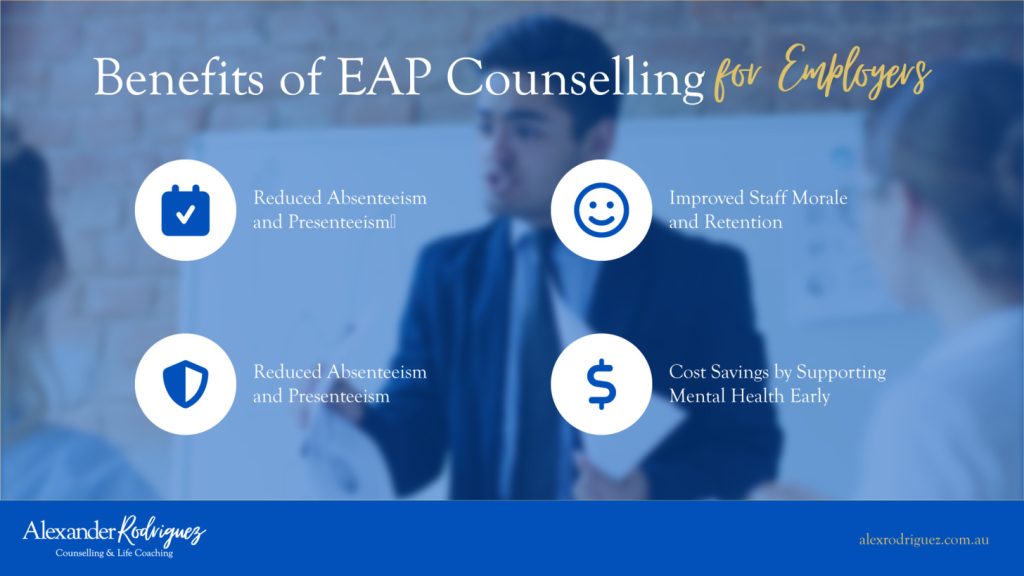
    For employers, it leads to improved productivity and less absenteeism.

    Employee Assistance Programs (EAP): What You Need to Know

    Employee Assistance Programs (EAPs) are designed to support staff when personal or work challenges affect their wellbeing. These confidential programs provide counselling, guidance, and resources that help employees manage stress, mental health concerns, and everyday difficulties. By offering a structured and supportive framework, EAPs promote resilience and create healthier, more productive workplaces.

    Definition of Employee Assistance Programs (EAP)

    Employee Assistance Programs (EAPs) are confidential, employer-funded services designed to support employees and their families. They typically provide short-term counselling, financial guidance, legal advice, and referral pathways to specialist support when needed. According to the Australian HR Institute, EAPs are considered an essential part of promoting workplace mental health and sustaining employee wellbeing.

    “Employee Assistance Programs are a cornerstone of modern workplace wellbeing initiatives, providing employees with the support they need to thrive.”

    EAPs aim to offer accessible and confidential support. They help employees tackle issues before they affect their work. EAPs meet various employee needs, fostering a caring work environment.

    How Counselling Is Delivered

    EAP counselling is available in different ways. This includes:

    This variety ensures employees can get help in a way that suits them. It makes support flexible and accessible.

    Who Can Access EAP Services

    EAP services are available to all employees and, in many cases, their immediate families. This broader access ensures that support extends beyond the individual, recognising the important role family wellbeing plays in overall mental health. By making services inclusive, organisations demonstrate a genuine commitment to caring for their people. Clear communication about who can use EAP services helps build a supportive workplace culture and encourages employees to seek help when they need it.

    Why EAP Counselling Matters in 2025

    In 2025, EAP counselling is more important than ever as workplace stress and mental health challenges continue to rise. With increasing rates of anxiety, depression, and burnout among employees, modern workplaces require strong support systems that go beyond traditional HR practices. EAP counselling provides timely, confidential assistance that helps staff manage personal and professional pressures, while also building healthier, more productive organisations.

    Rising Workplace Stress, Burnout, and Anxiety

    Workplace stress, burnout, and anxiety are increasing. EAP counselling is a vital support for employees. It gives them confidential access to professional help.

    The demands of modern work can harm mental health. Long hours, tight deadlines, and heavy workloads are common. EAP counselling services help employers create a healthier work place.

    Post-COVID Shift Towards Mental Health Awareness

    Since the COVID-19 pandemic, conversations about mental health in the workplace have become far more visible. At Alex Rodriguez Counselling & Life Coaching, I have seen how this shift has encouraged employees to speak up about stress, anxiety, and burnout rather than keeping struggles hidden.

    Employee Assistance Program (EAP) counselling is central to this change. By offering confidential support, it gives staff the tools to care for their mental wellbeing and helps employers build a culture where people feel safe, valued, and understood. This proactive approach also reduces stigma, making it easier for employees to reach out when they need help.

    Legal and Ethical Obligations for Australian Employers

    Australian employers have a legal and ethical responsibility to provide a safe and healthy workplace. This responsibility extends to supporting mental health, not just physical safety. EAP counselling plays a key role in meeting this duty of care by giving employees access to professional, confidential support when they need it.

    By investing in EAP programs, organisations demonstrate genuine care for their staff’s wellbeing. This proactive approach helps prevent mental health issues from escalating, reduces risks in the workplace, and lowers costs associated with absenteeism, turnover, and potential compliance breaches.

    Common Issues Addressed in EAP Counselling

    As a counsellor, I have seen how EAP counselling provides vital support for employees facing workplace and personal challenges. These confidential support services help staff manage their mental wellbeing and build resilience. Through EAP counselling, employees can access guidance for issues such as:

    • Stress and burnout
    • Anxiety and depression
    • Workplace conflict and communication problems
    • Work-life balance struggles
    • Substance misuse or dependency
    • Financial and legal concerns

    By addressing these challenges early, EAP counselling reduces the impact on productivity while improving employee satisfaction and wellbeing.

    Stress and Burnout Management

    Stress and burnout are big problems at work. They affect how well employees do their jobs and how happy they are. EAP counselling teaches ways to deal with stress, like:

    • Identifying stress triggers
    • Developing coping mechanisms
    • Improving time management skills

    By tackling stress and burnout, EAPs help employees balance their work and personal lives better. This improves their overall wellbeing.

    Anxiety and Depression Support

    EAP counselling offers a safe place for employees to talk about anxiety and depression. They get help with:

    • Recognizing symptoms of anxiety and depression
    • Access to professional counsellors for guidance and therapy
    • Strategies for managing symptoms and improving mental health

    Early help from EAP counselling can stop mental health problems from getting worse. It ensures employees get the support they need.

    Conflict Resolution in the Workplace

    Workplace conflicts can really hurt morale and productivity. EAP counselling helps solve these problems with:

    • Mediation services
    • Conflict resolution strategies
    • Improved communication techniques

    By fixing conflicts, EAPs make the workplace better for everyone.

    Work-Life Balance Coaching

    Having a good work-life balance is key for employee wellbeing. EAP counselling teaches how to:

    • Set boundaries
    • Prioritize tasks
    • Manage work demands

    Good work-life balance leads to better mental health, job satisfaction, and overall wellbeing for employees.

    Issue EAP Counselling Support Benefits
    Stress and Burnout Stress management techniques, coping mechanisms Improved wellbeing, productivity
    Anxiety and Depression Professional counselling, symptom management Early intervention, improved mental health
    Conflict Resolution Mediation services, conflict resolution strategies Harmonious work environment, improved morale
    Work-Life Balance Coaching on boundaries, prioritization Better mental health, job satisfaction

    “EAP counselling has been instrumental in supporting my mental health during challenging times at work. The confidentiality and professionalism of the counsellors have made a significant difference.”

    Anonymous Employee

    EAP counselling tackles many workplace issues, helping employees manage their mental health. It’s a key part of promoting wellbeing at work.

    Benefits of EAP Counselling for Employees

    Employee Assistance Programs (EAPs) are a big help for workers facing today’s work challenges. They give employees a chance to talk to professionals about their mental health. This helps them manage their wellbeing.

    Confidential and Stigma-Free Access to Help

    EAP counselling is private and free from stigma. It lets employees get help without worrying about being judged or affecting their job. This privacy is key to creating a safe place for them to talk about their mental health.

    Early Intervention Prevents Escalation

    Getting help early through EAP counselling can stop mental health problems from getting worse. It helps employees deal with stress, anxiety, or depression quickly. This keeps their wellbeing and work performance strong.

    Access to Professional Counsellors

    EAPs connect employees with skilled counsellors for many mental health issues. These experts give advice, support, and ways to handle stress and other challenges. They help employees deal with tough times well.

    Better Wellbeing and Work Performance

    EAP counselling helps employees’ mental health, leading to better wellbeing and work. When they feel supported, they’re more likely to be engaged, productive, and happy at work.

    In summary, EAP counselling is a big plus for employees. It offers private access to professional help, which is crucial for their mental health and wellbeing.

    Benefits of EAP Counselling for Employers

    Supporting mental health through EAP counselling brings big benefits to organizations. It saves money and boosts productivity. As mental wellbeing in the workplace becomes more important, EAPs are key to a healthy work environment.

    Reduced Absenteeism and Presenteeism

    EAP counselling helps cut down on time off and work performance issues. It gives employees the support they need for mental health. This means they can tackle problems early, avoiding long absences.

    A study by the Australian Bureau of Statistics shows mental health is a big reason for missing work. Employees take about 6.3 days off each year for mental health. With EAP counselling, employers can lower this number, saving money and boosting productivity.

    Improved Staff Morale and Retention

    EAP counselling shows employers care about their employees’ wellbeing. This makes employees feel valued and more likely to stay engaged. It leads to happier workers and less turnover.

    A survey by the Australian Human Resources Institute found 75% of employees feel more valued with EAP services. This boosts morale and helps keep staff, saving on recruitment and training costs.

    Meeting Duty of Care and Compliance Requirements

    Employers must provide a safe and healthy work environment. This includes supporting mental wellbeing. EAP counselling helps meet this duty by offering professional help and promoting mental health awareness.

    By investing in EAP counselling, employers also meet legal requirements. This reduces the risk of accidents and injuries, and avoids costly lawsuits.

    ROI: Cost Savings by Supporting Mental Health Early

    Employee Assistance Programs (EAPs) deliver strong financial returns by addressing mental health issues early. A peer-reviewed study analyzing over 166,000 cases found an average ROI of $5.39 for every $1 invested, driven by reduced healthcare costs, increased productivity, and organisational support services.

    Further evidence from cost-benefit research shows ROI ranging from $1.49 to $13 per dollar spent, depending on factors such as employee uptake and program design.

    EAP Investment ROI Range Source
    $1 $5.39 Peer-reviewed study
    $1 $1.49 – $13 Cost-benefit research

    By offering EAP counselling, employers can help employees deal with mental health issues early. This reduces the risk of costly problems later on. It leads to big savings and boosts productivity, making EAP counselling a smart investment.

    “EAPs are a critical component of a comprehensive mental health strategy in the workplace. By providing employees with access to confidential counselling services, employers can promote a culture of mental health awareness and support, leading to improved productivity and cost savings.”

    How to Access EAP Counselling

    If you are considering EAP counselling, the first step is knowing how to get started. At Alex Rodriguez Counselling & Life Coaching, I work with organisations to make sure their employees have easy and confidential access to support. Most Employee Assistance Programs (EAPs) allow staff and their families to book sessions directly, either through a hotline, online appointments, or by speaking with HR. My goal is to make the process simple, so you can focus on your mental health and wellbeing without added stress.

    Typical Process – Hotlines, HR Referral, Direct Booking

    Getting EAP counselling is simple, and I make sure the process is as stress-free as possible. You can choose the option that works best for you:

    • Hotline or Helpline: Call a 24/7 support line to talk with a counsellor or arrange a session.
    • HR Referral: Your HR team can provide my contact details or booking link so you can connect with me directly.
    • Direct Booking: You can alsobook a session online or by calling me to set up an appointment.

    Whichever way you choose, I ensure that your experience is confidential, supportive, and focused on your mental wellbeing.

    Number of Free Sessions Usually Included

    EAPs usually offer 3 to 6 free sessions per issue. This means you can get professional help without extra cost.

    EAP Provider Number of Free Sessions
    Provider A 4 sessions
    Provider B 6 sessions
    Provider C 3 sessions

    Confidentiality and Privacy Protections

    EAP counselling keeps your info private. EAPs follow strict laws to protect your confidentiality and privacy.

    “Confidentiality is key to trust. It lets people share their worries safely, without fear of being judged.” –

    A/Prof Jane Smith, Counselling Expert

    What Happens After – Ongoing Therapy Options

    Need more help after the free sessions? EAPs can help you find ongoing therapy. They might:

    • Refer you to a private therapist
    • Help you continue with the EAP or other providers
    • Guide you to more mental health resources

    Your EAP counsellor will help you find the best support for your ongoing needs.

    Choosing the Right EAP Provider (For Businesses)

    At Alex Rodriguez Counselling & Life Coaching, I understand how important it is for organisations to choose the right EAP provider. Not every program offers the same level of care, which is why I focus on delivering more than just counselling. I provide a wide range of services, maintain strong professional standards, and ensure that support is simple and accessible for your staff. By partnering with me, you can be confident your team will receive the care they need to improve their wellbeing and workplace performance.

    Accreditation and Professional Standards

    First, check if the EAP provider is accredited and follows professional standards. In Australia, look for accreditation from bodies like the Australian Counselling Association (ACA). Accreditation means the counsellors are qualified and follow a code of ethics, giving you confidence in their service.

    Range of Services Offered Beyond Counselling

    EAP services include more than just counselling. Look for providers that offer work-life balance coaching, stress management workshops, and critical incident response. Choose a provider that meets your employees’ specific needs.

    Availability: 24/7 and Multilingual Support

    In today’s world, 24/7 EAP access is crucial. Choose a provider that offers 24/7 support so your employees can get help anytime. Also, if your team is diverse, pick a provider with multilingual support for everyone.

    Reporting, Feedback, and Measurable Outcomes

    It’s vital to have a provider that offers detailed reporting and feedback. Look for regular updates, employee feedback, and clear outcomes. This shows how effective the EAP is and where it can improve.

    Criteria What to Look For Benefits
    Accreditation Recognition by bodies like ACA Ensures quality and ethical standards
    Range of Services Beyond counselling: coaching, workshops, etc. Comprehensive support for various employee needs
    Availability 24/7 support, multilingual options Accessible help at any time for all employees
    Reporting & Feedback Regular updates, employee feedback, measurable outcomes Demonstrates EAP effectiveness and identifies improvement areas

    Real-World Impact: EAP Counselling Case Study

    Looking at a real case study shows how EAP counselling works. Employee Assistance Programs (EAPs) play a big role in helping workplace mental health. Their success is clear in real-life examples.

    At Alex Rodriguez Counselling & Life Coaching, I worked with an employee (let’s call him James) who was struggling with high stress and anxiety due to workload pressures. Through his company’s Employee Assistance Program (EAP), he accessed a series of confidential counselling sessions with me at no cost to him.

    Together, we identified strategies to manage his stress, improve his work-life balance, and rebuild his confidence. Within a few weeks, James reported sleeping better, feeling more focused, and communicating more effectively with his team.

    From the employer’s perspective, the program reduced his absenteeism and prevented further burnout, which helped the business maintain productivity. This case shows how EAP counselling can create a win–win outcome, supporting both employee wellbeing and organisational performance.

    Anonymous Employee Outcome

    An employee was dealing with anxiety and burnout. EAP counselling gave them confidential help. They learned how to handle stress better.

    This helped them feel better at work and balance their life better.

    “I was unsure at first, but EAP counselling changed my life. The counsellor was kind and gave me useful tips. I felt supported and could handle my anxiety.” – Anonymous Employee Testimonial

    Organisational Benefit

    EAP counselling also helps the workplace. It helps employees when they’re struggling. This can make employees happier and less absent.

    In one case, a company saw 25% less absenteeism with EAP. This boosted productivity and made the workplace better.

    • Improved employee wellbeing
    • Reduced absenteeism
    • Enhanced staff morale
    • Better workplace culture

    As workplaces deal with mental health, EAP counselling is key. It gives employees professional help. This makes the workplace kinder and more productive.

    Is EAP Counselling Right for You?

    EAP counselling can change lives, but how do you know if it’s for you? It’s key to look at signs that show you might need it. Also, think about why companies invest in these programs.

    Signs an Employee May Benefit from EAP

    If you’re feeling stressed, anxious, or burnt out, EAP counselling could help. Other signs include:

    • Having trouble balancing work and life
    • Finding it hard to solve work conflicts
    • Seeing your wellbeing or job performance drop

    Spotting these signs early lets you seek help through EAP counselling.

    Why Businesses Should Invest in EAP Programs

    Offering EAP programs is more than kindness; it’s a smart business move. It can bring big benefits. Companies gain by:

    • Lowering absences and work performance issues
    • Boosting staff happiness and keeping them longer
    • Increasing productivity and job happiness

    This way, businesses support their employees’ mental health. They also create a better work place.

    Knowing the good of EAP counselling and spotting when you or your team needs it helps make smart choices. It’s about using these valuable tools wisely.

    Final Thoughts & Next Steps

    In today’s fast-paced work environment, EAP counselling is key for workplace wellbeing and employee mental health. It’s important to see its benefits for both employees and employers.

    Key Takeaways on EAP and Workplace Wellbeing

    EAP counselling is a vital part of workplace wellbeing strategies. It helps not just individual employees but also the whole work environment.

    • Confidential Support: EAP services offer a safe, confidential space for employees to tackle their challenges.
    • Early Intervention: EAP counselling can stop mental health issues from getting worse by acting early.
    • Improved Productivity: Supported employees tend to be more productive and engaged at work.

    Why Employees Should Use EAP When Offered

    Using EAP counselling services is a proactive step for employees to keep their mental wellbeing in check. It’s a valuable resource for dealing with work life stresses.

    Benefits for Employees Description
    Access to Professional Counsellors Employees get professional counselling services that fit their needs.
    Confidentiality EAP services are confidential, offering a safe space for employees to share their concerns.
    Work-Life Balance Counselling helps employees find a better balance between work and personal life.

    Why Employers Should View EAP as an Investment

    From my perspective at Alex Rodriguez Counselling & Life Coaching, I have seen how valuable it is for organisations to invest in EAP counselling. When companies provide confidential support for their staff, they build a healthier, more engaged, and more productive workforce. It is about creating a workplace culture that truly values employee wellbeing.

    By embracing EAP counselling, employers send a clear message that mental health matters.

    FAQ

    What is EAP counselling, and how does it work?

    EAP counselling is a service for employees to support their mental health. It offers confidential access to professional counsellors. They help with stress, anxiety, and balancing work and life.

    Who can access EAP counselling services?

    EAP services are for employees and their families. Who can use it varies by EAP provider and employer policies.

    How is EAP counselling delivered?

    EAP counselling is offered in different ways. You can have in-person, online, or phone sessions. The choice depends on the provider and your preference.

    Is EAP counselling confidential?

    Yes, EAP counselling is confidential. Counsellors follow strict confidentiality rules. They won’t share your information without your consent.

    How many free sessions are usually included in an EAP program?

    Free sessions vary by EAP provider and employer agreement. Usually, you get 3 to 6 sessions per issue.

    What happens after the free EAP sessions are used up?

    After free sessions, you might pay for more counselling or get referrals. Some employers offer extra support or extended services.

    How do I choose the right EAP provider for my business?

    Look for accreditation, a wide range of services, and 24/7 support. Also, check if they can report outcomes and give feedback.

    What are the benefits of EAP counselling for employees?

    EAP counselling offers confidential support and early help for mental health issues. It improves wellbeing and work performance.

    What are the benefits of EAP counselling for employers?

    Employers see less absenteeism and better morale and retention. It also saves costs by supporting employees’ mental health early on.

    How can I tell if an employee may benefit from EAP counselling?

    Look for changes in behaviour or performance, more absences, or reports of stress or anxiety.

    Why should businesses invest in EAP programs?

    EAP programs support employee mental health. This leads to better productivity, less turnover, and a positive impact on profits.
  • Find an Occupational Therapist: Tips for Choosing the Right Therapist

    Find an Occupational Therapist: Tips for Choosing the Right Therapist

    Find an Occupational Therapist when day-to-day tasks start feeling harder, slower, or less safe than they should, because the right support can help you get back to living with more confidence and independence. Across Australia, the need for support is significant, with the Australian Bureau of Statistics reporting that 5.5 million Australians (21.4%) had disability in 2022. If you are looking for an occupational therapist, begin by figuring out what you want to improve right now, such as showering and dressing, cooking, energy levels, pain management, mobility, sensory overwhelm, or getting back to work and study.

    If looking for Occupational Therapy nearby, it helps to compare providers using a reputable directory so it is easier to review experience areas, availability, and service delivery options such as clinic appointments, home visits, school visits, and telehealth. Before committing, it is also worth confirming the therapist’s registration on the national practitioner register, which includes occupational therapy. With a shortlist in front of you, it becomes much easier to choose an occupational therapist who listens properly, explains a clear plan, and builds support around your real routines, not generic advice.

    You need a therapist who is not just skilled but also caring and supportive. Our team offers personalised services that meet your specific needs. To learn more or book a session, call us on 0429 220 646.

    Key Takeaways

    • Consider the therapist’s qualifications and experience
    • Assess their approach to occupational therapy
    • Personalised care is crucial for effective therapy
    • Book a session to discuss your needs and goals
    • Supportive therapists make a significant difference in recovery

    Understanding Occupational Therapy and Its Benefits

    Occupational therapy helps you do the everyday things that matter most, even when injury, disability, illness, stress, or developmental differences make life feel harder. It is a practical, goals-focused health service that looks at your real routines, your environment, and what is getting in the way, then builds a plan to help you function more comfortably and confidently. Rather than focusing only on symptoms, occupational therapy focuses on how you live, what you need to do each day, and what support will make those tasks easier and safer.

    The benefits often show up in clear, real-world changes. You may build skills for daily living, improve strength or coordination, learn strategies for sensory overload or fatigue, reduce fall risk at home, or return to work and study with the right adjustments. With the right plan, you can feel more independent, more capable, and less overwhelmed by day-to-day demands.

    What Occupational Therapists Do

    Occupational therapists (OTs) work with individuals to meet their needs. They create personalised plans to help with daily tasks. This approach considers physical, emotional, and environmental factors.

    They aim to promote independence and participation in activities. This makes life more meaningful and enjoyable.

    Common Conditions Treated by Occupational Therapists in Australia

    In Australia, occupational therapists help with many conditions. These include developmental delays in children, physical injuries, mental health issues, and disabilities due to age. Here’s a table showing some common conditions occupational therapy can treat:

    Condition Age Group Treatment Focus
    Developmental Delay Children Improving motor skills and adaptive behaviours
    Stroke Rehabilitation Adults/Elderly Regaining physical function and independence
    Mental Health Conditions All Ages Enhancing coping strategies and daily functioning

    How Occupational Therapy Improves Daily Living

    Occupational therapy greatly improves daily living. It enhances the ability to perform tasks and participate in meaningful activities. This helps maintain independence.

    Through tailored interventions, occupational therapists help individuals adapt to their environment. They overcome challenges and live more fulfilling lives.

    When to Seek Help from an Occupational Therapist

    When everyday tasks start feeling harder than they used to, it’s a sign to reach out. An Occupational Therapist can help you navigate life’s demands with more ease and less stress. Use a professional Occupational Therapist directory today to find a specialist who offers home, clinic, or telehealth services tailored to your needs.

    Professional support is vital during major life transitions. Consider consulting an occupational therapist if you are recovering from surgery, navigating a new diagnosis, or managing long-term pain. They also provide specialised care for children with developmental or sensory requirements. This is where learning how to select an occupational therapist becomes important, because the best outcomes usually come from the right match. When it is time to choose an occupational therapist, look for someone who listens carefully, explains a clear plan, and helps turn goals into practical steps that fit real routines, not perfect ones.

    Signs You Might Need Occupational Therapy

    Some signs show you might need occupational therapy. These signs fall into physical and cognitive, or emotional categories.

    Physical Indicators

    • Having trouble with daily tasks like dressing, bathing, or eating
    • Living with chronic pain or discomfort
    • Struggling with coordination or balance

    Cognitive and Emotional Signs

    • Having trouble remembering things or focusing
    • Feeling anxious or depressed
    • Struggling to manage stress or emotions

    Life Transitions That Benefit from Occupational Therapy Support

    Occupational therapy is very helpful during big life changes. These include:

    • Starting a new life in a different home or aged care
    • Going back to work after being sick or hurt
    • Adjusting to a new disability or chronic condition

    Knowing these signs and life changes helps you decide when to get occupational therapy. It can make your daily life better and improve your overall health.

    Types of Occupational Therapy Specialisations in Australia

    Occupational therapy covers a wide range of areas, with each specialisation designed to support different needs and life stages. In Australia, occupational therapists work with people to build, maintain, or regain the skills needed for everyday living, learning, work, and community participation, whether support is needed for a short period or ongoing. The right specialisation makes support more targeted and practical, because it matches the therapy approach to what is actually happening in daily life.

    Common occupational therapy specialisations include paediatric occupational therapy for development, play, school participation, and sensory needs, and mental health occupational therapy for routine-building, emotional regulation, and daily functioning. There is also rehabilitation occupational therapy for recovery after injury or surgery, neurological occupational therapy for conditions affecting the brain and nervous system, and aged care occupational therapy focused on falls prevention, mobility, and staying independent at home. Many occupational therapists also specialise in hand therapy, workplace and return-to-work rehabilitation, assistive technology and equipment prescription, and home modifications to improve safety and access. If you are looking for an occupational therapist, understanding these specialisations helps you narrow your options and choose support that fits your goals.

    Paediatric Occupational Therapy

    Paediatric occupational therapists help children with developmental delays and sensory issues. They use play to help kids get the skills needed for school and other places.

    Mental Health Occupational Therapy

    Mental health occupational therapists support people with anxiety, depression, and trauma. They teach coping strategies and help improve daily routines and well-being.

    Geriatric Occupational Therapy

    Geriatric occupational therapists help older adults stay independent and live well. They deal with aging issues like mobility loss and adapting to new homes.

    Physical Rehabilitation

    Occupational therapists in physical rehabilitation help people after injuries or illnesses. They work on getting strength, mobility, and functional skills back.

    Workplace Assessment and Modification

    These occupational therapists check workplaces for hazards and suggest changes. They work with employers and employees to make work safer and more efficient.

    Knowing about occupational therapy specialisations helps you find the right fit for your needs or career goals.

    How to Find an Occupational Therapist Near You in Australia

    If you are looking for an occupational therapist, it helps to start with a clear idea of what you want support with, because occupational therapy covers a wide range of needs. Think about what is getting in the way right now, such as daily living tasks, recovery after injury, returning to work, child development, sensory needs, or home safety. Once your goal is clear, finding an occupational therapist becomes much easier, because you can search for someone who actually specialises in the support you need.

    A practical next step is using a directory or looking at a listing to compare local options, check areas of focus, and see whether appointments are available in a clinic, through home visits, or via telehealth. Referrals can also speed things up, so it is worth speaking with a GP, psychologist, physiotherapist, paediatrician, or another provider who already understands your situation, then asking for a recommendation. Community health services may also offer occupational therapy or help you access the right pathway, especially if support is needed at home or within the community. When it is time to choose an occupational therapist, look for someone who communicates clearly, listens properly, and can explain what the first few sessions will involve and how progress will be tracked.

    Online Directories and Resources

    Online directories make it easy to find occupational therapists. Here are two important ones:

    Occupational Therapy Australia Directory

    The Occupational Therapy Australia Directory lists all registered occupational therapists in Australia. You can search by location, name, or specialty.

    HealthDirect Service Finder

    HealthDirect’s Service Finder is also a great tool. It helps you find health services, including occupational therapy, near you.

    Directory Description Search Criteria
    Occupational Therapy Australia Directory Lists registered occupational therapists across Australia Location, name, specialty
    HealthDirect Service Finder Helps locate health services Location, service type

    GP and Healthcare Provider Referrals

    Your GP or healthcare providers can recommend occupational therapists. They often work with a network of professionals.

    NDIS Provider Finder

    If you’re an NDIS participant, the NDIS Provider Finder is essential. It lets you search for registered NDIS providers, including occupational therapists, in your area.

    Community Health Centres

    Community health centres often provide occupational therapy services. They offer a range of health services and are a good place to ask about occupational therapy services.

    Using these resources, you can find an occupational therapist near you who meets your needs. Whether it’s for yourself or a family member, these online resources for occupational therapists make finding a therapist easier.

    Qualifications to Look for When Choosing an Occupational Therapist

    When you are finding an occupational therapist, it helps to look beyond the job title and check the qualifications that show a therapist is properly trained, registered, and working to professional standards. In Australia, an occupational therapist should have an accredited university qualification in occupational therapy and be registered with the national regulator. Registration matters because it confirms the therapist meets the required professional standards and is legally able to practise. It also gives you a clear place to verify credentials if you are unsure.

    It is also worth checking for evidence of ongoing professional development and experience that matches your needs. Some occupational therapists build advanced skills in areas like paediatrics, mental health, neurological rehab, aged care, hand therapy, assistive technology, home modifications, or workplace rehabilitation. If you are using NDIS funding, you may also want to confirm whether the provider understands NDIS processes, reporting requirements, and goal-based planning. When you choose an occupational therapist, a good sign is someone who explains their approach clearly, outlines what the first sessions will involve, and communicates in a way that makes you feel supported and understood.

    Required Education and Registration in Australia

    Therapists in Australia need to graduate from a recognised university. They also must be registered with the Occupational Therapy Board of Australia. This shows they have the right skills and knowledge for their job.

    Additional Specialisations and Training

    Many therapists get extra training in areas like paediatrics or mental health. This extra training helps them meet specific client needs better.

    Membership in Professional Organisations

    Being part of groups like Occupational Therapy Australia shows a therapist’s commitment. It means they keep up with new practices and network with others.

    Continuing Professional Development

    Therapists must keep learning to stay registered. This ongoing education keeps them up-to-date with the latest methods and research.

    Qualification Description Importance
    University Degree Accredited degree in Occupational Therapy Essential for registration
    Registration with OTA Registration with the Occupational Therapy Board of Australia Mandatory for practice
    CPD Continuing Professional Development activities Critical for staying updated

    Questions to Ask When Interviewing Potential Occupational Therapists

    When you are trying to find an occupational therapist, the right questions can quickly show whether a therapist is a good fit for your needs, your goals, and your comfort level. A strong occupational therapist will not just describe services in general terms. They will explain how they work, what support looks like in practice, and how progress is measured over time. These questions also help you avoid mismatches, especially if you need support in a specific area or you are using funding that has reporting requirements.

    Experience with Your Specific Condition

    It’s important to ask about the occupational therapist’s experience with your condition. Find out about their success rates and past interventions. This shows if they can help you.

    Treatment Approaches and Philosophy

    Understanding the occupational therapists’ methods and beliefs is crucial. Ask how they tailor therapy to each person. This helps you see if their approach matches your needs.

    Session Structure and Frequency

    Ask about the structure and frequency of therapy sessions. Knowing this helps you prepare and get the most from your sessions.

    Communication Style and Availability

    Good communication is essential for therapy success. Ask about their communication style and availability for questions. Also, find out how they handle emergencies or concerns.

    Collaboration with Other Healthcare Providers

    If you have a healthcare team, ask about collaboration with occupational therapy. A team effort can improve your care and results.

    By asking these questions, you can choose the right occupational therapist. This ensures they meet your needs and help you reach your goals.

    Understanding the Cost of Occupational Therapy in Australia

    The cost of occupational therapy in Australia can vary depending on where you live, the type of support you need, and how the session is delivered. A standard appointment in a clinic will often be priced differently from a home visit, and costs can increase if travel time is involved or if you need formal reports, equipment recommendations, or home modification advice. The simplest way to avoid surprises is to ask for a clear fee breakdown upfront, including session length, travel charges (if any), report fees, and cancellation rules.

    What you pay also depends on your funding pathway. If you are using the NDIS, registered providers must follow the NDIS Pricing Arrangements and Price Limits, which set maximum prices for supports for NDIA-managed and plan-managed participants. participants. If you are using Medicare, some people can access rebates for eligible allied health services through a GP Chronic Condition Management Plan, and occupational therapy is included under these referral pathways. If you have private health insurance, occupational therapy is usually covered under extras, but the benefit amounts and yearly limits vary a lot between funds and policies, so it is worth checking your product details before booking.

    Private Health Insurance Coverage

    Many Australians use private health insurance to help pay for occupational therapy. Your insurance might cover some of the costs, depending on your policy. Always check with your provider to know what’s covered.

    Medicare and Chronic Disease Management Plans

    If you have a chronic condition, Medicare’s Chronic Disease Management Plans can help a lot. These plans offer rebates for occupational therapy when a GP refers you.

    NDIS Funding Options

    If you’re part of the National Disability Insurance Scheme (NDIS), your therapy might be covered. NDIS funding can lower your out-of-pocket costs if you’re eligible.

    Department of Veterans’ Affairs Support

    Veterans and their families might get help from the Department of Veterans’ Affairs. This can include coverage for occupational therapy services.

    Out-of-Pocket Expenses and Fee Structures

    It’s important to know how occupational therapists charge. Some offer sliding scale fees or deals that can make therapy cheaper. Talking about costs with your occupational therapist is a good idea.

    “Occupational therapy is an investment in your health and wellbeing,” say occupational therapy experts. By knowing about funding and insurance, you can make better choices for your care.

    Red Flags to Watch Out for When Selecting an Occupational Therapist

    When finding an occupational therapist, it is easy to focus on availability, location, or whoever appears first in an occupational therapy directory. But the reality is that choosing the wrong fit can cost time, money, and momentum, especially when support is meant to improve daily functioning, confidence, and independence. Even if a provider looks qualified on paper or shows up quickly when you search occupational therapy near me, the way they communicate, assess, plan, and follow through matters just as much as credentials. Paying attention to early warning signs helps you find an occupational therapist who is genuinely aligned with your goals, your pace, and your real-life routine, rather than someone who offers generic support that does not translate into meaningful change. These red flags are not about being overly cautious. They are practical signals that can help you decide whether to continue, ask more questions, or move on before committing, such as:

    • Vague answers about assessment, planning, or what support looks like in day-to-day routines
    • Poor communication, including not listening properly or dismissing concerns
    • No clear plan, or an inability to explain how goals turn into practical steps
    • No explanation of how progress will be measured over time
    • One-size-fits-all or generic support that does not reflect real-life routines
    • Rushing into sessions without a proper assessment process
    • Weak follow-through, such as delays, missed updates, or inconsistent contact
    • Limited understanding of funding and reporting requirements if support is funded (for example, NDIS)
    • Making the process feel uncomfortable, unsupported, or misaligned with your goals and pace

    Lack of Clear Treatment Plans

    A good occupational therapist will have a clear treatment plan. This plan should outline your goals and what you can expect. If they don’t, it might mean they’re not professional enough.

    Poor Communication or Responsiveness

    Effective communication is key in therapy. If your occupational therapist doesn’t answer your questions or explain your treatment clearly, it can slow down your progress.

    Unwillingness to Collaborate with Other Healthcare Providers

    Occupational therapists often work with other healthcare teams. If your occupational therapist doesn’t want to work with others, it shows they might not be a team player.

    Unrealistic Promises or Guarantees

    Be cautious of occupational therapists who promise too much. Real therapy takes time, and good therapists set realistic goals.

    Outdated Practices or Techniques

    Make sure your occupational therapist uses the latest methods. Old techniques might not work well or could even harm your progress.

    Knowing these red flags helps you choose the right occupational therapist. This way, you get the best care for your needs.

    The Importance of the Therapist-Client Relationship

    The relationship you build with your occupational therapist can shape the whole therapy experience. Techniques and strategies matter, but they work best when you feel heard, respected, and understood. When there is a strong sense of trust, it becomes easier to speak honestly about what is difficult, what feels overwhelming, and what is not working in daily life. That openness helps the therapist tailor support to your real routines and priorities, so sessions stay practical, relevant, and genuinely helpful.

    A solid therapist-client connection also creates a sense of safety, which is especially important when you are navigating injury, disability, stress, pain, or major life changes. When you feel supported, you are more likely to ask questions, practise what is discussed between sessions, and stay engaged long enough to see meaningful progress. The right occupational therapist will communicate clearly, check in regularly, and adjust the plan as your needs change, so therapy feels like a steady partnership built around your goals.

    An occupational therapist should be both highly skilled and genuinely caring, offering support that feels steady and personal. Our team offers personalised services that meet your specific needs. To learn more or book a session, call us on 0429 220 646.

    Building Trust and Rapport

    Trust is the base of a great therapist-client relationship. When you trust your therapist, you’re more likely to share your struggles and dreams. This openness helps create a better treatment plan for you.

    The Role of Personal Connection in Therapy Success

    Having a personal connection with your therapist can make therapy better. This connection makes you feel safe and understood. It helps you reach your goals more easily.

    When to Consider Switching Therapists

    If you don’t feel comfortable or supported by your therapist, it might be time to look for another one. Your comfort and progress are very important. Finding the right therapist is crucial.

    Advocating for Your Needs in Therapy

    Don’t be shy about speaking up for what you need in therapy. Talk openly with your therapist about your goals, challenges, and any worries. This ensures you get the best results possible.

    FAQ

    What is occupational therapy, and how can it help me?

    Occupational therapy helps you learn, recover, or keep skills for daily life and work. In Australia, occupational therapists work with physical, cognitive, and emotional challenges. They aim to improve your quality of life.

    How do I find an occupational therapist near me in Australia?

    Look online at directories like the Occupational Therapy Australia directory. You can also ask your GP for a referral. Community health centres and NDIS provider finders are other places to check.

    What qualifications should I look for when choosing an occupational therapist?

    In Australia, occupational therapists need at least a bachelor’s degree. They must also be registered with the Occupational Therapy Board of Australia. Look for specialisations and professional memberships too.

    How much does occupational therapy cost in Australia?

    Costs vary based on location, insurance, and NDIS funding. Some services might be covered by Medicare or insurance. Others may cost you directly. Always talk about fees with your therapist.

    What are some red flags to watch out for when selecting an occupational therapist?

    Be wary if a therapist doesn’t have clear plans, communicates poorly, or won’t work with other doctors. Also, watch out for unrealistic promises or outdated methods. If you feel uneasy, it’s okay to look for another therapist.

    How important is the therapist-client relationship in occupational therapy?

    The relationship between you and your therapist is very important. It builds trust and helps therapy work better. If you don’t feel supported, it might be time to find a new therapist.

    Can I choose an occupational therapist with a specific specialisation?

    Yes, many occupational therapists specialise in areas like paediatrics or mental health. You can find one that fits your needs or goals by searching online.

    How do I know if I’m getting the most out of my occupational therapy sessions?

    To get the most from your sessions, talk openly with your therapist about your goals and progress. Ask about their methods and how they plan your sessions. This ensures they meet your needs and expectations.
  • High-functioning depression: signs, risks, and how counselling helps

    High-functioning depression: signs, risks, and how counselling helps

    High-functioning depression can be hard to spot because you can still look well on the outside and stay active in work, family, and daily life, even while feeling low and struggling privately. That matters because depressive disorders are common in Australia, with research suggesting approximately 20% of Australians will be diagnosed with a depressive disorder at some point in their lifetime.

    This guide explains common symptoms of depression, the real-world risks of pushing through in silence, and why depression and anxiety counselling can be a practical turning point. In this article, you will find clear examples of effective support for low mood, along with practical signs of when to seek help for depression before things escalate.

    At Alex Rodriguez Counselling & Life Coaching, we provide Depression & Anxiety Counselling for people who feel weighed down by persistent worry, low mood, or overwhelm. We use evidence-based coping strategies to help you understand your patterns, regulate difficult emotions, and respond to stress in healthier ways. With regular support, you can build steadier confidence, strengthen resilience, and feel more in control day to day.

    Call 0429 220 646 or email info@alexrodriguez.com.au to take the first step, or book a session online. The booking page lets you schedule on‑site or online appointments for flexibility. We know how important a positive outlook is, and our life coaching services complement counselling by helping people see life with more clarity and purpose.

    Key Takeaways

    • High-functioning depression can be hard to spot because daily functioning often continues.
    • Signs can include ongoing low mood, reduced enjoyment, fatigue, and changes in sleep or appetite.
    • Common patterns include overthinking, self-criticism, perfectionism, and subtle withdrawal.
    • Untreated depression can strain health, relationships, and work, and may worsen over time.
    • Seek professional help when symptoms persist, start affecting life, or coping becomes unsafe or unsustainable.
    • Counselling helps you understand patterns, build practical skills, and support relapse prevention.

    What Is High-Functioning Depression?

    High-functioning depression is not a medical diagnosis. It is a simple way to describe when someone can still keep up with everyday life, like work, study, or family responsibilities, but is privately experiencing depression symptoms. The key characteristic is functional preservation: people may keep working, parenting, studying, socialising, and “showing up” while carrying persistent dysphoria (low mood), anhedonia (reduced pleasure), and an ongoing sense of depletion.

    What makes high-functioning depression hard to recognise is that many people mask how they feel and rely on coping habits that help them keep going. They might use overachievement, perfectionism, people-pleasing, or rigid routines to maintain performance and appear fine. Inside, they can feel stuck in overthinking, harsh self-criticism, and unhelpful thought patterns, while also pushing down their emotions. They may notice physical changes too, such as poor sleep, changes in appetite, lower libido, or ongoing muscle tension. These signs can be present even when their day-to-day productivity looks normal.

    The Hidden Nature of the Condition

    High-functioning depression is often hidden because people conceal their feelings. To others, they may look fine, while inwardly they feel alone, sad, or exhausted. This concealment can deepen isolation and delay help‑seeking.

    Differences from Major Depressive Disorder

    Unlike major depression, high-functioning depression does not necessarily stop someone from completing daily tasks. However, the emotional pain and reduced well-being are real and deserve attention. Where major depressive disorder commonly causes clear and sustained impairment, high-functioning presentations can be subtler but still significantly impair quality of life over time.

    Characteristics High Functioning Depression Major Depressive Disorder
    Daily Functioning Generally maintained Often impaired
    Visible Symptoms Few or subtle More pronounced
    Emotional State Hidden sadness, emptiness, or numbness Clear sadness and/or loss of interest

    Recognising the Signs of High-Functioning Depression

    High-functioning depression can be difficult to recognise because it often hides in plain sight. You might still show up to work, meet deadlines, stay social, and keep everything looking okay from the outside, while privately feeling like even basic tasks take more effort than they should. Instead of obvious breakdowns, it can look like pushing through, staying busy, and performing well, even as your mood, energy, and motivation quietly decline. That is why it helps to look for patterns that keep showing up, not just one difficult day.

    • Persistent low mood or numbness
    • Reduced joy or interest
    • Ongoing fatigue
    • Sleep changes
    • Appetite or weight changes
    • Increased irritability
    • Constant overthinking
    • Harsh self-criticism or guilt
    • Poor focus or indecision
    • Overworking or perfectionism
    • Subtle withdrawal
    • More numbing habits (alcohol, food, scrolling)
    • Physical tension or stress symptoms
    • Lower motivation or libido

    If several of these signs describe your recent weeks, it is not something to brush off. A useful rule of thumb is noticing whether symptoms are present for two weeks or more, and whether they are affecting your relationships, work, sleep, or sense of self, even if you are still functioning. Reaching out early can make a real difference because support is not only for crisis points. It can help you name what is happening, reduce the load you are carrying, and build practical strategies to feel more like yourself again.

    The “looks fine” trap

    A common feature of high-functioning depression is a mismatch between external functioning and internal distress. You might meet expectations but feel as though you are running on fumes, which is why signs are often missed by others and minimised by the person affected.

    Behavioural changes

    Behavioural changes can be subtle but noticeable over time. People may pull back from friends and family, change their eating or sleep habits, or stop doing things they used to enjoy.

    Cognitive patterns

    High-functioning depression can affect thinking: reduced focus, slower memory retrieval, and difficulty making decisions are common. Knowing these signs helps catch depression early and opens the way to appropriate support.

    Spotting these patterns early can help people access the right support. For example, through depression counselling, people can talk through what is going on, understand the underlying drivers, and get practical strategies to address it before it escalates.

    The Silent Risks of Untreated Depression

    Untreated high-functioning depression can be risky because it often flies under the radar. When life keeps moving, and you are still doing what needs to be done, it is easy to minimise what you are feeling and keep pushing forward. The cost is that the emotional load stays there, day after day, without real relief.

    Over time, this can affect more areas of your life. Your mood may drop further, your sleep and energy can become less reliable, and your patience and confidence may be worn down. You might start pulling back from people or activities, feel more reactive in close relationships, or lose your sense of direction and meaning. Eventually, even simple tasks can feel heavier, and your ability to think clearly, plan, and stay motivated can start to slip. Getting support early can interrupt that slow build-up and help you regain steadier wellbeing.

    Depression also produces psychophysiological effects: disturbed sleep, appetite changes, chronic fatigue, and somatic tension are common and can lower resilience, increase irritability, and promote social withdrawal. Because distress is often masked, relationships may suffer through emotional disconnection, avoidance, or conflict. Reliance on short‑term coping (overwork, increased alcohol use, compulsive distraction) can intensify this cycle. That is why early engagement with counselling services and targeted depression counselling matters: it supports accurate formulation, builds evidence‑based coping skills, and provides structured support for low mood.

    Impact on physical health

    Persistent depression can affect physical health. Research links chronic depressive symptoms with poorer sleep quality, altered appetite and immune functioning, and an increased risk of cardiovascular problems in some people, underscoring that mental‑health conditions can have wide‑ranging effects on the body. Prompt assessment and treatment reduce long‑term health risks.

    Relationship consequences

    Depression can strain relationships by reducing emotional availability and increasing conflict or withdrawal.

    Career and performance effects

    Even when outward performance appears intact, untreated depression can erode productivity and satisfaction over time. The cumulative effect is often burnout, which can damage career prospects and work‑life balance.

    Risk of progression to major depression

    Without intervention, low‑grade depressive states can worsen for some people and progress to more severe depression. Early, targeted treatment, whether counselling, medication where appropriate, or a combination, reduces the chance of progression and supports recovery.

    Risks Consequences
    Untreated depression Physical health issues, relationship strain, reduced work performance
    Progression to major depression More severe impairment and reduced quality of life

    It is important to spot signs early and seek professional support. Counselling services use evidence‑based approaches such as Cognitive Behavioural Therapy (CBT), behavioural activation, and other therapies to treat depression and build sustainable coping. If you, or someone you care about, is experiencing persistent low mood, worsening sleep, or increasing withdrawal, consider contacting a healthcare provider for assessment. If there are any thoughts of self‑harm or immediate danger, contact emergency services or Li feline in Australia on 13 11 14 right away.

    When to Seek Professional Help

    Deciding whether you are struggling enough to reach out can be difficult when you are managing responsibilities but still feeling low inside. With high-functioning depression, people often continue to work, study, parent, and socialise while experiencing persistent dysphoria, emotional numbness, or anhedonia. Those internal signs matter and deserve attention.

    A simple way to know when to get professional help is to check for these two things:

    • Is it lasting? This means the negative feelings keep coming back and are not easing.
    • Is it getting in the way? This means it is starting to affect your everyday life, like work, study, sleep, or relationships.

    Also watch for these common changes:

    • Pulling back from people or plans
    • Getting stuck in overthinking
    • Feeling more snappy or easily upset
    • Rest is not helping you feel better
    • Needing much more effort to get through the day

    If this sounds like you, it is a good time to reach out for support.

    Act early if the way you are coping is starting to feel risky or hard to maintain. This might look like using alcohol or other substances to switch off, overworking to avoid your feelings, or noticing a steady drop in motivation and self-worth. Early depression counselling and broader counselling services help build evidence‑based emotional regulation skills and tailored support for low mood before problems escalate.

    Warning Signs That Shouldn’t Be Ignored

    Seek help promptly if you experience:

    • Persistent feelings of sadness or hopelessness
    • Loss of interest in activities you once enjoyed
    • Significant changes in appetite or sleep patterns
    • Difficulty concentrating or making decisions

    Overcoming Barriers to Seeking Help

    Many people delay help because of stigma, cost worries or the belief that others have it worse. In Australia there are accessible options: speak with your GP for assessment and referrals, explore Medicare‑supported mental health care plans (Better Access) if appropriate, or ask about employer Employee Assistance Programs (EAPs). Counselling services offer a confidential, non‑judgemental place to work through low mood and learn practical coping strategies.

    Australian Mental Health Care System Navigation

    Start with your GP, they can assess your symptoms, discuss treatment options (talking therapies, medication where indicated), and refer you to a psychologist or psychiatrist if needed. For urgent help, contact Lifeline on 13 11 14 or attend your local emergency department. For those seeking local support, Alex Rodriguez Counselling offers counselling and tailored support for depression and low mood across Sydney and online.

    How Counselling Helps with High-Functioning Depression

    Counselling can help with high-functioning depression by giving you a private, non-judgemental space to say what you have been carrying alone. Even when you seem okay to others, you might still feel less joy, ongoing low mood, irritability, changes in sleep, and constant pressure to keep performing.

    In counselling, things slow down so you can make sense of what is going on. You and your counsellor map out what is triggering the pattern and how your thoughts, feelings, actions, and body responses link together. This makes the problem clearer and more manageable, rather than confusing or self-blaming.

    Through counselling for depression, people learn evidence‑based skills that fit real life. Depending on your needs, therapy may include behavioural activation to help you restart activities that lift your mood and rebuild motivation. It may also use CBT to reduce overthinking and harsh self-talk, and ACT to help you create distance from distressing thoughts so they do not control your choices. You can also learn emotion regulation and stress management skills to calm your body and steady your nervous system.

    Alongside this, therapy often focuses on practical foundations that support everyday life. This can include improving sleep routines, setting healthier boundaries, building communication skills, and creating values-led goals that feel realistic and meaningful. These steps help you function day to day while lowering the risk of burnout and setbacks.

    The Therapeutic Relationship

    The relationship between counsellor and client is central. A reliable, empathic therapeutic bond creates safety to explore difficult feelings without fear of judgment. Key elements include active listening, empathy, non-judgmental acceptance, and individualised support.

    Creating a Safe Space for Expression

    Counselling provides confidential time to name and process difficult emotions. For people with high‑functioning depression, this alone can reduce shame, lessen isolation, and open the possibility of practical change.

    Setting Realistic Goals for Recovery

    Practical goal setting is a core part of treatment. Effective goals are specific, measurable, and broken into manageable steps. Regular review and adjustment help maintain momentum and adapt goals to changing circumstances.

    • Identify clear, achievable objectives.
    • Break larger aims into small, doable tasks.
    • Review progress regularly and adapt as needed.

    The Journey of Healing Through Counselling

    Counselling is a collaborative journey: assessing contributing factors, building coping strategies, and supporting sustainable recovery. With appropriate therapy and support, managing symptoms, improving mental health, and enhancing well-being are realistic outcomes.

    Evidence-Based Approaches Used at Alex Rodriguez Counselling

    At Alex Rodriguez Counselling & Life Coaching, we use evidence‑based counselling services grounded in contemporary psychological research to support people living with high-functioning depression. We begin with a structured assessment and collaborative goal‑setting to understand how your symptoms of depression show up in daily life. That lets us tailor a clear treatment plan that fits your context, whether you’re managing work pressure, relationship strain, chronic stress, or ongoing support for low mood needs in high-functioning depression Australia.

    Core approaches we commonly use include:

    Cognitive Behavioural Therapy (CBT)

    Cognitive Behavioural Therapy (CBT) helps identify and challenge unhelpful thoughts and behaviours that sustain low mood and rumination. CBT teaches practical coping skills you can use in everyday life to reduce negative thinking and improve functioning.

    Behavioural Activation

    Behavioural activation focuses on rebuilding routine, energy, and pleasurable activity, practical steps that restore motivation and reward pathways when anhedonia is present.

    Acceptance and Commitment Therapy (ACT)

    ACT supports psychological flexibility: it helps you relate differently to distressing thoughts and feelings and take values‑based action even when your mood is low.

    Mindfulness and Emotion Regulation

    Mindfulness‑based strategies (meditation, paced breathing, grounding) and targeted emotion‑regulation techniques support nervous‑system stability, sleep, and stress management — important foundations for recovery.

    Interpersonal and Attachment‑Informed Work

    Where relationship patterns maintain low mood, we may integrate interpersonal or attachment‑informed approaches to address communication, boundaries, and relational cycles.

    Progress Tracking and Relapse Prevention

    For people seeking help, we focus on progress tracking and relapse prevention. This includes using validated symptom measures, identifying early warning signs, and building practical plans to protect progress during stressful periods. We also clarify when to seek help for depression, so support is accessed early rather than only once coping starts to break down.

    These approaches are backed by strong evidence for reducing depressive symptoms and improving day-to-day functioning. If you would like to discuss which therapy options may suit your situation, our team can explain the choices and tailor a plan to your needs.

    Practical Techniques for Managing High-Functioning Depression

    Managing high-functioning depression isn’t about forcing positivity. It’s about building practical, repeatable skills that reduce the symptoms of depression, protect energy, and strengthen day‑to‑day support for low mood. These techniques are chosen because they are usable on busy days, small changes that add up.

    Daily micro‑actions you can try

    • Short movement: a 10–20 minute walk or gentle activity to lift mood and reset the body.
    • One manageable task: pick a single, achievable job each day (e.g., clear one drawer) to create a sense of progress.
    • Brief social check‑in: send one message or make a short call to a trusted person to maintain a connection.
    • Mini hobby: spend 15–20 minutes on a simple hobby (reading, drawing, music) to re‑activate interest pathways.

    Behavioural activation

    Behavioural activation uses planned, small actions to rebuild routine and pleasure. When anhedonia is present, action often precedes motivation: scheduling manageable activities helps restore reward pathways and momentum.

    Interrupting rumination and perfectionism

    Practical strategies to reduce mental overload include structured “worry time” (set aside 10–20 minutes at a fixed time), short mindfulness check‑ins, thought defusion exercises, and self‑compassionate self‑talk to soften harsh inner narratives. These approaches reduce repetitive negative thoughts and lower stress.

    Simple sleep and nervous‑system supports

    • Consistent wake and sleep times (even on weekends) to stabilise circadian rhythm.
    • Morning light exposure (15–30 minutes) to boost alertness and mood.
    • Paced breathing, grounding, or progressive muscle relaxation before bed to reduce arousal.
    • Regular meals and light activity to stabilise energy and appetite.

    Cognitive reframing and thought challenging

    Cognitive reframing means spotting unhelpful thoughts and testing their accuracy. Thought‑challenging replaces “always/never” thinking with balanced perspectives, reducing the depressive impact of negative self‑talk.

    Emotion regulation and grounding practices

    Developing emotion-regulation skills, journaling, practicing short breathing exercises, talking with a friend, or using the grounding (5-4-3-2-1 sensory technique) helps process difficult emotions and stay present. These tools are quick, portable, and effective during high‑stress moments.

    Boundaries, rest, and real connection

    Setting realistic boundaries (saying no without over‑explaining), scheduling genuine rest, and prioritising a small number of trusted relationships strengthen resilience. Quality of connection often matters more than quantity.

    Combining these daily strategies with depression counselling and broader counselling services helps make changes sustainable. For long‑term well-being, build emotional resilience through consistent micro‑skills and supportive routines. That means noticing early warning signs, reducing rumination, setting realistic boundaries, and practising self‑compassion instead of harsh self‑criticism.

    Developing healthy coping skills

    Learning reliable coping skills is central to emotional resilience. Practical, evidence‑based options include:

    • Mindfulness practices — short daily exercises (5–10 minutes) to reduce stress and improve attention.
    • Physical activity — gentle, regular movement (even 10–20 minutes most days) to lift mood and reduce anxiety.
    • Creative expression — art, music, or writing as a low‑pressure way to process feelings and build confidence.

    Sleep support and lifestyle changes

    Good sleep and a balanced lifestyle are foundational to resilience. Small, practical steps include:

    • Keep a consistent sleep schedule — aim for a regular bedtime and wake time to improve sleep quality.
    • Limit screens before bed and create a calm pre‑sleep routine (reading, gentle breathing).
    • Eat regular, balanced meals and include light movement through the day to stabilise energy.

    Preventing burnout

    Preventing burnout means recognising its signs and taking practical steps to manage work and stress. Useful tactics include:

    1. Set achievable goals and clear priorities — focus on what matters most.
    2. Schedule regular micro‑breaks to rest and recharge during the working day.
    3. Use workplace supports (talk to your manager about reasonable adjustments or access an Employee Assistance Program) and ask for help from colleagues, friends, or professionals when needed.

    Maintaining progress after counselling

    Sustaining gains after counselling is critical for long‑term mental health. Keep using the skills and strategies learned in therapy and embed them into routines. Practical tips include:

    • Review and adjust personal goals regularly to match changing circumstances.
    • Keep up self‑care activities (movement, sleep, social connection, creative time).
    • Plan check‑in appointments or booster sessions if you notice early signs of relapse.

    These approaches support recovery by strengthening day‑to‑day coping and reducing the impact of negative thoughts. If you need help translating these strategies into a personalised plan, a qualified provider can work with you to create a practical, sustainable approach that fits your life.

    Conclusion: Taking the First Step Towards Healing

    High-functioning depression can feel exhausting: outwardly, you may appear capable while carrying persistent heaviness, emptiness, or quiet hopelessness inside. The symptoms of depression can gradually erode energy, motivation, relationships, and sense of self. The turning point often begins when someone stops pushing through alone and recognises that reaching out is not weakness but a practical step towards change. With the right, reaching out is not a weakness but a practical step towards change. With the right support for low mood, recovery becomes more achievable than relying on willpower alone.

    Depression counselling provides a confidential space to speak honestly, make sense of what’s happening beneath the surface, and learn evidence‑based coping skills that fit real life. Through tailored counselling services, you can build emotional regulation, reduce rumination, strengthen boundaries, and create a plan that supports long‑term wellbeing, particularly if you’re navigating high-functioning depression in Australia or looking for high-functioning depression Sydney support.

    Call 0429 220 646 or email info@alexrodriguez.com.au to take the first step, or book a session online. The booking page lets you schedule on‑site or online appointments for flexibility. Our life coaching services complement counselling by helping people see life with greater clarity and purpose.

    FAQ

    What is high-functioning depression?

    High-functioning depression describes when someone appears to cope with daily responsibilities but experiences ongoing low mood, reduced pleasure, and internal distress. It’s not an official DSM/ICD diagnosis, but shares features with persistent depressive conditions.

    How is high-functioning depression different from major depressive disorder?

    People with high-functioning depression often keep working and meeting obligations despite feeling unwell, whereas major depressive disorder typically causes clear and sustained impairment. Both conditions are serious and merit assessment and treatment.

    What are the signs and symptoms?

    Common signs include persistent low mood, loss of interest, fatigue, sleep or appetite changes, difficulty concentrating, and negative thoughts. If these symptoms persist for most days over two weeks, seek professional advice.

    How can I get help in Sydney or Australia?

    Start by seeing your GP for assessment and referral. You may be eligible for Medicare‑supported mental health care plans (Better Access) or referral to a psychologist or psychiatrist. Local services, online counselling and organisations like Lifeline (13 11 14) are also available.

    What are the benefits of counselling?

    Counselling provides a safe place to explore difficult feelings, learn evidence‑based strategies (CBT, behavioural activation, mindfulness), and build a personalised plan to reduce symptoms and improve day‑to‑day functioning.

    How can I manage it on a daily basis?

    Practical daily strategies include small, scheduled activities (behavioural activation), short mindfulness or grounding exercises, consistent sleep routines, regular movement, and staying connected to a few trusted people. Counselling can help tailor these to your life.

    When should I seek professional help?

    Seek help if low mood, reduced interest, or other symptoms are present most days for two weeks or more, if they affect your ability to function, or if you notice increasing thoughts of self‑harm. For immediate crisis support, contact Lifeline on 13 11 14 or emergency services.

    How do I navigate the Australian mental health system?

    Begin with a GP appointment to discuss symptoms and options. Ask about a mental health treatment plan, Medicare rebates, local public services, or private counselling. Your GP can refer you to appropriate providers and specialist care if needed.
  • Imposter Syndrome: Stop Doubting Yourself and Build Confidence

    Imposter Syndrome: Stop Doubting Yourself and Build Confidence

    Imposter syndrome is not a rare quirk of a few high achievers; recent surveys suggest that around half of Australian workers report feeling like impostors, even when their performance is objectively strong. In a country where almost two in five people experience having a mental disorder in any given year, it is no surprise that imposter syndrome symptoms like chronic self-doubt and confidence struggles, negative self-talk, perfectionism, anxiety, and a constant fear of failure are quietly shaping careers and well-being.

    Whether you are battling imposter syndrome at work, second-guessing every achievement, or feeling stuck in unhelpful cognitive distortions, this guide will walk through how to overcome imposter syndrome with practical confidence-building strategies and self-worth exercises. You will also see how additional support, such as self-esteem and confidence coaching in Australia, can help you stop doubting yourself and start owning your strengths.

    At Alex Rodriguez Counselling & Life Coaching, we offer services like Self-Esteem & Confidence Coaching. We also do Cognitive reframing and belief work. Working with experienced coaches can teach you to change your thoughts and build confidence. Coaches can teach you to change your thoughts and build confidence.

    Call on 0429 220 646, or email info@alexrodriguez.com.au to take the first step, or book a session online; the booking page lets you schedule on-site or online appointments for flexibility. We know how vital a positive outlook is, and our life coaching services aim to help people see life in a brighter light.

    Key Takeaways

    • Imposter syndrome can hold you back from reaching your full potential.
    • Building confidence is a practice and a choice.
    • Self-Esteem & Confidence Coaching can help you overcome self-doubt.
    • Cognitive reframing and belief work can help you reframe your thoughts.
    • Working with experienced coaches can help you build confidence.

    What Is Imposter Syndrome and Why It Affect So Many Australians

    In Australia, people from all backgrounds experience imposter syndrome, a pattern of persistent self-doubt where someone struggles to internalise their achievements despite objective evidence of competence. Psychologists often describe it in terms of low self-efficacy (belief in your ability to succeed) and unstable self-esteem, even when performance reviews, exam results, or feedback are positive. Instead of attributing success to their skills or effort, many people fall into attribution biases, assuming their achievements are due to luck, timing, or other people “carrying” them. This is often reinforced by cognitive distortions such as all-or-nothing thinking, discounting the positive, and overgeneralisation.

    Imposter syndrome affects so many Australians because it links closely with perfectionism, chronic anxiety, and constant social comparison. In competitive workplaces and academic environments, people may feel pressure to meet unrealistic internal standards to avoid perceived failure, a pattern that clinicians sometimes call maladaptive perfectionism. Cultural factors like “tall poppy syndrome” can also make it harder to openly acknowledge strengths, which can deepen feelings of fraudulence. Over time, these processes can contribute to symptoms that overlap with generalised anxiety disorder and depressive disorders, such as rumination, anticipatory worry, and a persistent sense of not being good enough, even in the face of clear success.

    The Definition and Prevalence of Imposter Syndrome

    Imposter syndrome makes people doubt their achievements. Dr. Sarah Allen says it’s not about not being able to do things. It’s about feeling like you don’t deserve your success, no matter how hard you’ve worked.

    About 70% of people will feel like imposters at some point. It affects many, including those who have achieved a lot. It’s common in competitive fields and among high-achievers.

    Common Symptoms and Warning Signs

    Signs of imposter syndrome include feeling not good enough and doubting yourself. People might also feel anxious, work too hard, and struggle to accept praise.

    Symptom Description
    Persistent Self-Doubt Constantly questioning one’s abilities and second-guessing decisions.
    Fear of Exposure Fearing that others will discover one’s perceived inadequacies.
    Overwork Putting in excessive effort to compensate for feelings of inadequacy.

    The Unique Australian Work Culture and Imposter Feelings

    Australia’s work culture is both laid-back and competitive. In cities like Sydney and Melbourne, this mix can make people feel like impostors. They might feel they need to hide their true feelings of inadequacy.

    Teamwork and collaboration in Australian workplaces can also make people feel like impostors. They compare themselves to others and feel they don’t measure up.

    The Psychology Behind Self-Doubt and Negative Self-Talk

    Understanding self-doubt goes beyond simply “being more confident.” At a psychological level, it is closely tied to our core beliefs, schemas, and patterns of cognitive distortions. When someone has internalised beliefs like “I am not good enough” or “I always mess things up,” their mind starts filtering experiences through this lens. Positive feedback is discounted, mistakes are magnified, and neutral events are interpreted as proof of failure. This is where patterns like all-or-nothing thinking, catastrophising, and mind-reading show up, strengthening the inner critic and weakening self-efficacy (the belief in our ability to handle challenges).

    Self-doubt and negative self-talk often develop from a mix of early life experiences, attachment patterns, and ongoing social pressures. Harsh criticism in childhood, bullying, academic pressure, or growing up in perfectionistic or emotionally distant environments can all contribute to a self-critical internal voice. Later, social comparison, performance-driven workplaces, and cultural messages about success can reinforce this inner script. Over time, these psychological processes can fuel chronic anxiety, low mood, and impaired self-esteem. Targeted support, such as Self-Esteem and Confidence Coaching, CBT-based work on thoughts and beliefs, and compassion-focused approaches can help people identify these patterns, challenge unhelpful narratives, and build a more balanced and supportive internal dialogue.Understanding self-doubt goes beyond just being confident. It’s about changing how we think. Self-doubt and negative self-talk are linked to past experiences, societal pressures, and our own beliefs.

    Origins of Self-Doubt

    Self-doubt often starts in early life. It can come from too much criticism or high expectations. Knowing where self-doubt comes from is the first step to dealing with it.

    How Your Inner Critic Operates

    The inner critic is a part of self-doubt. It uses negative self-talk and critical voices. It feeds on cognitive distortions, like overgeneralizing and catastrophizing. Knowing how your inner critic works is key to fighting it.

    Cognitive Distortions That Fuel Self-Doubt

    Cognitive distortions are big players in self-doubt. They include:

    • All-or-nothing thinking
    • Overgeneralisation
    • Catastrophising
    • Personalisation

    Spotting and challenging these distortions can help you stop negative self-talk and build confidence.

    Cognitive Distortion Description Example
    All-or-Nothing Thinking Viewing situations as either entirely good or entirely bad “If I’m not perfect, I’m a total failure.”
    Overgeneralisation Making broad conclusions based on a single event “I made a mistake once, so I’ll always fail.”
    Catastrophising Expecting the worst-case scenario “If I don’t get this job, my life will be ruined.”
    Personalisation Taking things too personally or blaming yourself for events that are not fully under your control “My team missed the deadline; it’s all my fault.”

    By grasping the psychology of self-doubt and negative self-talk, we can find ways to overcome them. Research shows that changing our thoughts is crucial. It helps us deal with feelings of being an imposter.

    How to Recognise Imposter Syndrome in Your Life

    Imposter syndrome can show up in many areas of life, not just at work or in formal achievements. You might notice it when you start a new role, hand in an assignment, receive praise, or are asked to take on more responsibility. Instead of feeling proud, you feel a wave of panic or shame and think, “They have no idea I am not actually that good,” or “If they looked more closely, they would see I am a fraud.” You might downplay your success, tell people “I just got lucky,” or feel uncomfortable when others see you as capable or talented. Learning to notice these imposter syndrome symptoms is a key step in changing how you respond.

    Recognising imposter syndrome starts with paying attention to these patterns in your thoughts, emotions, and behaviour. Common signs include constantly comparing yourself to others and feeling inferior, ongoing self-doubt and confidence struggles, and a stream of negative self-talk that dismisses your efforts. You may set unrealistically high standards, over-prepare for tasks because you fear being exposed, or avoid new opportunities out of fear of failure. Many people also experience perfectionism and anxiety, feeling relief instead of pride when things go well, and a strong urge to hide their mistakes. When you can name these experiences as imposter syndrome rather than “the truth” about who you are, you create space to respond differently and begin breaking the cycle of self-doubt.

    Imposter Syndrome at Work

    At work, imposter syndrome often makes you worry you’re not good enough. You might think your success is just luck, not your skills. This can lead to feeling unsure and anxious all the time.

    For example, someone who does well might think they’re just making it up as they go. They might believe their colleagues are more capable than they are.

    Academic and Professional Achievement Contexts

    In school or work, the need to do well can make you feel like you’re not good enough. You might think your success is because of luck, not your hard work. This can make you always worry about not meeting expectations.

    You might fear being seen as an “impostor” all the time.

    Personal Relationships and Social Situations

    Imposter syndrome can also mess with your personal life and how you interact with others. You might feel like you’re pretending to be someone else. This can make it hard to really connect with people.

    Social events can be scary because you worry about being judged or seen as “fake.”

    Knowing where imposter syndrome shows up in your life is the first step to beating it. It helps you start to overcome these feelings.

    Breaking the Cycle: Perfectionism, Anxiety, and Fear of Failure

    It is key to understand how perfectionism, anxiety, and fear of failure are linked, especially when dealing with imposter syndrome. Perfectionism often shows up as unrealistically high standards, a belief that anything less than “perfect” is not good enough, and harsh negative self-talk when you fall short. This keeps your nervous system on high alert, increasing performance anxiety and making every task feel like a test of your worth. Over time, your brain starts to use unhelpful cognitive distortions like all-or-nothing thinking and catastrophising, so even small mistakes feel like proof that you are incompetent or do not belong.

    These patterns can trap you in a cycle that is hard to escape, but not impossible to change. One part of breaking the cycle is learning to notice and challenge perfectionistic thoughts and to practise more flexible and realistic beliefs, such as “It’s okay to make mistakes; they help me learn.”

    Practical confidence-building strategies and self-worth exercises can help you separate your value as a person from your performance. Gradually taking “imperfect” action, practicing self-compassion, and seeking support, such as therapy or confidence coaching, can reduce the fear of failure and help you feel safer trying new things. With consistent work, it becomes easier to aim for growth instead of perfection and to recognise that mistakes are part of learning, not evidence that you are a fraud.

    Understanding the Perfectionism Trap

    Perfectionism often hides deeper fears. It seems good, but it can lead to too much fear of failure and anxiety. Spotting perfectionism, like setting too high standards and being too hard on yourself, is important.

    Managing Anxiety That Reinforces Imposter Feelings

    Anxiety makes it harder to shake off imposter feelings. Mindfulness, meditation, and CBT can help manage anxiety.

    Transforming Fear of Failure into Growth Opportunities

    Seeing failure as a chance to learn is key. A growth mindset lets you view failure as a way to grow and improve.

    Strategy Description Benefit
    Mindfulness and Meditation Practices that help reduce anxiety and increase self-awareness Reduces stress and improves mental clarity
    Cognitive-Behavioral Therapy (CBT) A therapeutic approach that helps change negative thought patterns Enhances coping skills and reduces anxiety
    Growth Mindset Viewing challenges and failures as opportunities for growth Fosters resilience and promotes continuous learning

    By tackling perfectionism, anxiety, and fear of failure, you can break free. This way, you build confidence that lasts.

    Developing Self-Compassion: Your First Step to Authentic Confidence

    Building real confidence begins with self-compassion, not with pushing yourself harder or pretending to be strong all the time. From a psychological perspective, self-compassion is linked to healthier self-doubt and confidence because it softens the impact of shame and harsh inner criticism on the nervous system. Many people grow up with internalised critical inner voices or maladaptive schemas such as “I must never fail” or “I am only worthy if I perform perfectly.” In reality, harsh negative self-talk keeps you stuck in cycles of shame and fear of failure, activating the body’s threat system and making it harder to think clearly. Self-compassion, as described in compassion-focused therapy (CFT) and acceptance and commitment therapy (ACT), creates a safer internal “attachment base” where you can learn, experiment, and recover from setbacks without attacking yourself. Psychologists describe self-compassion as treating yourself with the same kindness, understanding, and patience that you would offer to a close friend who is struggling, which directly supports healthier self-doubt and confidence patterns over time.

    Self-compassion also means recognising what psychologists call common humanity: the idea that mistakes, doubts, and imperfect days are a normal part of being human rather than evidence that you are broken. Instead of automatic thoughts like “I am useless,” you begin to practise more balanced cognitive restructuring, saying things like “I am disappointed, but I am learning, and I can try again.” This shift reduces self-judgment, downregulates the threat response, and supports better emotion regulation, so it becomes easier to think clearly and take confident action. Over time, practising self-compassion helps loosen rigid cognitive distortions, strengthens your ability to use practical confidence building strategies and self-worth exercises, and builds a more stable sense of self-esteem that is not constantly rising and falling with each success or setback.

    Self-Compassion vs. Self-Esteem

    It’s key to know the difference between self-compassion and self-esteem. Self-esteem is about feeling good about oneself. But self-compassion is about being kind to oneself, no matter how we feel about ourselves. Self-compassion builds a strong sense of self-worth, not based on achievements or others’ opinions.

    Studies show self-compassion is more linked to emotional strength and happiness than self-esteem. This is because self-compassion lets us accept our flaws and struggles without judging ourselves.

    Practical Self-Compassion Exercises

    To grow self-compassion, try these exercises:

    • Mindfulness meditation focusing on self-kindness
    • Writing a compassionate letter to oneself
    • Practicing deep, slow breathing to calm the nervous system

    These self-worth exercises help create a kinder inner voice, essential for confidence.

    Creating a Supportive Inner Dialogue

    A supportive inner dialogue is crucial for self-compassion. It means talking to oneself with kindness and understanding, especially when things get tough. This way, we build confidence strategies based on encouragement, not criticism.

    Negative Self-Talk Compassionate Self-Talk
    “I’m not good enough.” “I’m doing my best, and that’s enough.”
    “I’ll never succeed.” “I’ll learn from my mistakes and keep moving forward.”

    Changing our inner dialogue can lead to a more positive and resilient mindset. This boosts our confidence and overall well-being.

    Cognitive Reframing: Changing Your Thought Patterns

    Cognitive reframing is a powerful tool for changing negative thoughts that drive imposter syndrome and keep you feeling stuck. In cognitive behavioural therapy (CBT), this process is often called cognitive restructuring and focuses on identifying the automatic thoughts and cognitive distortions that shape how you see yourself. When you are caught in imposter syndrome symptoms, your mind might jump to conclusions like “I only succeeded because of luck” or “Everyone else is more capable than me.” With cognitive reframing, you slow down and examine the evidence, ask whether there are alternative explanations, and deliberately create more balanced, realistic thoughts. Over time, this helps reduce harsh negative self-talk, soften perfectionism and anxiety, and support healthier self-doubt and confidence patterns.

    Practising cognitive reframing is one of the most effective confidence building strategies for overcoming imposter syndrome, including imposter syndrome at work. You might start by writing down a difficult situation, the automatic thought (“I am a fraud”), the emotion it creates (fear of failure, shame, anxiety), and then gently challenging that belief with facts: past achievements, skills you have built, and feedback from others. Replacing “I am a fraud” with “I am still learning, but I have handled challenges before” is not about false positivity, but about accuracy. When repeated regularly, this process begins to rewire entrenched cognitive distortions and supports deeper self-worth exercises, helping your brain register that you are capable, learning, and allowed to make mistakes. As your thoughts become more balanced, imposter syndrome loses its grip, and your confidence grows from a more grounded and realistic view of yourself.

    Identifying Unhelpful Beliefs

    The first step is to notice our thoughts and spot beliefs that hold us back. These might include negative self-talk or always expecting the worst. For example, someone with imposter syndrome might think, “I’m not good enough for this role.” Spotting these thoughts is key to changing them.

    Evidence-Based Techniques for Thought Restructuring

    There are proven ways to change bad thoughts. Cognitive-behavioral therapy (CBT) is one, focusing on replacing negative thoughts with positive ones. Mindfulness is another, helping us observe our thoughts without judgment.

    Keeping a thought journal is a practical way to change thoughts. It helps us see patterns and challenge negative thoughts. For instance, instead of thinking, “I’ll never do this,” we can say, “I’ll learn and grow from it.”

    Negative Thought Reframed Thought
    I’m not good enough. I’m capable and can learn.
    I’ll fail. I’ll take it as a learning opportunity.

    Developing a Growth Mindset in Daily Life

    Having a growth mindset is crucial for cognitive reframing. It means seeing challenges as chances to grow, not threats. By focusing on learning, we build resilience and persistence. For example, instead of saying, “I’m not cut out for this,” we say, “I’m facing a challenge that will help me grow.”

    By using cognitive reframing daily, we build confidence and fight imposter syndrome. It’s about realizing our thoughts aren’t facts and we can change them.

    Building Confidence Through Values and Strengths-Based Work

    Confidence is not just about visible success; it grows when your actions align with your personal values and your sense of identity. In psychology, this is closely related to self-determination theory, which highlights the importance of autonomy, competence, and relatedness for healthy motivation. When you choose goals that reflect what truly matters to you, rather than only external approval, you build intrinsic motivation and a stronger internal compass. This is especially helpful if you struggle with imposter syndrome, because it shifts the focus from constant comparison to others toward living in line with your own values. Working this way also supports a growth mindset, where challenges are seen as opportunities to learn rather than proof that you are not good enough, which directly reduces fear of failure and softens perfectionismand anxiety.

    Strengths-based work adds another layer by focusing on your existing resources rather than only on your problems. In positive psychology, using your signature strengths regularly is associated with increased well-being, resilience, and a more stable sense of self. Mapping your strengths can help you develop an internal locus of control, where you experience yourself as an active agent in your life rather than a passive imposter waiting to be exposed. This perspective makes it easier to challenge negative self-talk and unhelpful cognitive distortions, and to embed practical confidence building strategies and self-worth exercises into everyday life. Over time, these values and a strengths-based approach support psychological flexibility and resilience, so your self-doubt and confidence are less dependent on perfect performance and more grounded in who you know yourself to be.

    Discovering Your Core Values

    Finding your core values is key to confidence. These values guide your choices and actions. Reflect on what’s important to you and what you stand for.

    • What causes or issues do I feel strongly about?
    • What kind of person do I want to be?
    • What values do I want to be remembered for?

    Knowing your values helps you make choices that reflect who you are. This boosts your self-confidence and purpose.

    Identifying and Leveraging Your Unique Strengths

    Your unique strengths set you apart. Using these strengths boosts your confidence. Here’s how to identify and use them:

    1. Self-Reflection: Understand what you’re naturally good at and enjoy.
    2. Feedback: Get insights from trusted people on your strengths.
    3. Practice: Keep improving your strengths through learning and practice.

    By focusing on your strengths, you’ll feel more accomplished and confident in your abilities.

    Aligning Actions with Values for Authentic Confidence

    Aligning your actions with your values builds real confidence. When your actions match your values, you feel whole and assured. Make sure your goals and actions reflect your values. Living by your values and using your strengths builds confidence that stands strong against challenges.

    Practical Strategies for Overcoming Imposter Syndrome Daily

    Simple yet effective strategies can help you beat imposter syndrome day by day, rather than waiting for a big breakthrough. One of the most important steps in overcoming imposter syndrome is learning to set clear boundaries around time, energy, and expectations. This might mean saying no to unnecessary tasks, limiting overtime, or challenging the belief that everything must be perfect, which directly reduces perfectionism and anxiety. Choosing small, realistic goals is another powerful form of behavioural activation. When you break tasks into manageable steps and track tiny wins, you give your brain regular evidence that you are capable, which slowly shifts patterns of self-doubt and confidence and softens harsh negative self-talk. Support such as Time management coaching, focus & productivity coaching, and changing habits coaching can reinforce these daily changes so you are not trying to rebuild your routines alone.

    Building a support circle is also a practical daily strategy for imposter syndrome at work and in other areas of life. Sharing experiences with trusted friends, colleagues, mentors, or a therapist helps normalise imposter syndrome symptoms and reduces the shame of feeling “the only one.” Others can offer more balanced perspectives when cognitive distortions are strong, reminding you of your skills, strengths, and progress. Regular self-reflection is another key habit, and it can be as simple as a short journal check-in at the end of the day where you note what went well, what you learned, and how you handled difficulties. Over time, these routines become core confidence building strategies and self-worth exercises, helping you respond more compassionately to yourself, recognise your achievements more accurately, and gradually loosen the grip of imposter syndrome in everyday life. If you need structured help building these skills, Self-esteem & confidence coaching or Public speaking coaching can offer guided practice to help you show up more confidently in both personal and professional settings.

    Setting Boundaries and Practicing Assertiveness

    Learning to set boundaries and be assertive is key to managing imposter syndrome. It means being clear about what you need and saying it to others.

    • Identify your limits and communicate them clearly.
    • Practice saying “no” without feeling guilty.
    • Use “I” statements to express your needs and feelings.

    Gradual Goal Setting and Celebrating Small Wins

    Setting and achieving small goals can greatly boost your confidence. It helps you feel less like an imposter.

    1. Break down large tasks into smaller, manageable goals.
    2. Celebrate each achievement along the way.
    3. Reflect on your progress regularly.

    Building a Support Network

    A supportive network of peers, mentors, and friends is crucial. They offer encouragement and keep you grounded.

    • Seek out mentors who can offer guidance.
    • Join groups or communities related to your field.
    • Nurture your personal relationships.

    Journaling and Self-Reflection Techniques

    Journaling and self-reflection are powerful tools for understanding and managing imposter syndrome.

    Tracking Your Progress

    Keeping a journal helps you track your progress and gain insights into your thoughts and feelings.

    Challenging Negative Thoughts in Real-Time

    Self-reflection lets you challenge negative thoughts and change them into positive ones as they happen.

    Strategy Description Benefit
    Setting Boundaries Clearly communicate your needs and limits. Reduces stress and increases confidence.
    Gradual Goal Setting Break tasks into smaller, achievable goals. Boosts confidence through successive achievements.
    Building a Support Network Surround yourself with supportive peers and mentors. Provides encouragement and valuable guidance.
    Journaling and Self-Reflection Track progress and challenge negative thoughts. Enhances self-awareness and mental well-being.

    By using these strategies every day, you can manage imposter syndrome and build lasting confidence.

    How Alex Rodriguez Counselling Can Help You Overcome Self-Doubt and Build Lasting Confidence

    Overcoming self-doubt and confidence struggles is a journey, and you do not have to do it on your own. In our work at Alex Rodriguez Counselling and Life Coaching, we support people who are dealing with imposter syndrome, persistent negative self-talk, and the ongoing pressure of perfectionism and anxiety. Together, we look at the specific patterns that keep you stuck, whether that is imposter syndrome at work, fear of speaking up, or the sense that your achievements “do not really count.” My goal is to create a warm, non-judgemental space where you can explore what is happening beneath the surface and learn practical tools to build genuine, steady confidence, rather than relying only on external success.

    Through Self-Esteem & Confidence Coaching, we draw on evidence-based approaches such as cognitive behavioural therapy (CBT), acceptance and commitment therapy (ACT), and compassion-focused strategies to help you shift the way you relate to yourself. We work directly with imposter syndrome symptoms by identifying the cognitive distortions and old beliefs that feed them, then using cognitive reframing and belief work to replace unhelpful thoughts with more balanced and realistic ones. This includes practising new responses to fear of failure, learning to soften the inner critic, and building a kinder internal voice to reduce harsh negative self-talk. Along the way, we incorporate tailored confidence building strategies and self-worth exercises so you can start feeling the change not just in sessions, but in your daily life.

    By working together, you gain more than insight; you build a toolkit you can actually use. We will set values-aligned goals, practise new skills between sessions, and celebrate small wins so that confidence grows from repeated experience, not just positive talk. Over time, many people find that self-doubt and confidence swings become less intense, they feel more grounded in their strengths, and imposter syndrome loosens its grip. My focus is to help you build lasting confidence that supports your relationships, work, and personal goals, so you can move toward a more fulfilling and authentic life with greater clarity and self-trust.

    Call on 0429 220 646, or email info@alexrodriguez.com.au to take the first step, or book a session online; the booking page lets you schedule on-site or online appointments for flexibility. We know how vital a positive outlook is, and our life coaching services aim to help people see life in a brighter light.

    FAQ

    What is imposter syndrome, and how does it affect Australians?

    Imposter syndrome makes people doubt their achievements and feel like they’re pretending. It’s common in Australia, especially in work, due to high expectations.

    How can I identify if I’m experiencing imposter syndrome?

    Signs include doubting yourself, negative thoughts, fear of not doing well, and needing to be perfect. If you feel this way at work or school, you might have imposter syndrome.

    Can imposter syndrome be overcome, and if so, how?

    Yes, you can beat imposter syndrome. Start by being kind to yourself, change your thinking, and focus on your strengths. Also, talking to a professional like Alex Rodriguez Counselling can help.

    How does perfectionism contribute to imposter syndrome?

    Perfectionism makes you feel like you’re not good enough. It’s about setting high, unrealistic goals. To overcome it, learn to accept your achievements and find a balance.

    What role does self-compassion play in overcoming imposter syndrome?

    Self-compassion is key. It means being kind and understanding to yourself, especially when you doubt yourself. You can learn it through exercises.

    How can cognitive reframing help with imposter syndrome?

    Cognitive reframing helps by changing negative thoughts into positive ones. It builds confidence and helps manage self-doubt.

    What are some practical strategies for overcoming imposter syndrome daily?

    To fight imposter syndrome, set limits, achieve goals step by step, and surround yourself with support. Journaling and self-reflection also help.

    How can Alex Rodriguez Counselling help individuals overcome imposter syndrome?

    Alex Rodriguez Counselling provides professional help to understand and beat imposter syndrome. They focus on self-compassion, changing negative thoughts, and building confidence through your strengths.

    Can imposter syndrome affect personal relationships?

    Yes, it can make you feel like you’re not good enough in relationships. Recognizing and dealing with these feelings can improve your connections with others.

    How can I start building confidence and overcoming self-doubt?

    First, accept your feelings and find out why you doubt yourself. Then, try self-compassion, changing your thoughts, and focusing on your strengths. This will help you build confidence and beat imposter syndrome.
  • Therapy in Sydney: Best Options, Costs & What to Expect in 2026

    Therapy in Sydney: Best Options, Costs & What to Expect in 2026

    Therapy in Sydney can feel overwhelming, especially when you are dealing with anxiety, low mood, burnout, grief, trauma, or relationship stress. When you start looking into Therapy Services in Sydney Australia, you quickly realise there are many different pathways and providers, and it can be hard to know where to begin. And it is not a “small group” issue. Across Australia, 21.4% of people aged 16 to 85 experienced a mental disorder in 12 months, with anxiety disorders at 16.8% and affective disorders (including depression) at 7.5%.

    What makes getting mental health help feel even harder is the number of options and the different “labels” for support. You might be choosing between a psychologist, counsellor, life coach, social worker, or psychiatrist, and you might also be deciding between in-person sessions, telehealth, short-term skills-based treatment, or longer-term, deeper work. On top of that, you have to think about the therapist’s approach, experience with your concerns, and whether you feel safe and understood.

    Costs matter too. Under Australia’s Better Access arrangements, eligible people can claim Medicare benefits for up to 10 individual and 10 group sessions per calendar year (with referrals typically starting in a smaller block). Fees still vary widely, but the APS National Schedule of Suggested Fees 2025 to 2026 lists $318 for a standard 46 to 60-minute consultation as a benchmark. Healthdirect also notes that a Mental Health Treatment Plan may only cover part of the cost, and telehealth can sometimes be a lower-cost option.

    If you’re struggling and would like to explore counselling services, consider reaching out to us today. We’ve supported clients across Sydney and online for several years and bring practical, outcome-focused counselling to help you overcome any challenges.

    Call on 0429 220 646, or email info@alexrodriguez.com.au to take the first step, or book a session online; the booking page lets you schedule on-site or online appointments for flexibility. We know how vital a positive outlook is, and our counselling services aim to help people see life in a brighter light.

    Key Takeaways

    • Therapy in Sydney gives you multiple support pathways.
    • A GP Mental Health Treatment Plan can guide next steps.
    • Medicare Better Access can reduce out-of-pocket costs.
    • Session fees vary widely across providers.
    • Choose in-person sessions or telehealth for flexibility.
    • Counselling Sydney options can cover specialised needs.
    • Track progress and review goals every few sessions.

    The Current State of Mental Health Services in Sydney

    Therapy in Sydney sits within a mixed mental health system that includes public hospital and community services, private clinicians, and Medicare-funded care. Demand remains high across Australia, with the AIHW reporting about 12.6 million Medicare mental health services delivered to 2.7 million people in 2025.

    In Sydney, many people start through primary care, usually a GP appointment and a Mental Health Treatment Plan, which can support access to Medicare-subsidised psychological therapy under the Better Access pathway. Others may be linked with NSW Health Community Mental Health Teams through their Local Health District, or with outpatient clinics when needs are more complex. Alongside this, there is a large private network offering counselling services and evidence-based mental health therapy through both in-person appointments and telehealth.

    Because support is delivered through multiple entry points, it helps to think in terms of stepped care. This means matching the intensity of support to what I need right now, from short-term, skills-based therapy through to specialist mental health services.

    Statistics on Mental Health in Australia

    Australia is facing a big mental health crisis. Many people struggle with anxiety, depression, or other mental health issues. A lot of Australians look for therapy each year.

    Age Group Percentage Disorder Type
    16–85 years 42.9% Any Mental Disorder
    16–85 years 21.5% 12-month Mental Disorder
    16–24 years 17.2% Anxiety Disorders
    16–24 years 38.8% 12-month Mental Disorder

    Source: ABS, National Study of Mental Health and Wellbeing

    How Sydney’s Therapy Landscape Has Evolved

    Sydney’s therapy scene has changed a lot. Now, there are many different types of therapy available. You can choose from face-to-face sessions or online therapy.

    Emerging Trends for 2026

    For 2026, Sydney’s therapy scene will focus on personalized and easy-to-access options. Medicare rebates can help make therapy more affordable. Online therapy is also set to become even more popular.

    Therapy Sydney: Comprehensive Guide to Available Options

    When you search for Therapy Sydney or Therapy Sydney Australia, you will find a mix of public services, Medicare-supported care, and private providers. That range helps you match support to your needs, whether you want short-term skills, longer-term counselling, or specialist mental health care.

    Here are the main options you can access across Sydney.

    Start with a GP and a Mental Health Treatment Plan

    You can book with your GP, talk through what you have been dealing with, then request a Mental Health Treatment Plan and referral. This pathway can support access to Medicare-subsidised mental health services under the Better Access initiative (Medicare rebates cover part of the fee, and sessions per year have a set limit).

    Psychologists (for structured, evidence-based therapy)

    If you want psychologist-led mental health therapy, you can check practitioner registration on the AHPRA public register before booking. That step helps you confirm the person holds current registration in psychology.

    Counsellors and psychotherapists (talk therapy and support)

    If you want ongoing counselling Sydney sessions focused on support, coping, and personal growth, you can search professional directories such as the Australian Counselling Association directory and PACFA’s “Find a therapist” directory. PACFA also lets you filter by telehealth, languages, and areas of practice.

    Public mental health care through NSW Health and Local Health Districts

    You can access mental health care through NSW Health services, including community-based care delivered through local teams. For example, the Sydney Local Health District outlines mental health services across hospitals and the community, including community mental health teams across multiple locations.

    Urgent support via the NSW Mental Health Line

    If you need urgent guidance on the right service, you can contact the Mental Health Line for advice and referral options to mental health services.

    With therapy in Sydney, you get choice, but you also benefit from choosing based on what you want help with, how quickly you need support, whether you prefer in-person or telehealth, and which provider type fits your goals.

    Psychotherapy vs Counselling

    Psychotherapy and counselling are often confused, but they support you in different ways. Psychotherapy typically helps you work through longer-term mental health concerns by exploring deeper patterns, underlying causes, and the way past experiences may shape how you think, feel, and respond today. Counselling often helps you manage more immediate challenges by focusing on practical support, coping strategies, and clear next steps for a specific issue or life situation.

    If you are exploring options, you can start by reviewing counselling services such as:

    Cognitive Behavioural Therapy (CBT)

    Cognitive Behavioural Therapy (CBT) is a popular method for many mental health issues. It helps change negative thoughts and behaviours. This way, people learn better ways to cope.

    Mindfulness-Based Therapies

    Mindfulness-based therapies focus on being present and flexible. There are two main types:

    Acceptance and Commitment Therapy

    Acceptance and Commitment Therapy (ACT) teaches people to accept their thoughts and feelings. It encourages actions that match their values.

    Dialectical Behaviour Therapy

    Dialectical Behaviour Therapy (DBT) mixes CBT with mindfulness. It helps manage emotions and improve relationships.

    Knowing about these therapy options in Sydney helps choose the right mental health therapy. Ready to book? Visit our therapy booking page to book a session.

    How to Determine Which Therapy Approach Is Right for You

    Choosing the right therapy in Sydney can be challenging because there are numerous options, and not every approach suits every person or situation. The goal is not to find the “best” therapy overall; it is to find what fits you, your needs, and what you want to change.

    Start by getting clear on what you want help with right now. Ask yourself: are you trying to manage symptoms (like anxious thoughts, panic, low mood, sleep issues, stress), work through a life event (break-up, grief, job loss), improve relationships and communication, or explore deeper patterns that keep repeating? Your answer points you towards the right level of mental health therapy.

    Match your needs to the therapy style

    • If you want practical skills and structured tools, you will often suit approaches like CBT, ACT, DBT-informed therapy, solution-focused therapy, or coaching-style support, where you leave with strategies to practise between sessions.
    • If you want deeper, longer-term work, you may prefer psychotherapy approaches that explore patterns, attachment, identity, and past experiences.
    • If your main challenge involves conflict, trust, or communication, you may benefit from couples counselling, relationship therapy, or family therapy.
    • If you are dealing with trauma, you can look for trauma-informed therapy and specific modalities (for example, EMDR or trauma-focused CBT), depending on your goals and readiness.

    Think about the provider type that fits your situation

    You might choose a psychologist, counsellor, psychotherapist, mental health social worker, or psychiatrist, depending on whether you want therapy, counselling support, or medication assessment. If you are comparing counselling in Sydney options, you can also look at session structure, focus areas, and whether you want skills-based support or deeper psychotherapy.

    Use simple questions to check fit before you book

    • What concerns do you work with most often?
    • What approach do you use, and what does a typical session look like?
    • How long do you usually work with someone for this type of concern?
    • What outcomes should you expect in the first 4 to 6 sessions?
    • Do you offer in-person sessions in Sydney and telehealth, and what are your fees?

    Prioritise comfort, safety, and connection

    Even the “right” technique will not work well if you do not feel comfortable. You want someone who communicates clearly, respects your pace, and helps you feel heard. A good fit usually feels like you can be honest without being judged, and you leave sessions feeling clearer, not worse.

    Know when you need more urgent or specialised support

    If you are experiencing severe symptoms, feeling unsafe, or struggling to function day-to-day, you may need more immediate support through your GP, NSW Health services, or crisis pathways rather than waiting for standard appointments.

    At the end of the day, the best Therapy Sydney Australia approach is the one you can commit to, feel safe in, and actually use in your daily life. If the first therapist or approach does not feel right, you can switch. That is a normal part of finding the right support.

    Self-Assessment Questions to Consider

    Start by asking yourself some key questions. What’s bothering you the most? Is it anxiety, depression, or maybe relationship problems? What do you hope to achieve from therapy? Thinking about these can help you find the right therapy.

    When to Seek Professional Guidance

    If you’re not sure what therapy you need, getting help from a professional is key. They can look at your situation and suggest the best therapy for you.

    Matching Therapy Types to Specific Concerns

    Each therapy type is designed for different issues. Cognitive Behavioural Therapy (CBT) is great for dealing with depression and anxiety. Mindfulness-based therapies are good for managing stress. A Mental Health Care Plan (MHCP) can even help you get rebates for up to 10 sessions a year, making therapy more affordable.

    Therapy Type Primary Concerns
    Cognitive Behavioural Therapy (CBT) Depression, Anxiety
    Mindfulness-Based Therapies Stress Management, Anxiety

    Navigating Therapy Costs in Sydney for 2026

    When shopping around for therapy services in Sydney in 2026, you are usually weighing up the clinic’s session fee (which providers set themselves) against what you can claim back through Medicare (if you have the right referral). As a reference point, the Australian Psychological Society’s National Schedule of Suggested Fees 2025 to 2026 lists an average cost of $318 for a standard 46 to 60-minute consultation, noting it is a suggested fee only.

    If you access mental health therapy through a GP Mental Health Treatment Plan and a referral under Better Access, you can claim Medicare benefits for up to 10 individual and 10 group mental health treatment services per calendar year (your provider can still charge above the rebate, so you pay a gap). Your GP commonly refers you for an initial block of sessions (often 6) before review. This applies whether you are booking a psychologist or exploring counselling Sydney-style support, depending on the provider type and item used.

    Cost item Typical session length Amount ( What it means for you
    APS suggested fee (reference only) 46 to 60 mins $318 A benchmark only. Many clinics charge less or more.
    Example private clinic fee 50 mins $259 A real-world example of what you may see published by a practice.
    Medicare benefit: Psychologist 50+ mins $98.95 If your session fee is $259, an example out-of-pocket gap is $160.05.
    Medicare benefit: Clinical psychologist 50+ mins $145.25 If your session fee is $259, an example out-of-pocket gap is $113.75.
    Better Access session limits Per calendar year Up to 10 individual + 10 group Medicare rebates apply up to these limits; after that, you can still attend but pay privately.

    Medicare Rebates and Mental Health Plans

    A Mental Health Care Plan (MHCP) can lower what you pay out of pocket. With an MHCP, you can get a Medicare rebate for therapy sessions. This makes getting help more affordable.

    Private Health Insurance Coverage Options

    Some private health insurance plans help pay for therapy. It’s good to check with your insurance to see how much they cover.

    Finding the Best Therapist in Sydney: A Step-by-Step Guide

    Finding the right therapist can feel tough because you are choosing someone you can trust, not just a clinic. When you search for a therapist in Sydney, you will see psychologists, counsellors, psychotherapists, social workers, and psychiatrists, plus public and walk-in services. Using a simple checklist helps you narrow it down quickly and choose the best fit for your needs.

    1) Get clear on what you want help with

    Write down 2 to 3 issues (anxiety, low mood, grief, trauma, relationship stress, anger, work stress) and one outcome you want to notice in real life. This makes it easier to match you with the right type of mental health therapy and avoids choosing based on proximity alone.

    2) Choose the right provider type using official terms

    Use these common terms (easy to link externally) so you are comparing like-for-like:

    • GP Mental Health Treatment Plan (your usual entry point for Medicare-supported therapy)
    • Psychologist (assessment and evidence-based psychological treatment)
    • Accredited counsellor/psychotherapist (talk therapy and structured counselling, depending on training and approach)
    • Mental health social worker (therapy plus practical, psychosocial support)
    • Psychiatrist (specialist medical care, including medication review)

    3) Verify credentials before you book

    If you are seeing a registered health practitioner (for example, a psychologist), you can check the AHPRA Register of practitioners to confirm they are currently registered. If you are choosing counselling Sydney services, you can search practitioner directories such as Australian Counselling Association (ACA) Find a Counsellor and PACFA Find a Therapist, which let you filter by location, issues, languages, and telehealth.

    4) Use Medicare terms to understand costs and rebates

    If you want Medicare rebates, ask your GP about the Better Access initiative and confirm the clinic uses the relevant Medicare Benefits Schedule (MBS) mental health items. Better Access allows eligible people to claim Medicare benefits for up to 10 individual and 10 group mental health treatment services per calendar year.

    5) Shortlist based on “fit factors” that actually affect outcomes

    Before you commit, check:

    • Your issue matches (anxiety, trauma, relationships, grief, anger, work stress)
    • modality and structure (skills-based, trauma-informed, longer-term psychotherapy)
    • appointment availability (weekly or fortnightly consistency)
    • delivery (in-person vs telehealth)
    • fees, cancellation policy, and whether reports or letters cost extra

    6) Treat the first session as a fit check

    You do not need instant results, but you should leave with a clear plan for what you will work on next and what progress might look like over the first few sessions. If the fit is off, switching early is normal.

    Researching Credentials and Specialisations

    When looking for a therapist, check their credentials and specialisations. Make sure they are registered with bodies like the Australian Health Practitioner Regulation Agency (AHPRA) or the Australian Psychological Society (APS). It’s also important to find someone with experience in your specific issues.

    The Importance of the Therapeutic Relationship

    The relationship with your therapist is crucial. Feeling comfortable and understood by them can greatly improve your therapy. It’s important to find someone you can connect with well.

    Questions to Ask During Initial Consultations

    Initial consultations are a chance to ask important questions. You can ask about their approach, experience, and how they can help with your concerns. Some key questions include:

    • What experience do you have in dealing with my specific issue?
    • What therapeutic approaches do you use?
    • How will we measure progress in therapy?

    Red Flags to Watch For

    It’s also important to watch out for red flags. Look for unprofessional behaviour, unclear boundaries, or a therapist who doesn’t listen. If you feel uncomfortable or unsure, it’s best to keep looking.

    For more information or to book a session, call us at 0429 220 646.

    Alex Rodriguez Counselling & Life Coaching: Counselling Services Overview

    At Alex Rodriguez Counselling & Life Coaching, we offer a broad range of support for people seeking therapy in Sydney, with a focus on practical, goal-oriented help for concerns such as anxiety, stress, low mood, relationship challenges, and life transitions. We provide structured counselling and coaching approaches that help build coping strategies, strengthen communication, and improve confidence in everyday life. We also support both individual needs and, depending on the situation, relationship, and family-focused goals.

    We offer both in-person appointments and online counselling services via telehealth, so we can keep care consistent even when schedules are busy or travel is difficult. This flexibility helps us match the format of support to what works best for each client’s needs and goals. Book a session today to explore our services and find the right support for you.

    Therapeutic Approach and Philosophy

    The centre focuses on a supportive and non-judgmental environment. This approach makes clients feel at ease. They can explore their concerns and work towards their goals.

    Specialised Services Offered

    The centre provides many specialised services, including:

    Booking Process and What to Expect

    Booking a session is easy, with online booking available on their website. Clients can expect a welcoming and professional environment. Initial consultations are tailored to their specific needs.

    How to Prepare for Your Therapy Journey

    Starting therapy can be a real turning point, but preparation helps you get more value from every session. When you are considering mental health therapy in Sydney, it helps to arrive with a clear sense of what is bringing you in, what you want to change, and what support feels realistic for your life right now. You do not need to have all the answers, but having a simple starting point makes it easier to build momentum. You can jot down what has been happening over the last few weeks or months, including symptoms (worry, panic, low mood, irritability, poor sleep), triggers (work pressure, family conflict, relationship stress), and how it is affecting daily life (relationships, focus, energy). If you have tried therapy before, you can also note what helped and what did not, so your therapist can tailor the approach to you from the first session.

    It also helps to set one or two practical goals, such as “sleep improves”, “less overthinking”, “better boundaries”, or “more confidence in conversations”. Then organise the logistics: confirm fees and cancellation policies, decide whether you want in-person sessions or telehealth, and if you plan to claim Medicare rebates, book a GP appointment for a Mental Health Treatment Plan and bring any referral paperwork. Finally, keep your expectations realistic. Progress is not always linear, and some sessions may feel challenging. What matters is that you feel safe and understood, and you leave with clarity about what you are working on next. If something does not feel right, you can raise it in session so therapy stays collaborative and genuinely helpful.

    Setting Realistic Expectations

    It’s important to know what therapy can do. Therapy is a journey that takes time, and you might see small steps at first. Being patient and open can help you enjoy the journey more.

    Gathering Relevant Medical History

    Collecting your medical history is key. It includes past mental health issues, treatments, and big life events. This info helps your therapist tailor the therapy just for you.

    Identifying Your Goals for Therapy

    Knowing what you want from therapy is vital. Are you looking to deal with depression, handle grief, or boost your mental health? Clear goals make your therapy more effective.

    Practical Preparations Benefits
    Finding a quiet, comfortable space for sessions Enhances focus and relaxation during therapy
    Ensuring reliable internet connectivity for online sessions Reduces technical issues during virtual therapy
    Keeping a journal or log of your thoughts and feelings Helps track progress and identify patterns

    By following these steps, you can make a space that helps you grow and heal. Remember, therapy is a team effort. Being ready is the first step to a more fulfilling life.

    Online vs In-Person Therapy: Making the Right Choice

    Online therapy has become a common option for people who want flexible access to therapy in Sydney, especially when work hours, parenting, travel time, or health issues make regular appointments harder. With telehealth, you can attend sessions from home, during a break at work, or even while travelling, which often makes it easier to stay consistent. It can also widen your choice of clinicians because you are not limited to the suburb you live in. For many people, online sessions feel more comfortable because you are in a familiar environment, which can help you open up sooner and follow through with ongoing mental health therapy.

    In-person therapy can be the better fit when you want a dedicated space away from daily distractions, or when you find it easier to connect face-to-face. Some people prefer the structure of travelling to a clinic, sitting in the room, and having a clear start and end to the session. In-person sessions may also suit you if you do not have a private space at home, if internet reliability is a concern, or if you feel more grounded with in-room support for complex presentations. If you are comparing options for Therapy Sydney Australia, it helps to think about your comfort, privacy, and consistency first, then match the format accordingly.

    To make the right choice, you can ask yourself a few practical questions: Do you have a quiet, private place for telehealth? Do you feel safe talking at home? Do you prefer a structured clinic environment? Will travel time or parking reduce your likelihood of attending regularly? Many people benefit from a blended approach too, starting in-person to build rapport and moving to online sessions for convenience, or switching formats when life gets busy. The best format is the one you can commit to consistently, because regular sessions are what make counselling progress more likely.

    Benefits of Virtual Sessions

    Online therapy is convenient and flexible, making it great for those with busy lives or mobility issues. Virtual sessions can be done from home, saving travel time and making it easier to keep up with appointments.

    When Face-to-Face Therapy Is Preferable

    Face-to-face therapy is better for those who value personal interaction and non-verbal cues. It’s especially helpful for those with serious mental health concerns.

    Aspect Online Therapy In-Person Therapy
    Accessibility High Moderate
    Flexibility High Moderate
    Personal Connection Moderate High

    What to Expect in Your First Therapy Session

    Your first therapy session is an important starting point because it sets the tone for how you and your therapist will work together. You are not expected to “perform” or share everything at once. The aim is to help you feel comfortable, understand what brought you to therapy, and agree on a clear plan for what you want to work on. If you are starting therapy in Sydney, this first session is also where you learn how the service runs, what support looks like, and whether the therapist feels like the right fit for you.

    You will usually begin with a short intake process. Your therapist may ask what led you to book, how long you have been experiencing the issue, and how it is affecting your daily life (sleep, work, relationships, motivation, stress levels). You might also be asked about your background, any previous therapy, health history, and what support you already have. If you are attending mental health therapy, your therapist may ask gentle questions about safety, including whether you have had thoughts of self-harm, so they can understand risk and make sure you have the right supports in place.

    Your therapist will also explain the basics of therapy, including confidentiality, its limits (for example, safety concerns), session length, cancellation policies, and what approach they use. This is your opportunity to ask questions, too, such as how they typically work with your concern, what progress might look like, and how many sessions people often need for similar issues. You can also ask whether they provide in-person and telehealth sessions if you want flexibility.

    By the end of the session, you should leave with a clearer understanding of what is happening for you and what the next step is. That could be one practical strategy to try during the week, a goal to focus on, or a plan for the next few sessions. Even if you feel emotional afterwards, you should still feel supported, respected, and clear on what comes next. If you do not feel comfortable, it is okay to try another therapist. Finding the right fit is part of the process.

    Common Procedures and Assessments

    In your first session, your therapist will do an initial assessment. They’ll talk about your mental health history, what’s bothering you now, and why you’re seeking help. Alex Rodriguez Counselling & Life Coaching aims to make this process comfortable for you.

    Setting Goals and Treatment Plans

    Setting clear goals is vital in therapy. Your therapist will help you set goals and create a plan just for you. This way, you’re part of your own healing journey.

    Addressing Anxiety About Starting Therapy

    Starting therapy can make you feel nervous. Your therapist is ready to help you feel safe and understood. Knowing about confidentiality and boundaries can also ease your worries.

    Confidentiality and Boundaries

    Keeping your information private is a big part of therapy. Your therapist promises to keep your trust and follow professional rules. This makes your therapy sessions a safe and supportive place.

    Aspect Description
    Initial Assessment Discussion of mental health history and current concerns
    Goal Setting Identifying objectives and developing a treatment plan
    Confidentiality Maintaining privacy and professional boundaries

    Measuring Progress: How to Know If Therapy Is Working

    Figuring out whether therapy in Sydney is working can feel tricky because progress is not always obvious week to week. What you notice will depend on the therapy approach, what you are working through, and what else is happening in your life. Some concerns shift faster with practical strategies, while deeper patterns, trauma, grief, or long-term relationship issues often take more time. That is why it helps to judge progress against your own goals, not an ideal timeline.

    A simple way to measure progress is to track real-life changes, not just how you feel in session. You might notice better sleep, fewer anxious spirals, improved mood, calmer reactions, or stronger boundaries and communication. You can also look for “process” signs like feeling safer to be honest, understanding triggers more clearly, and having clear next steps after sessions. If you are unsure, check in around 4 to 6 sessions and ask for a review so you and your therapist can adjust your mental health therapy plan if needed.

    Realistic Timeframes for Different Issues

    Recovery times for mental health issues vary. For example, anxiety or depression symptoms might start to get better in a few weeks. But, dealing with trauma can take much longer.

    Self-Assessment Tools and Techniques

    Using self-assessment tools can help you see how you’re doing. You can try journaling, mindfulness, or standardized tests. For example, the Patient Health Questionnaire (PHQ-9) is used to check on depression.

    Issue Typical Timeframe for Improvement Self-Assessment Tools
    Anxiety 2-6 weeks GAD-7 Questionnaire
    Depression 4-8 weeks PHQ-9 Questionnaire
    Trauma Several months PCL-5 Questionnaire

    When to Consider a Different Approach

    If you’re not seeing progress, it might be time to try something new. This could mean changing therapists or trying a different therapy style. For advice, call a mental health expert at 0429 220 646.

    Celebrating Small Victories in Your Therapy Journey

    It’s important to celebrate the small wins in therapy. Recognizing these achievements can boost your motivation and make you feel more positive about the therapy process.

    Conclusion: Taking the First Step Towards Mental Well-being

    Starting mental health therapy is a brave step towards feeling better and living with more stability, clarity, and confidence. When you understand your options for counselling Sydney and Therapy Sydney, you can make decisions that suit your needs, budget, and preferences, whether you want practical coping strategies, deeper psychotherapy, relationship support, or a mix of approaches. The most important part is choosing support that feels safe, respectful, and consistent, because progress comes from showing up and working through things step by step.

    At Alex Rodriguez Counselling & Life Coaching, we offer supportive services designed to help you move towards your wellbeing goals. When you take that first step, you give yourself the chance to build healthier patterns, improve relationships, and feel more balanced in everyday life. With the right support, you can confidently navigate your mental health journey.

    Call on 0429 220 646, or email info@alexrodriguez.com.au to take the first step, or book a session online; the booking page lets you schedule on-site or online appointments for flexibility. We know how vital a positive outlook is, and our counselling services aim to help people see life in a brighter light.

    FAQ

    What types of therapy services are available in Sydney?

    Sydney has many therapy services. You can find psychotherapy, counselling, and Cognitive Behavioural Therapy (CBT). There are also mindfulness-based therapies and special services like anger management and relationship counselling.

    How do I determine which therapy approach is right for me?

    Think about what you need and what worries you. Then, talk to a therapist. They can help find the best therapy for you.

    What are the costs associated with therapy in Sydney?

    The cost of therapy in Sydney varies. It depends on the therapist’s qualifications and the type of session. Medicare rebates and private health insurance can help lower the cost.

    How can I find the right therapist in Sydney?

    Start by looking at a therapist’s credentials and what they specialize in. It’s also important to feel comfortable with them. Ask questions during your first meeting to make sure you’re a good match.

    What services does Alex Rodriguez Counselling & Life Coaching offer?

    Alex Rodriguez Counselling & Life Coaching offers many services. They help with anger management, relationship issues, depression, anxiety, grief, and career goals. They tailor their services to meet your specific needs.

    How do I prepare for my therapy journey?

    Before starting therapy, set realistic goals and gather your medical history. Identify what you want to achieve in therapy. Also, find a quiet and comfortable place for your sessions.

    What are the benefits of online therapy compared to in-person therapy?

    Online therapy is flexible and great for those with busy lives or mobility issues. In-person therapy offers a different kind of connection. Some people prefer a mix of both.

    What can I expect in my first therapy session?

    In your first session, you’ll talk about your mental health history and current concerns. You’ll set goals and create a treatment plan. It’s also a chance to address any anxiety about starting therapy.

    How do I measure progress in therapy?

    Measuring progress means understanding how long it takes to solve issues. Use self-assessment tools and celebrate small victories. Know when it’s time to try a different approach.

    Are there affordable therapy alternatives available in Sydney?

    Yes, there are affordable options in Sydney. You can try online therapy, community clinics, or services with clear fees. Some may be covered by Medicare or private health insurance.
  • Anxiety Test: A Guide to Understanding Your Symptoms and What to Do Next

    Anxiety Test: A Guide to Understanding Your Symptoms and What to Do Next

    Anxiety test tools matter more than many people realise in Australia, where anxiety disorders are the most common group of mental health conditions. Recent national data show that around 1 in 5 adults (21.5 percent) have a mental disorder in any 12 months, and anxiety disorders affect about 17 percent of people aged 16 to 85, which is roughly 3.4 million Australians. More than two in five people will experience a mental disorder at some point in their life, so feeling stuck in worry, fear, or physical tension is far more common than it might seem.

    If you have been feeling restless, on edge, or overwhelmed, an anxiety test can offer a simple, structured way to check your anxiety symptoms and decide whether what you are experiencing might be more than everyday stress. While no online quiz can replace a professional assessment, it can help you choose your next step, from talking with your GP to accessing counselling services or working with a life coach and counsellor in Sydney for practical, personalised strategies. In this guide, I walk you through how these screening tools work, what your results can and cannot tell you, and how to use them as a starting point for getting the right support.

    If you’re struggling and would like to explore services like Depression & Anxiety Counselling, reach out to us at Alex Rodriguez Counselling & Life Coaching. We’ve supported clients across Sydney and online for several years and bring practical, outcome-focused counselling to help you overcome any challenges.

    Call on 0429 220 646, or email info@alexrodriguez.com.au to take the first step, or book a session online; the booking page lets you schedule on-site or online appointments for flexibility. We know how vital a positive outlook is, and our counselling services aim to help people see life in a brighter light.

    Key Takeaways

    • Understand the importance of assessing your anxiety symptoms.
    • Learn how the GAD-7 screening tool can help you evaluate your anxiety levels.
    • Discover the benefits of taking an anxiety test for your mental health.
    • Find out how to take the next steps after understanding your anxiety symptoms.
    • Explore how professional counselling and coaching can support your journey towards better mental health.

    Understanding Anxiety and Its Impact

    Getting to know anxiety is the first step to handling its effects in a grounded, informed way. In clinical terms, anxiety is not only a feeling of worry, but a pattern of heightened arousal in the nervous system that can show up as racing thoughts, difficulty concentrating, muscle tension, heart palpitations, and disturbed sleep. These are often described as anxiety symptoms, and they are common in conditions such as generalised anxiety disorder (GAD), social anxiety disorder, panic disorder, and specific phobias. When the brain stays stuck in a fight or flight state, everyday situations can begin to feel threatening, even when you logically know you are safe.

    Over time, this ongoing anxiety can shape how you live, the choices you make, and how you see yourself. It can lead to avoidance of social situations, strain relationships, reduce performance at work or study, and lower overall quality of life. Many people also experience physical or somatic symptoms, such as headaches, digestive issues, or chronic fatigue, without realising they are linked to anxiety symptoms. Understanding how anxiety works in the body and mind helps to reduce shame and self-blame, and it lays the foundation for choosing helpful next steps, from self-care strategies and evidence-based therapies to professional support like counselling or life coaching.

    What Is Anxiety?

    Anxiety is a normal feeling of worry or fear. But when it gets too much and stops us from living our lives, it might be an anxiety disorder.

    Common Types of Anxiety Disorders in Australia

    In Australia, many people deal with different anxiety disorders. These include Generalized Anxiety Disorder (GAD), Panic Disorder, Social Anxiety Disorder, and Specific Phobias. Each one affects people in different ways.

    Australian Statistics on Anxiety

    Anxiety disorders are common in Australia. About 1 in 4 people will face anxiety at some point. This shows how important it is to know about it and find ways to manage it.

    Anxiety Disorder Prevalence in Australia
    Generalized Anxiety Disorder (GAD) Approximately 2-3%
    Social Anxiety Disorder Around 7-12%
    Panic Disorder About 2-3%

    The Importance of Early Recognition

    Spotting anxiety disorders early is key to managing them well. Recognizing the signs early can help improve someone’s life a lot.

    At Alex Rodriguez Counselling & Life Coaching, we offer help. Our Self-Esteem & Confidence Coaching, Time Management Coaching, and Focus & Productivity Coaching aim to help people manage their anxiety and feel better overall.

    Signs and Symptoms of Anxiety

    Recognising anxiety symptoms is the first step to feeling better and reducing overall psychological distress. In clinical terms, anxiety involves a pattern of excessive fear, worry, or apprehension that is difficult to control and disproportionate to the actual situation. In conditions such as generalised anxiety disorder (GAD), social anxiety disorder, panic disorder, specific phobias, and agoraphobia, these symptoms persist over time and can lead to significant functional impairment in work, study, relationships, and daily life.

    Physical (somatic) symptoms of anxiety often reflect autonomic arousal and can include increased heart rate (palpitations), shortness of breath, chest tightness, sweating, trembling or shaking, muscle tension, gastrointestinal upset, nausea, dizziness, and sleep disturbance or insomnia. Some people also experience chronic fatigue or headaches linked to ongoing hyperarousal of the nervous system. During panic attacks, there may be a sudden surge of intense fear accompanied by chest pain, choking sensations, derealisation or depersonalisation, and a fear of “losing control” or “going crazy.”

    Cognitive and emotional symptoms commonly include excessive worry, rumination, difficulty concentrating, irritability, feeling “on edge,” and a persistent sense of dread. People may notice cognitive distortions such as catastrophising, overestimating threat, and underestimating their ability to cope, which can drive avoidance behaviours, safety behaviours, and social withdrawal. If your anxiety symptoms are persistent, cause clinically significant distress, or interfere with daily functioning, it is important to seek a comprehensive assessment from your GP, psychologist, or professional counselling services, as early intervention with evidence-based treatments such as cognitive behavioural therapy (CBT) can greatly improve quality of life.

    Physical Symptoms

    Anxiety can cause physical symptoms like a racing heart, trembling, and digestive issues. These symptoms can be distressing and may make you worry more about your health.

    Psychological Symptoms

    Psychologically, anxiety can make you feel fear, apprehension, and irritability. You might have racing thoughts or constant worry that gets in the way of daily activities.

    Behavioural Changes

    Anxiety can also change how you behave. You might start avoiding certain situations or withdrawing from social activities. These changes can affect your personal and work life.

    How Symptoms Affect Daily Life

    Anxiety symptoms can make everyday tasks hard and affect your overall well-being. It’s important to notice these effects to get the right support and find ways to manage anxiety.

    As mental health experts say, “Early recognition of anxiety symptoms is key to effective management and recovery.” Taking an online anxiety screening is a good first step to understanding your mental health.

    Why Take an Anxiety Test?

    Taking an anxiety test is a smart and proactive step toward understanding your mental health. Instead of guessing or brushing things off as “just stress,” a structured anxiety test gives you a clearer picture of your anxiety symptoms, how often they show up, and how intense they are. These tools are usually brief self-report questionnaires that screen for patterns of worry, tension, and physical arousal that commonly appear in conditions such as generalised anxiety disorder (GAD), social anxiety disorder, and panic disorder.

    An anxiety test can also help you connect the dots between different experiences. You might realise that poor sleep, muscle tension, irritability, and difficulty concentrating are part of an underlying anxiety pattern rather than separate problems. Seeing your responses summarised can validate what you are going through and give you simple language to describe it, which is very useful when talking with your GP, psychologist, or counsellor. It can also highlight whether self-help strategies like The 3-3-3 Rule for Anxiety might be enough right now, or whether extra support is needed.

    Most importantly, an anxiety test can guide your next steps. While it does not provide a formal diagnosis, your results can indicate whether it is time to explore professional counselling services, psychological treatment such as cognitive behavioural therapy (CBT), or more targeted support like depression and anxiety counselling. Using a screening tool in this way helps you act early, before anxiety symptoms start to severely affect your work, relationships, or day-to-day life.

    Benefits of Self-Assessment

    An anxiety quiz has many advantages. It helps you see if your symptoms match common anxiety disorders. It also clarifies your mental health and prompts you to get professional help if you need it.

    • Gain insight into your symptoms
    • Understand whether your experiences align with anxiety disorder criteria
    • Take the first step towards seeking appropriate support

    Limitations of Self-Testing

    Though an anxiety test is useful, it has its limits. It’s not a diagnostic tool. Only a professional can give a formal diagnosis. Use self-tests as a guide, not as the final word.

    Benefits Limitations
    Provides insight into symptoms Not a diagnostic tool
    Encourages seeking professional help Results should be interpreted with caution

    When to Seek Professional Assessment

    If your anxiety test shows high levels of anxiety or you’re feeling really distressed, get a professional assessment. A mental health expert can give a detailed evaluation and suggest the right treatment.

    Breaking Down Stigma Around Mental Health Testing

    Doing an anxiety test shows you’re strong, not weak. It’s a step towards better mental health understanding and management. By embracing mental health testing, we can reduce the stigma around mental health talks.

    Types of Anxiety Tests and Assessments

    Knowing about different anxiety tests and assessments is key to understanding your mental health and choosing the right support. These tools range from quick self-report questionnaires that you can complete online to detailed clinical interviews carried out by a GP, psychologist, or counsellor. Together, they help identify possible anxiety disorders, measure the severity of your anxiety symptoms, and clarify how much they are affecting your daily life.

    One common group of tools is standardised self-report scales. These are brief questionnaires where you rate how often you experience certain symptoms, such as excessive worry, restlessness, muscle tension, or sleep problems. Examples include general anxiety scales, broader mental health measures, and combined tools that assess anxiety, low mood, and stress. They are designed to be reliable and valid, which means they give a consistent indication of symptom severity and can be used over time to track changes or response to treatment.

    On the more in-depth side are clinical assessments, such as structured or semi-structured diagnostic interviews that use criteria from manuals like the DSM-5 or ICD-11. In these, a clinician asks specific questions about your history, triggers, physical symptoms, thoughts, behaviour, and any co-occurring issues such as depression, substance use, or trauma. They may also complete a risk assessment and gather information about functioning at home, work, or study. Some services combine these interviews with additional psychological testing or outcome measures to monitor progress. Understanding these different types of tests helps you know what to expect and how each one can guide you toward appropriate treatment options and counselling services if you need them.

    Clinical Diagnostic Tools Used in Australia

    In Australia, doctors use many tools to check for anxiety. The GAD-7 (Generalized Anxiety Disorder 7-item scale) is one well-known tool. It’s a reliable anxiety checklist for spotting symptoms of generalized anxiety disorder.

    Tools like the GAD-7 are great because they give a clear assessment. They help doctors make accurate diagnoses. These tools are used along with a detailed clinical interview.

    Self-Administered Questionnaires

    Self-administered questionnaires are also used to check for anxiety. They let people think about their symptoms privately. They’re good for starting to understand symptoms before seeing a doctor.

    There are many anxiety rating scales and symptom checklists to fill out yourself. But remember, they’re not perfect. Always see a professional if you’re worried about your symptoms.

    Online Anxiety Screening Tools

    Online tools for screening anxiety are becoming more common. They’re a good first step for those unsure about seeking help. They help people understand their symptoms better.

    Reliability Factors

    When using online tools, check their reliability. Look for tools from trusted health groups or based on solid clinical criteria. The GAD-7 is often used online because it’s reliable.

    Privacy Considerations

    Privacy is key when using online tools. Make sure the site you choose protects your info well. Always check the privacy policy before using an online tool.

    Here’s a comparison of different anxiety assessment methods:

    Assessment Method Reliability Privacy Accessibility
    Clinical Diagnostic Tools High High Moderate
    Self-Administered Questionnaires Moderate to High High High
    Online Anxiety Screening Tools Varies Varies High

    As shown, each method has its own benefits and things to consider. The right tool depends on what you need and prefer.

    Taking an Anxiety Test: What to Expect

    Knowing what to expect from an anxiety test can reduce your anxiety and make the whole process feel safer and more manageable. Most anxiety tests are structured screening tools or standardised self-report questionnaires. You will usually be asked a series of questions about how often you experience certain anxiety symptoms, such as excessive worry, restlessness, muscle tension, difficulty sleeping, or feeling on edge. These questions often use rating scales like “never, sometimes, often, almost always,” and can be completed online, on paper, or on a tablet in a clinic.

    In a professional setting, your GP, psychologist, counsellor, or life coach and counsellor in Sydney may combine a brief anxiety test with a conversation about your history, current stressors, physical health, and any previous mental health support. This is sometimes called a clinical interview or psychosocial assessment. They may also check for related issues like low mood, panic attacks, or avoidance behaviours, and might ask about how your symptoms affect work, study, relationships, and daily functioning. Everything you share is usually kept confidential, within clear ethical and legal limits that your clinician will explain.

    After you complete the anxiety test, the answers are scored to give an indication of your symptom severity. Your clinician will explain what the score means, whether it falls in a mild, moderate, or severe range, and what that suggests about next steps. This might include self-help strategies such as grounding exercises or The 3-3-3 Rule for Anxiety, lifestyle changes, or more structured support like counselling services, cognitive behavioural therapy (CBT), or depression and anxiety counselling if both anxiety and low mood are present. Remember that the test itself is not a diagnosis, but a tool to guide a more complete understanding of your mental health and to help you choose the most appropriate support.

    Preparing for the Assessment

    Find a quiet, comfortable spot to take the test. Make sure you have enough time to finish without feeling rushed.

    Common Questions in Anxiety Tests

    Anxiety tests ask about your feelings, actions, and physical signs over time. They might ask about your mood, sleep, and how you handle stress.

    Answering Honestly vs. Overthinking

    Be honest when answering. Try to think of your first thoughts, not overthink. This gives a true picture of your experiences.

    Time Considerations and Environment

    Choose a calm time to take the test. A good environment helps you relax and answer more accurately.

    Understanding these points can help you feel more confident and clear when taking your anxiety test.

    Interpreting Your Anxiety Test Results

    Understanding your anxiety quiz results can give you clear insight into what is happening with your mental health. When you complete an anxiety test like the GAD-7, you are rating how often you experience different anxiety symptoms, such as feeling nervous, not being able to stop worrying, or having trouble relaxing. Seeing this summarised as a score can feel confronting at first, yet it is simply a structured way of turning your lived experience into information you and your clinician can work with.2

    On the GAD-7, your total score reflects your symptom severity. In general, lower scores suggest minimal or mild anxiety, while higher scores point to moderate or severe levels that are more likely to cause functional impairment in areas like work, study, and relationships. For example, scores in the lower range may indicate that self-help strategies and lifestyle changes could be enough right now, while scores in the higher range suggest that a more comprehensive clinical assessment and structured treatment would be helpful. I look not only at the number, but also at which questions you scored most highly on, since that shows the particular patterns of worry and tension you are dealing with.

    It is important to remember that an anxiety test is a screening tool, not a diagnosis. Your score is one piece of the puzzle that needs to be considered alongside your personal history, current stressors, physical health, and the impact on your daily life. If your results indicate moderate to severe anxiety, or if you feel your symptoms are getting in the way of how you want to live, that is a strong sign to reach out for support from your GP, psychologist, or professional counselling services. Working through your results with a mental health professional can turn a simple quiz score into a clear plan for next steps, treatment options, and ongoing monitoring of your progress.

    Understanding Score Ranges

    The GAD-7 anxiety test scores range from 0 to 21. Higher scores mean more severe anxiety. Here’s a simple guide to the score ranges:

    Score Range Anxiety Level
    0-4 Minimal Anxiety
    5-9 Mild Anxiety
    10-14 Moderate Anxiety
    15-21 Severe Anxiety

    What High Scores Mean

    A high score on the GAD-7 shows you have a lot of anxiety. If your score is in the moderate or severe range, you should talk to a mental health expert.

    What Low to Moderate Scores Indicate

    If your score is mild or moderate, you might be feeling some anxiety. These feelings can still affect your life. Early action can stop symptoms from getting worse.

    The Importance of Context

    When looking at your anxiety test results, think about your life situation. Things like recent stress or big changes can affect your score. It’s important to see the bigger picture.

    When to Retest

    If you’re thinking about retaking an anxiety test, wait until you’ve made big changes. This could be in how you cope or your treatment plan. Retesting shows if what you’re doing is working.

    Next Steps After Your Anxiety Test

    Your anxiety test results have given you valuable insights into your mental health. Now it is about turning that information into action. Rather than seeing your score as a label, I encourage you to view it as a map that shows where you are starting from. Take a moment to notice which anxiety symptoms scored highest, how long they have been present, and how much they are affecting your sleep, relationships, work, or study. This reflection helps you and any professional you work with to target support where it is needed most.

    Your next step depends on how severe your anxiety appears and how much it is impacting your daily life. If your results suggest mild anxiety, self-help strategies can be a helpful starting point, such as breathing exercises, grounding tools like The 3-3-3 Rule for Anxiety, regular movement, and improving sleep and routines. If your score falls in the moderate to severe range, or if you feel overwhelmed, it is important to talk with your GP and consider professional counselling services, psychological treatment such as cognitive behavioural therapy (CBT), or depression and anxiety counselling if low mood is also present.

    Going forward, you can use the same anxiety test from time to time to track your progress and see how your score changes as you try new strategies or begin therapy. If your symptoms get worse, last for several weeks, or start to interfere with your safety or ability to cope day to day, treat that as a signal to reach out sooner rather than later. The most important thing is that you do not stay stuck with the score on the page. Talk about your results with someone you trust, book an appointment with a GP, psychologist, or counsellor, and let your anxiety test be the starting point for getting the support you deserve.

    If Your Results Indicate Mild Anxiety

    If you have mild anxiety, focus on prevention and self-help. Try relaxation techniques like deep breathing. Also, make healthy lifestyle changes, like exercising regularly and eating well.

    If Your Results Indicate Moderate Anxiety

    Moderate anxiety might need a mix of self-help and professional help. Look for a mental health expert. They can help you manage your anxiety and find coping strategies.

    If Your Results Indicate Severe Anxiety

    Severe anxiety is serious and needs immediate professional help. A mental health expert can create a treatment plan. This might include therapy, medication, or both.

    Creating a Personalised Action Plan

    Every anxiety level needs a personal action plan. This plan should outline steps to manage your anxiety. For example:

    • Set realistic goals and deadlines
    • Practice mindfulness and meditation
    • Stay active with regular exercise
    • Get support from friends, family, or a group

    Involving Trusted Support People

    Having trusted people support you is crucial. This could be friends, family, or a support group. They offer emotional support and practical help, making you feel connected.

    Remember, managing anxiety is a journey, and it’s okay to take it one step at a time. By being proactive and seeking help, you can find effective ways to cope. This will improve your mental well-being.

    Self-Help Strategies for Managing Anxiety

    You can start managing anxiety by weaving simple self-help strategies into your everyday routine. These small, repeatable actions help your nervous system shift out of constant “fight or flight,” reduce anxiety symptoms, and give you a greater sense of control. Over time, these habits support your overall well-being and can work alongside the recommendations from your anxiety test results or clinical assessment.

    One helpful starting point is learning basic self-regulation skills. Slow breathing exercises, gentle stretching, and grounding techniques that use your senses, such as naming things you can see, hear, and feel in the room around you, can calm the autonomic nervous system and bring you back to the present moment when worry spikes. Many people also benefit from mindfulness practices such as short, guided body scans or mindful walks, which train their attention to come back from rumination and catastrophic thinking.

    You can also work with your thoughts and behaviours in practical ways. Noticing common cognitive distortions such as catastrophising or all-or-nothing thinking, then gently challenging them, is a core strategy from cognitive behavioural therapy (CBT) that you can begin to use on your own. At the same time, small steps of behavioural activation help you keep moving toward the activities and values that matter to you, even when anxiety symptoms are present. Regular sleep, balanced meals, reducing caffeine and alcohol, and staying connected with supportive people all play a role in stabilising mood and anxiety.

    If you find that self-help strategies are not enough, or your anxiety feels moderate to severe, they are still a useful foundation to bring into professional support. Working with a GP, psychologist, or accessing counselling services, depression and anxiety counselling, or a life coach and counsellor in Sydney can help you turn these tools into a personalised plan that fits your life, culture, and goals, instead of trying to manage anxiety on your own.

    Evidence-Based Relaxation Techniques

    Relaxation techniques are key in managing anxiety. Deep breathing, progressive muscle relaxation, and visualization can calm your mind and body.

    Deep Breathing: Take slow, deep breaths in through your nose and out through your mouth. This can slow your heart rate and reduce stress.

    Progressive Muscle Relaxation: Tense and then relax different muscle groups in your body, starting from your toes and moving up to your head.

    Lifestyle Modifications

    Making lifestyle changes can greatly affect your anxiety levels. Regular exercise, good sleep hygiene, and healthy nutrition are important.

    Exercise and Physical Activity

    Regular physical activity reduces anxiety by releasing endorphins, which boost your mood. Jogging, yoga, or a brisk walk can be helpful.

    Sleep Hygiene

    Keeping a consistent sleep schedule and having a relaxing bedtime routine can improve your sleep quality. This reduces anxiety.

    Nutrition and Anxiety

    Eating a balanced diet with fruits, vegetables, whole grains, and lean proteins supports mental health. Avoid too much caffeine and sugar.

    Relaxation Technique Description Benefits
    Deep Breathing Slow, deep breaths in through the nose and out through the mouth Reduces stress, slows heart rate
    Progressive Muscle Relaxation Tensing and relaxing different muscle groups Relieves physical tension, promotes relaxation
    Visualization Imagining a peaceful, relaxing scene or activity Calms the mind, reduces anxiety

    Mindfulness and Meditation Practices

    Mindfulness and meditation focus on the present moment. They help reduce worries about the past or future. Regular practice can significantly lower anxiety levels.

    Australian Mental Health Apps and Resources

    Many apps and online resources offer support for managing anxiety. Mindfulness apps and online therapy platforms are popular choices.

    By using these self-help strategies daily, you can manage your anxiety and improve your mental health.

    Professional Support Options in Australia

    Anxiety can feel overwhelming, but you do not have to face it alone. In Australia, there are many layers of professional support, from your local GP through to specialist mental health services and crisis lines. A good first step is often talking with your GP, who can complete a mental health assessment and create a mental health treatment plan. Under the Australian Government’s Better Access initiative, eligible people can claim Medicare benefits for up to 10 individual and 10 group psychological therapy sessions with an approved mental health professional each calendar year.

    From there, you might be referred to a psychologist, clinical psychologist, accredited counsellor, mental health social worker, or psychiatrist, depending on your needs. These practitioners can offer evidence-based treatments like cognitive behavioural therapy (CBT), exposure-based therapies, acceptance and commitment therapy (ACT), or trauma-informed approaches. Professional counselling services can help you understand your anxiety symptoms, build coping skills, and work through underlying stressors in a safe, structured way. In my work as a life coach and counsellor in Sydney, I often blend practical coaching tools with depression and anxiety counselling so clients have both emotional support and concrete strategies they can use between sessions.

    There are also national helplines and online services if you need immediate or after-hours support. Lifeline offers 24/7 crisis support on 13 11 14, by phone, text, and online chat, for anyone in Australia experiencing a personal crisis or thoughts of suicide. Beyond Blue provides free, confidential 24/7 counselling for anxiety and depression via phone (1300 22 4636), webchat and email, along with extensive self-help resources. If life is in immediate danger, you should always call Triple Zero (000) first. Knowing these options means that after you complete an anxiety test, you have a clear idea of where to turn next for the level of support that fits your situation.

    Medicare-Covered Mental Health Services

    Medicare in Australia helps make mental health services more affordable. You can see psychologists, psychiatrists, and other experts. With a mental health plan from your GP, you can get up to 10 sessions a year.

    Finding the Right Mental Health Professional

    Finding the right therapist is important. Look at their expertise, approach, and how well you connect. Your GP or health insurer can help find someone.

    What to Expect in Your First Therapy Session

    Your first session is a chance to talk about your worries. The therapist will ask about your symptoms and goals. It’s a time to see if you feel comfortable with them.

    Support Groups and Community Resources

    Support groups offer a sense of belonging. Organizations like Beyond Blue and Anxiety Australia have groups online and in person. They’re great for managing anxiety.

    Crisis Services and Helplines

    For urgent help, crisis helplines are always available. Lifeline (13 11 14) and Beyond Blue (1300 22 4636) offer confidential support. They can also connect you with local help.

    Exploring these options is a big step towards better mental health. It can help you manage anxiety and improve your well-being.

    Conclusion: Taking Control of Your Anxiety Journey

    Anxiety does not have to rule your life. Noticing early anxiety symptoms or finally acknowledging something you have been living with for years is already a powerful step toward change. Using an anxiety test to understand what you are experiencing, then pairing those results with the right support, helps you move from feeling confused and overwhelmed to feeling informed and more in control of your mental health.

    Remember that anxiety tests are not only about diagnosis. They are tools that help you make sense of your inner world, clarify how severe your anxiety is, and point toward strategies that actually fit you. With the right help, you can develop practical coping skills, reshape unhelpful thinking patterns, and build routines that support your wellbeing. Over time, this work can reduce the intensity of anxiety symptoms and create more space for the relationships, goals, and activities that matter to you.

    If anxiety is affecting you, you are not alone, and you do not have to fix it by yourself. In Australia, there are many counselling services and mental health professionals available. At Alex Rodriguez Counselling & Life Coach, my work as a life coach and counsellor in Sydney and through depression and anxiety counselling, focuses on creating a plan that feels realistic, compassionate, and tailored to your life. By reaching out, talking through your anxiety test results, and taking small, steady steps, you can move toward a more balanced, fulfilling life where anxiety is something you manage, not something that controls you.

    Call us on 0429 220 646 or email info@alexrodriguez.com.au to take the first step, or book a session online. The booking page allows you to schedule on-site or online appointments for added flexibility. We know how vital a positive outlook is, and our counselling services aim to help people see life in a brighter light.

    FAQ

    What is an anxiety test, and how does it work?

    An anxiety test is a tool to check how anxious you feel. It has questions about your symptoms and feelings. This helps you understand your anxiety level.

    Are online anxiety tests reliable?

    Online tests can be a good start to understanding anxiety. But their accuracy can vary. Always use tests from trusted mental health sites.

    How do I prepare for an anxiety test?

    Find a quiet spot to take the test. Be honest with your answers. Don’t worry too much about what you say.

    What do the results of an anxiety test mean?

    The results show how severe your anxiety is. Knowing your score can guide you on what to do next.

    Can I take an anxiety test if I’m unsure about my symptoms?

    Yes, it’s a good way to understand your symptoms. It can help you see if you need professional help.

    How often should I take an anxiety test?

    Take the test when you’re worried about your symptoms. It’s good to check in regularly. But, don’t do it too often to avoid more anxiety.

    What are the benefits of seeking professional help for anxiety?

    Professional help offers tailored advice and treatments. They can teach you coping strategies and help you tackle underlying issues.

    Are there any free anxiety tests available online?

    Yes, there are free tests online. But make sure to use reputable sites for accurate results.

    Can anxiety tests diagnose anxiety disorders?

    No, tests can’t officially diagnose anxiety disorders. A professional is needed for a full diagnosis.

    How can I manage my anxiety after taking the test?

    Start with self-help like relaxation and mindfulness. You can also get professional help for a custom plan.
  • Decision-Making Psychology: Techniques That Improve Clarity

    Decision-Making Psychology: Techniques That Improve Clarity

    Decision making sits at the heart of everyday life, yet many Australians are trying to choose clearly while running on mental emptiness. The Australian Bureau of Statistics reports that about one-third of adults (33 percent) always or often feel rushed for time, a pattern of time stress that undermines careful thinking and increases the chance of snap choices. University of Melbourne research using the HILDA survey similarly finds that around a third of Australians live with chronic time pressure, linking it with poorer wellbeing and strain on family life. Psychologists describe this combination of stress and constant choices as “decision fatigue,” a state of mental overload that makes it harder to keep making good decisions. In this article, we will unpack the psychology behind how your brain chooses, then explore practical, science-backed techniques to reduce decision fatigue, cut through noise, and improve clarity in your everyday and work decisions.

    If you’re struggling and would like to explore services like Focus & Productivity Coaching, reach out to us at Alex Rodriguez Counselling & Life Coaching. We’ve supported clients across Sydney and online for several years and bring practical, outcome-focused coaching to help you set clearer goals and healthier routines.

    Call on 0429 220 646, or email info@alexrodriguez.com.au to take the first step, or book a session online; the booking page lets you schedule on-site or online appointments for flexibility. We know how vital a positive outlook is and our services aim to help people see life in a brighter light.

    Choosing a productivity mindset boosts our clarity and gives us hope for the future.

    Key Takeaways

    • Understanding the psychology of decision making helps you spot biases and think more clearly.
    • Clear decisions reduce stress, rumination, and regret, and keep you aligned with your values and goals.
    • Self-awareness and metacognition let you notice automatic thoughts and emotions before you choose.
    • Structured tools like the WRAP method and decision matrices give you a repeatable way to handle complex choices.
    • Good time management reduces decision fatigue and creates space for calm, reflective thinking.
    • Tackling decision paralysis means breaking choices into smaller steps, using simple rules, and practicing self-compassion.
    • Building supportive habits, including Changing Habits Coaching, leads to more consistent, less reactive decision making.
    • Sharing your decision making process builds trust, while coaching or counselling offers tailored support for ongoing growth.

    The Psychology Behind Decision Making

    Decision making is not just a logical process. It is shaped by how our brain balances fast intuition and slower, deliberate thinking. Psychologists often describe this using dual-process theory: System 1 is quick, automatic, and driven by habits and emotions, while System 2 is slower, more analytical, and effortful. When we rely too heavily on System 1, we are more vulnerable to cognitive biases such as confirmation bias (only noticing information that supports what we already believe), the availability heuristic (judging something as more likely because it is easy to recall), or loss aversion (fearing losses more than we value gains).

    Our emotions and body states also play a major role in decision making through what is sometimes called the affect heuristic. Stress, tiredness, or anxiety can narrow our focus and push us toward short-term relief instead of long-term benefit. On top of this, social psychology shows that factors like social proof, authority, and group norms can quietly steer our choices without us realising it. By understanding concepts like dual-process thinking, cognitive load, decision fatigue, and social influence, and by building skills through focus and productivity coaching, we can start to notice what is really driving our choices and create habits that support clearer, more intentional decisions.

    Cognitive Processes That Drive Decisions

    Our brains use shortcuts to make decisions faster. These shortcuts, or heuristics, help us simplify choices. For example, the availability heuristic makes us judge things based on how easy it is to think of examples.

    Amos Tversky also talked about the elimination by aspects model. This method helps us narrow down options by looking at one thing at a time.

    How Emotions Impact Decision Quality

    Our feelings play a big role in how we decide things. Stress or strong emotions can make it hard to think clearly. This can lead to acting on impulse or getting stuck in indecision.

    Knowing how our emotions affect our choices is key. It helps us find ways to manage them better.

    The Role of Bias in Australian Workplace Decisions

    Biases are part of how we make decisions and can affect work choices in Australia. For example, confirmation bias means we tend to look for information that agrees with what we already think. Spotting these biases is the first step to avoiding bad decisions.

    Bias Type Description Impact on Decision Making
    Confirmation Bias Favoring information that confirms existing beliefs Leads to narrow consideration of options
    Anchoring Bias Relying too heavily on the first piece of information encountered Can result in biased estimates or decisions
    Availability Heuristic Judging likelihood based on how easily examples come to mind Can lead to overestimation of vivid or recent events

    Knowing about these psychological factors helps us make better choices. Strategies like Self-Esteem & Confidence Coaching and Focus & Productivity Coaching can help us become more aware of our biases. This way, we can make smarter decisions.

    Why Decision Clarity Matters in Daily Life

    Being clear in our decision making is key to reaching our goals and protecting our mental health. Every choice we make shapes our personal and work lives, and unclear choices often increase stress, worry, and second-guessing. In psychology, this mental strain is linked to higher cognitive load and rumination, where our mind keeps going over the same options without moving forward. When decisions are vague or half-hearted, we are more likely to experience decision paralysis and anxiety, which can drain motivation and make it harder to take consistent action.

    Clear decisions, on the other hand, support stronger self-efficacy (our belief in our ability to handle challenges) and better executive functioning (skills like planning, prioritising, and self-control). When we choose in line with our values and long-term goals, we reduce cognitive dissonance, that uncomfortable feeling of acting against what matters to us. This kind of values-based decision making helps us set realistic boundaries, focus our energy on the right tasks, and build a sense of purpose in both our career and personal life. Over time, decision clarity becomes a protective factor for wellbeing, reducing stress and helping us feel more in control of our path.

    Personal Consequences of Poor Decision Making

    Poor choices can make us feel anxious and regretful. If we don’t make smart, informed decisions, we might face negative emotions. For example, a quick choice could lead to outcomes that harm us, causing unhappiness and stress.

    Professional Impact of Decision Quality

    At work, the quality of our decisions really matters. Good decisions can boost our career and reputation. But, bad choices can slow us down and stop us from growing professionally.

    The Connection Between Decisions and Mental Wellbeing

    At Alex Rodriguez Counselling & Life Coaching, we know how crucial clear decision-making is. Our coaching helps people make informed, confident choices for their personal and professional lives.

    Decision Clarity Aspect Personal Impact Professional Impact
    Clear Decision Making Reduced anxiety and stress Enhanced professional reputation
    Poor Decision Making Increased regret and dissatisfaction Career stagnation
    Decision Coaching Improved mental wellbeing Better career advancement opportunities

    Self-Awareness: The Foundation of Better Decision Making

    Self-awareness is key to making good decisions because it shines a light on what is happening inside us before we act. In psychology, this is often called metacognition or thinking about our thinking. When we pause to notice our automatic thoughts, emotional reactions, and physical signals, we can see patterns that usually run in the background. For example, we might realise that fear of failure, people pleasing, or perfectionism is quietly shaping our choices. This kind of cognitive appraisal helps us separate facts from assumptions and identify unhelpful thinking styles, such as catastrophising or black and white thinking, before they drive our decisions.

    Self-awareness also supports better emotional regulation and values-based choices. When we understand our core beliefs, personal values, and long-term goals, we can test decisions against them instead of getting swept up in short-term impulses or social pressure. This reduces the pull of habits, biases, and old coping patterns that no longer serve us. Over time, practices like mindfulness, journaling, or talking things through with a trusted person train our brains to check in rather than react. The more we build this self-awareness muscle, the easier it becomes to make decisions that genuinely fit who we are and the life we are trying to create.

    Identifying Your Decision-Making Style

    Knowing how you make decisions is important. Do you act quickly or take your time? Figuring out your decision-making style can show you where to get better. For example, if you rush into decisions, mindfulness can help you think more.

    Recognising Personal Biases and Triggers

    We all have biases and triggers that affect our choices. Self-reflection helps us see these. By knowing them, we can make fairer choices.

    How Self-Esteem Coaching Improves Decision Confidence

    Self-esteem coaching boosts our confidence in making decisions. When we feel better about ourselves, we trust our choices more. This comes from knowing ourselves and our strengths, leading to braver decisions.

    Practical Exercises for Building Decision Confidence

    • Practice self-reflection through journaling to understand your decision-making patterns.
    • Engage in self-esteem coaching to build confidence in your choices.
    • Use decision-making frameworks like the WRAP method to structure your decisions.

    Adding these habits to your life can improve your cognitive clarity. For tailored advice, book a session with a coach with us at Alex Rodriguez Counselling & Life Coaching.

    Effective Decision Making Techniques for Clarity

    Getting clear in decision making is a skill you can learn with practice, not something you are simply born with. At our coaching center in Blacktown, NSW, we focus on structured decision-making, using practical tools that reduce guesswork and emotional noise. One of the core models we use is the WRAP method, which stands for Widen Your Options, Reality-test Your Assumptions, Attain Distance Before Deciding, and Prepare to Be Wrong. This framework helps you step back from tunnel vision, question automatic thoughts and cognitive biases, and consider several realistic alternatives instead of rushing into the first option that appears.

    Alongside WRAP, we build skills in techniques such as pros and cons analysis, decision matrices, and implementation intentions (clear if–then plans for follow-through). These tools support the brain’s executive functions, like planning, prioritising, and self-control, and counter common issues such as decision fatigue and overthinking. In coaching sessions, we apply these methods to real-life situations, so you can practise slowing down reactive choices, testing your assumptions, and aligning decisions with your long-term goals and values. Over time, this structured approach makes your decision making clearer, calmer, and more confident in both personal and professional life.

    The WRAP Method for Structured Decisions

    The WRAP method has four steps: Widen your options, Reality-test your assumptions, Attain distance before deciding, and Prepare to be wrong. It makes you think deeply about your choices.

    Pro-Con Analysis

    The pro-con analysis is simple yet effective. It’s about listing the good and bad points of each choice. This way, you can make a better decision.

    For example, when thinking about a career change, you might list job security, salary, and personal fulfillment as pros or cons.

    Decision Trees for Complex Choices

    Decision trees are great for complicated decisions. They show possible solutions based on certain conditions. This makes complex decisions easier to handle.

    When to Use Decision Trees

    Use decision trees when there are many variables and outcomes. They help organize your decision-making by breaking it down into simpler parts.

    Creating Your First Decision Tree

    To make a decision tree, first identify your main decision. Then, map out your choices and their possible outcomes. This visual tool clarifies the effects of different decisions.

    Using the WRAP method, pro-con analysis, and decision trees can greatly improve your decision-making. These methods help you make clear choices, whether personal or professional. They give you confidence in navigating complex decisions.

    Time Management Strategies to Enhance Decision Quality

    Managing your time well can completely change how you make decisions. When your day is constantly rushed, your brain works under higher cognitive load, which increases decision fatigue and pushes you toward quick, reactive choices instead of thoughtful ones. Good time management creates breathing space for reflective thinking, so you can weigh up options, consider long-term consequences, and align decisions with your values and goals instead of just putting out fires.

    Practical strategies like time blocking, setting clear priorities for the day, and using tools such as the Eisenhower matrix (urgent vs important) help free up mental bandwidth for higher-quality decision making. Building routines for deep-focus work, limiting multitasking, and batching similar tasks also protect your attention span so you can think more clearly when it really counts. If you struggle to structure your day on your own, working with focus and productivity coaching can help you design a realistic schedule, set boundaries around your time, and create habits that support calmer, more confident decisions across both your work and personal life.

    Setting Decision Deadlines

    Setting deadlines is a top strategy for better decision making. It stops you from putting things off and helps you make timely choices.

    Batching Similar Decisions

    Grouping similar decisions together also boosts decision quality. It makes your decision-making smoother, cuts down on mental effort, and leads to better choices. This method helps you focus on one type of decision at a time.

    The Connection Between Time Pressure and Decision Quality

    Time pressure can be good or bad for decision making. It can push you to act fast, which is good in some cases. But too much pressure can lead to hasty, bad choices. It’s all about finding the right amount.

    Australian Work-Life Balance and Decision Making

    In Australia, keeping a good work-life balance is important. When you balance work and personal life well, you make better decisions. This balance helps you make choices with a clear mind, without the stress of an unbalanced life.

    Using these time management tips can improve your decision-making skills. Whether it’s setting deadlines, grouping similar decisions, or handling time pressure, managing your time well is key. It helps you make clear, quality decisions.

    Overcoming Decision Paralysis and Procrastination

    Understanding what causes decision paralysis is key to overcoming it. In psychology, this “analysis paralysis” often comes from intolerance of uncertainty, fear of failure, and perfectionism. When every option feels risky or “not good enough,” the brain shifts into avoidance mode, which then shows up as procrastination. Instead of choosing, we delay, over-research, or keep tweaking small details. Over time, this avoidance behaviour becomes a habit that blocks both personal and professional growth, leading to missed opportunities, lowered self-confidence, and more stress and self-criticism.

    To move through decision paralysis, it helps to use structured techniques and gentle behavioural experiments. Breaking choices into smaller steps, setting simple decision rules (such as time limits or clear criteria), and using implementation intentions (if–then plans) can reduce overwhelm and give your brain a clear path forward. Practicing self-compassion also matters, because accepting that “good enough” decisions are often more realistic than perfect ones lowers pressure and makes it easier to act. By gradually taking small, committed actions rather than waiting for absolute certainty, you retrain your mind to tolerate discomfort, reduce procrastination, and build trust in your own decision making.

    Root Causes of Decision Avoidance

    Decision avoidance comes from many sources. Fear of wrong choices, lack of confidence, and too many options are common. The reasons for avoiding decisions are complex. Some common ones include:

    • Fear of failure or making the wrong choice
    • Lack of confidence in one’s decision-making abilities
    • An overwhelming number of options
    • Past experiences that have led to decision-making anxiety

    Techniques to Break Through Analysis Paralysis

    To overcome analysis paralysis, use strategies that tackle its causes. Some effective methods include:

    Technique Description
    Setting deadlines Having a deadline can stop endless thinking.
    Simplifying options Less choices make decisions easier.
    Seeking support Talking to trusted people or experts can offer valuable advice.

    How Focus & Productivity Coaching Addresses Decision Blocks

    Focus and productivity coaching can help with decision paralysis. A coach can teach strategies to beat decision avoidance and improve decision-making. They can help challenge negative thoughts, build confidence, and organize decision-making.

    If you’re facing decision paralysis, consider reaching out to us at Alex Rodriguez Counselling & Life Coaching. Call us on 0429 220 646 to talk about your situation and create a plan tailored for you.

    Habit Formation for Consistent Decision Making

    Building consistent decision-making habits is key to making clearer choices over time. In psychology, habits are learned behaviours that run on automaticity, which means they use less mental energy once they are established. When you build positive routines around how you think, plan, and choose, you reduce decision fatigue and free up mental space for more important or complex decisions. Simple practices such as setting daily priorities, reviewing your goals each week, or using the same checklist before big choices help train your brain to follow a steady, predictable process instead of reacting on impulse.

    Habit formation works best when you use clear cues, small behavioural steps, and regular rewards. For example, you might link a decision review to a specific time of day (cue), spend five minutes writing out options and likely outcomes (behaviour), and then acknowledge the effort you took to choose intentionally (reward). Over time, this becomes part of your routine. At the same time, noticing and interrupting unhelpful patterns like avoidance, overthinking, or emotional eating as a response to stress stops those habits from driving your choices. By steadily replacing old patterns with small, repeatable actions that support your goals, especially with support like Changing Habits Coaching, you build a foundation of consistent decision making that feels more confident and aligned with the life you want to create.

    Creating Decision-Making Routines

    Having a routine makes decision-making easier. Start by setting clear goals and gathering all the information you need. Then, weigh your options carefully.

    Try setting aside a specific time each day or week for big decisions. This helps keep things consistent and prevents hasty choices.

    Breaking Harmful Decision Patterns

    It’s also important to break patterns that lead to bad decisions. Avoid making choices when you’re feeling strong emotions or in a rush. Knowing what triggers your poor decisions helps you find ways to manage them better.

    The Role of Changing Habits Coaching in Decision Improvement

    Coaching can greatly help improve your decision-making habits. A coach can spot areas for improvement and create strategies to overcome challenges. With ongoing support, you can make steady progress.

    Decision-Making Habit Positive Change Outcome
    Impulsive Decisions Implementing a 24-hour reflection rule More considered choices
    Avoidance Setting clear decision deadlines Increased confidence in decision making
    Overthinking Using a decision tree analysis Reduced analysis paralysis

    By focusing on habit formation and getting professional help when needed, you can make better decisions consistently. For more on how coaching can help your personal growth, book a session with us at Alexander.

    Communicating Your Decision Making Process to Others

    Telling others how you make decisions builds trust, openness, and stronger relationships. When you share your thought process, people can see the rationale behind your choices rather than guessing or filling in the gaps. In psychology, this supports perspective taking and reduces mind reading, where others assume they know what you are thinking. By explaining how you weighed up options, what information you used, and which values or priorities guided you, you create a sense of procedural fairness so even if someone does not fully agree with the outcome, they feel respected and included in the process.

    Clear communication about decisions is also key for healthy teamwork and collaboration. Using skills such as assertive communication, active listening, and checking for understanding helps everyone feel heard rather than shut down. This builds psychological safety, where people feel safe to ask questions, raise concerns, or offer feedback without fear of criticism. In both work and personal life, regularly talking through your decision making, inviting input when appropriate, and explaining any changes of direction helps prevent misunderstandings and resentment. Over time, this openness strengthens trust, improves cooperation, and makes it easier to tackle complex choices together.

    Structuring Your Decision Rationale

    To share your decision-making clearly, organize your reasons well. This means:

    • Listing the main factors that shaped your choice
    • Showing how you weighed your options
    • Telling what you chose and why it’s good

    This way, you make your decision-making easy to see. It helps others understand your thinking.

    Handling Pushback on Your Decisions

    Not everyone will agree with you. Dealing with disagreements well is key. Here’s how:

    1. Listen to others’ worries
    2. Explain why you made your choice
    3. Be open to new ideas and change if needed

    Dr. Morgan Levy says, “Living with a mental health issue makes decisions hard.” This shows why being kind and understanding is vital in making choices.

    How Public Speaking Coaching Enhances Decision Communication

    Public speaking coaching boosts your skill in sharing decisions. Coaching helps you speak more clearly and confidently about your choices.

    Practical Tips for Confident Decision Presentation

    To speak up about your decisions with confidence, try these tips:

    Tip Description
    Prepare thoroughly Practice your talk to sound clear and sure
    Use visual aids Use slides, diagrams, or charts to help your message
    Engage your audience Ask for questions and feedback to keep people involved

    Using these tips can make your decision sharing better. This leads to better teamwork and understanding.

    Conclusion: Taking the Next Step in Your Decision Making Journey

    Decision making is complex, but achieving clarity is possible when you approach it with intention. Understanding your choices, noticing the thoughts and emotions behind them, and applying structured techniques helps you move from confusion to confidence. When your decisions are guided by your core values and long-term goals, you are less likely to feel pulled in every direction and more likely to feel that your life is moving in a direction that actually fits you.

    If you are feeling stuck, overwhelmed, or tired of second-guessing yourself, it can be helpful to get support rather than trying to fix everything on your own. Working with a professional coach or counsellor can give you a safe, structured space to unpack your current patterns, learn tools like the WRAP method, and build a clear decision coaching plan that suits your personality, lifestyle, and responsibilities. This kind of personalised support can speed up your progress and help you stay accountable to the changes you want to make.

    Taking the next step in your decision making journey starts with honest self-reflection. Begin by noticing how you currently make decisions, where you tend to delay or avoid, and which situations trigger the most doubt or stress. Then, choose one or two small areas to improve, such as practicing self-awareness before big choices, using time management strategies to reduce rush, or setting simple rules for overcoming decision paralysis. Each small improvement strengthens your confidence and clarity, so over time you are better equipped to face life’s challenges with a calmer mind and a stronger sense of direction.

    Call on 0429 220 646, or email info@alexrodriguez.com.au to take the first step, or book a session online; the booking page lets you schedule on-site or online appointments for flexibility. We know how vital a positive outlook is. Our services aim to help you navigate through your daily life with ease.

    FAQ

    What is decision coaching and how can it help me?

    Decision coaching helps you make better choices by understanding your thoughts, values, and goals. It helps you clear your mind, overcome indecision, and learn how to make decisions.

    How do emotions impact my decision-making quality?

    Emotions greatly affect your choices. Knowing how they influence you can lead to better, more balanced decisions. This can improve your decision-making skills.

    What is the WRAP method, and how can it improve my decision-making?

    The WRAP method is a way to make decisions. It involves defining problems, finding solutions, evaluating them, and choosing the best one. It makes complex decisions easier to handle.

    How can self-awareness improve my decision-making?

    Knowing yourself is key to making good decisions. Understanding your decision-making style and biases helps you make choices that fit your values and goals. This builds confidence in your decisions.

    What are some effective time management strategies for enhancing decision quality?

    Setting deadlines, grouping similar decisions, and managing stress can improve your decision-making. These strategies help you make quicker, better decisions that support your goals.

    How can I overcome decision paralysis and procrastination?

    Breaking down big decisions, finding the root of your avoidance, and getting coaching can help. These steps help you make decisions faster and more confidently.

    How can I communicate my decision-making process to others effectively?

    Clearly explaining your decision-making, handling criticism, and getting public speaking coaching can help. These steps improve how you share your decision-making with others, building trust.

    What role does habit formation play in consistent decision-making?

    Creating routines, breaking bad habits, and getting coaching can help you make consistent decisions. These steps support your goals and improve your well-being.

    How can executive coaching support my decision-making?

    Executive coaching offers personalized help and feedback. It helps you develop better decision-making skills, overcome indecision, and improve your decision quality.

    What is the connection between decisions and mental wellbeing?

    Your decisions can greatly affect your mental health. Making informed choices supports your mental wellbeing and reduces risks of negative outcomes.